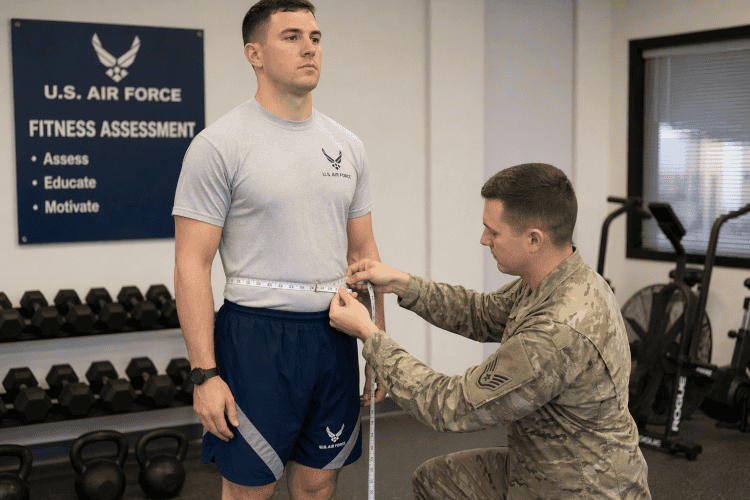
The U.S. Air Force does not use traditional height-and-weight charts to assess whether someone meets accession body standards.
This page is for Air Force applicants, ROTC cadets, officer candidates, and families who want a clear explanation of how the Air Force evaluates body composition, including Body Mass Index (BMI), waist-to-height measurements, and body fat standards.
Instead of fixed weight limits, the Air Force uses BMI screening and, when necessary, a body fat assessment to determine whether an applicant meets medical accession requirements.
As of recent Air Force guidance, applicants are generally screened using a BMI range of approximately 17.5 to 27.5. Those who exceed screening limits may be evaluated using an approved body-fat measurement method rather than being automatically disqualified.
Body composition standards have been adjusted in recent years to improve accession flexibility while still maintaining operational readiness, and final determinations are made through official medical screening.
Table of Contents
What People Get Wrong About Air Force Body Composition Standards
Many still believe the Air Force uses strict pound-based weight tables like some other branches. In reality, the focus has shifted to body composition (how much fat vs. muscle) rather than how much you weight on a scale alone.
Another common myth is that failing the initial BMI screen means automatic disqualification. Most applicants who fall outside BMI ranges get a chance to pass via Waist-to-Height Ratio or body fat measurement.
Standards continue to evolve for better fairness and readiness, but it’s best to always confirm with a recruiter or official medical guidance to be absolutely sure.
Initial Screening: Body Mass Index (BMI)
The Air Force uses BMI as a quick first check for new applicants.
General accession screening range: Approximately 17.5 – 27.5 BMI.
- Below 17.5 or significantly above 27.5 may require further evaluation.
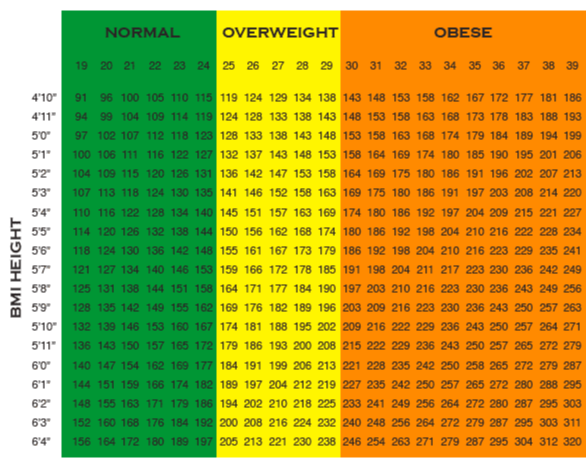
- BMI is calculated as: weight (lbs) × 703 ÷ height² (inches)
Pro Tip: Use the BMI / Waist-to-Height Ratio (WHtR) calculator below to determine if your height, weight, BMI, and WHtR meet the Air Force standards for 2026:
BMI Chart For Reference
Primary Standard: Waist-to-Height Ratio (WHtR)
As of January 1, 2026, the Department of Defense and Air Force use **Waist-to-Height Ratio** as the key body composition metric.
How to Measure Your Waist (Step-by-Step)
- Step 1: Stand up straight with your feet together and relax your abdomen.
- Step 2: Locate the midpoint between the lowest rib and the top of the hip bone (usually right at the belly button level).
- Step 3: Wrap a flexible tape measure around your waist at that point. Make sure the tape is snug but not compressing the skin, and is parallel to the floor.
- Step 4: Breathe out normally and take the measurement.
Here’s a quick snapshot of exactly how to do it:

Air Force Standards
WHtR must be less than 0.55** to meet the requirement, regardless of gender.
Example: A person who is 70 inches tall must have a waist smaller than **38.5 inches** (70 × 0.55 = 38.5).
- WHtR below 0.55 = Low/Moderate Risk (meets standard).
- WHtR of 0.55 or higher = High Risk → further body fat evaluation.
Body Fat Percentage Standards (When Required)
If WHtR is 0.55 or higher, the Air Force may use body fat percentage:
- Men: Maximum 18%
- Women: Maximum 26%
These are the DoD/Air Force upper limits. Meeting WHtR usually avoids the need for body fat taping.
Pilot & Aircrew Additional Requirements
Pilot, navigator, and aircrew candidates face anthropometric (body measurement) screening beyond general body composition.
This includes:
- Standing height
- Sitting height
- Reach
- Leg length and other cockpit-specific proportions
Good news: There are no strict “too tall” or “too short” disqualifiers for most applicants. The Air Force evaluates you for specific aircraft and often grants waivers or assigns compatible airframes.
Other common pilot medical requirements include vision standards, no recent history of asthma or allergies after age 12, and normal color vision.
Frequently Asked Questions About Air Force Height and Weight Standards
Does the Air Force still use height and weight tables?
No. Traditional weight tables have been largely replaced by Waist-to-Height Ratio across the Department of Defense starting in 2026.
What happens if I exceed the WHtR limit?
If you happen to exceed the WHtR limit, you’ll undergo a body fat measurement test. If you’re still over limits, you may enter a remedial program with time to improve before facing administrative consequences.
Are standards different for men and women?
The WHtR standard (0.55) is the same for both. Body fat limits differ slightly (18% men / 26% women).
Can I join if I’m over the BMI limit?
Often yes. Many applicants pass through the full WHtR or body fat assessment.
How do I prepare before talking to a recruiter?
Aim for a waist under 55% of your height. Focus on overall fitness, nutrition, and building muscle while reducing excess body fat, then go visit an Air Force recruiter near you.
Related Links – References:
https://www.airforce.com/how-to-join/prepare-for-success/meet-requirements
https://carerrs.airforce.com/height-weight/
https://www.airforce.com/find-a-recruiter