The United States Air Force offers a wide range of career fields that vary significantly in daily duties, work environments, and long-term career impact.
As with any large organization, some roles are less visible or less commonly sought by new enlistees, despite being necessary for overall operations.
Discussions about less desirable Air Force jobs often focus on working conditions, schedules, and the nature of the tasks rather than the importance of the mission itself.
The sections below describe several Air Force Specialty Codes that are sometimes viewed less favorably based on these factors.
Related Article – Worst Jobs in the US Navy
Table of Contents
#5. Security Forces (3P0X1)

,_North_Dakota_Air_National_Guard,_discuss_a_91st_130522-Z-WA217-511.jpg)
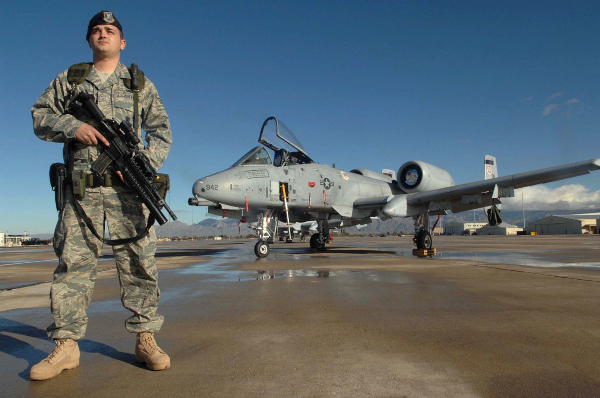
Security Forces serve an important yet non-glamorous role within the United States Air Force.
Air Force Security Forces are tasked with keeping airmen and their families safe and are the ones responsible for protecting the base and its assets from outside attack.
Sounds thrilling, right?
One trend you will notice is that the USAF and other military branches tend to romanticize Specialty Codes (aka Air Force military jobs) more than they are worth.
For example, check out this video about Security Forces posted by the USAF:
While YouTube videos demonstrate Security Forces as a glamorous job protecting multi-million dollar aircraft, the realities of the job are far from it.
The life of a Security Forces specialist is one spent guarding a gate for hours on end, checking IDs, and driving around the base.
The role can involve extended periods of monitoring access points and conducting routine security duties.
Air Force Security Forces (3P0X1) have a lot of downtime. However, it does present an opportunity to seek training and improve skills related to combat tactics and law enforcement.
Security Forces endure a job that is both physically and mentally exhausting.
According to the job description, candidates for USAF 3P0X1 must not have a fear of working around nuclear weapons or dealing with extreme heights.
Nonetheless, the Specialty Code can lead to a lucrative career in law enforcement once you complete a tour.
Related Article – Army Military Police (MOS 31B): Career Details
#4. Services (3F1X1)


Air Force Services (3F1X1) is another Specialty Code that ranks among the worst jobs in the Air Force.
Why?
Air Force Services is an especially important and necessary job on bases that consist of hundreds of service members. It’s just not elegant or deeply fascinating.
You have to remember that military bases are like small cities that require the traditional essential services to keep the place operational.
For this reason, USAF Services work to maintain and operate hotels, restaurants, and fitness centers on military bases.
Here is a decent representation of what you can expect in Air Force Services:
The vast majority of professions in Services (3F1X1) revolve around lodging or food service.
While necessary, food and hospitality roles often involve physically demanding work and irregular schedules.
Regardless, learning how to manage a budget and getting promoted to supervising roles can prepare you for numerous careers in the civilian world.
It’s generally far from anyone’s first selection for an Air Force job, but working on USAF bases comes with a variety of benefits.
Air Force bases are generally considered the most sophisticated and advanced of any military branch.
In fact, many support their own golf courses and other luxuries.
Related Article – Navy Culinary Specialist (CS): Career Details
#3. Client Systems (3D1X1)

Air Force Client Systems (3D1X1) is comparable to the job duties of a civilian IT technician.
While not the worst Air Force job you can think of it’s also not what generally comes to mind when someone enlists in the U.S. Air Force.
Client Systems Specialists ensure that all computer hardware and software are functioning properly.
As a result, they may install new software or troubleshoot existing problems.
Client Systems Specialists receive training and learn how to repair a variety of tech issues.
Since technology is becoming more common in all aspects of the military, the job is garnering more attraction.
Still, sitting behind a computer screen for hours and hours is not what most want when they enlist and plan to see the world.
Compensation for Client Systems Specialists is determined by military pay scales rather than private sector rates.
Consequently, it doesn’t make the military job all that rewarding in terms of pay.
Be that as it may, it’s still a decent field to consider especially if you would like to receive training in Information Technology.
#2. Civil Engineering (CE)

%2C_and_Senior_Master_Sgt._Joseph_Enderte%2C_right%2C_the_head_130522-Z-PQ189-6530.jpg)
Air Force Civil Engineering (CE) is an extraordinarily rewarding military career path.
The problem?
The military work is incredibly backbreaking with intense physical demands.
Moreover, you don’t get any of the glory compared to troops that see combat.
Air Force Civil Engineering represents a category of jobs, including servicing Electrical Systems or HVAC.
You can get a fair idea of the type of work you’ll pursue in Air Force Civil Engineering (CE) by watching the video, below:
In addition to AF Civil Engineering jobs being physically demanding, you also have to take into account the requirements.
Air Force Civil Engineers earn a fraction of their private sector counterparts and also work under less-than-ideal conditions.
The pros are that you get to tour parts of the world and live on different Air Force bases. Unfortunately, it may be difficult to find available time to actually enjoy it.
Air Force Civil Engineering roles are sometimes viewed unfavorably due to physical demands and extended work hours.
Related Article – Navy Seabees Career Details
#1. Air Transportation (2T2X1)

Air Force Air Transportation is an example of a job title that sounds more exciting compared to the realities of the assignment.
For starters, Air Transportation doesn’t actually spend much (if any) time in the air.
Instead, they are primarily responsible for loading and unloading cargo from military aircraft.
While it may sound like a military role, loading a plane correctly is actually extremely important.
You likely won’t earn any prestigious medals or awards for serving in Air Transportation (2T2X1).
Nevertheless, it’s a way to get into the United States Air Force and serve an important albeit non-glamorous role.
USAF Air Transportation manages a plethora of moving parts in a hectic, physically demanding work setting.
It’s one of the more physical Air Force Specialty Codes outside combat and without the glory.
Air Transportation Specialists must transport cargo and passengers safely and quickly to maintain order on a military base.
It’s not only demanding but often requires long hours on base including working overnight / less desirable shifts.
Air Transportation Specialists usually work in the elements so they also encounter all types of weather.
Despite the demanding nature of the role, Air Transportation remains an essential part of Air Force logistics operations.
What People Get Wrong About the Worst Air Force Jobs
One common misconception is that jobs labeled as “worst” are unimportant or lack value to the Air Force mission.
In reality, many of these roles are essential to base operations, security, logistics, and support functions that allow other units to operate effectively.
Another misunderstanding is that dissatisfaction with certain jobs is universal.
Individual experiences vary widely based on assignment location, leadership, work schedule, and personal career goals, meaning the same job can be viewed very differently by different Airmen.
Some people assume that these positions offer no transferable skills.
Many of the roles discussed provide technical, mechanical, logistical, or leadership experience that can translate to civilian careers after military service.
There is also confusion between job difficulty and job importance.
Physically demanding or repetitive work does not indicate lower mission priority, as many support roles operate under strict timelines and operational requirements.
Finally, these jobs are sometimes viewed as permanent assignments.
In practice, Airmen may retrain, promote, or transition into different roles over the course of their careers depending on service needs and eligibility.