
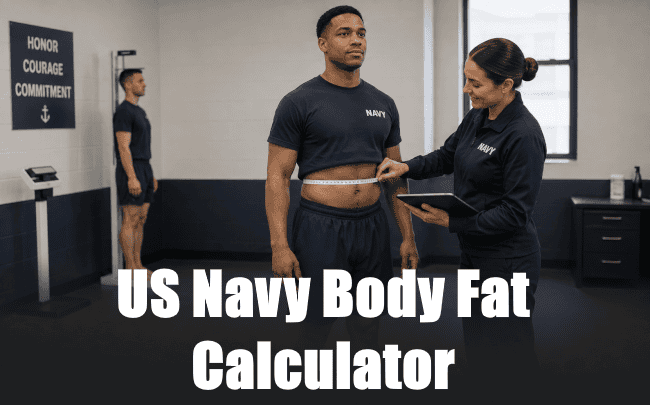
Use the Navy body fat calculator below to estimate whether your body composition falls within current U.S. Navy standards.
The calculator uses your height, waist circumference, weight, and sex to follow the Navy’s current two-step Body Composition Assessment, or BCA, process. It first calculates your waist-to-height ratio. When necessary, it then estimates your body fat percentage using the appropriate Navy table for males or females.
The Navy introduced this revised BCA process for calendar year 2026. It replaces the older screening procedure commonly associated with height-and-weight charts, neck measurements, and hip measurements.
Current June 2026 Navy BCA Method
U.S. Navy Body Fat Calculator
Enter your height, waist measurement, weight, and sex to estimate whether you meet the current U.S. Navy Body Composition Assessment standards.
How to take the waist measurement
- Stand with your feet about shoulder-width apart.
- Place a non-stretch tape around bare skin directly across the belly button.
- Keep the tape parallel to the floor and snug without compressing the skin.
- Keep your arms down and measure at the end of a normal exhale.
- Take two measurements. If they differ by more than one inch, take a third and average the two closest measurements.
This calculator provides an unofficial at-home estimate. Only authorized Navy CFL/ACFL personnel can conduct and record an official BCA. It is not intended for medical diagnosis or as a guarantee of enlistment, retention, or program eligibility. Accession and special-program standards may differ.
Method and standards: U.S. Navy PRP Guide-4, Body Composition Assessment, June 2026.
This US Navy body fat calculator provides an unofficial at-home estimate. Only an authorized Command Fitness Leader or Assistant Command Fitness Leader can conduct an official Navy BCA.
How to Use the Navy Body Fat Calculator
You will need three measurements to use the calculator:
- Height
- Waist circumference
- Weight
You will also need to select male or female because the Navy uses separate body-fat estimation tables and maximum body-fat standards for each sex.
Step 1: Select Your Measurement System
Choose either:
- Imperial for feet, inches, and pounds
- Metric for centimeters and kilograms
The calculator will automatically convert metric measurements into the units required by the Navy’s BCA tables.
Step 2: Enter Your Sex
Select male or female. This selection does not affect the initial waist-to-height screening, which is sex-neutral.
However, it is required if the calculator needs to perform the second step and estimate your body fat percentage.
Step 3: Enter Your Height
Measure your height while standing straight on a flat surface. Remove your shoes and look directly forward with your chin level.
For an official BCA, the Navy records the raw measurement and rounds height up to the nearest half-inch. The calculator applies this rounding rule automatically.
Step 4: Measure Your Waist at the Belly Button
Wrap a non-stretchable measuring tape around your abdomen directly across your belly button.
Keep the tape:
- Parallel to the floor
- In contact with your skin
- Snug without compressing the skin
- Positioned across the belly button rather than the narrowest part of the waist
Stand normally with your arms at your sides. Take the measurement after a normal exhale without sucking in your stomach or holding your breath.
The Navy requires two waist measurements. Each measurement is rounded down to the nearest half-inch. If the measurements differ by more than one inch, an additional measurement is taken and the two closest measurements are averaged.
For an at-home estimate, take at least two measurements and use the lower rounded measurement when they are consistent.
Step 5: Enter Your Weight
Enter your current weight. Official Navy weight measurements are taken without shoes and are rounded to the nearest pound.
Measurements below half a pound are rounded down, while measurements of half a pound or more are rounded up. The calculator handles this rounding automatically.
Step 6: Calculate Your Results
Click the calculate button to see whether you pass the initial waist-to-height screening.
When the second step is required, the calculator will also estimate your Navy body fat percentage and compare it with the maximum allowable standard.
Related Article – Navy Height & Weight Standards
How the Navy Body Fat Method Works
The current Navy method for body fat assessment uses a two-step process.
Every Sailor’s height, waist, and weight are recorded. The first step compares waist circumference with height. The second step is only required when the waist-to-height result exceeds the allowed limit.
Step 1: Waist-to-Height Ratio
The calculator divides your rounded waist measurement by your rounded height:
Waist-to-height ratio = waist circumference ÷ height
The result is rounded down to four decimal places.
A result of 0.5499 or lower is within Navy BCA standards. No body-fat calculation is required.
A result of 0.5500 or higher means you exceed the initial screening limit and must proceed to the second step. It does not automatically mean that you have failed the BCA.
For example, consider someone who is 70 inches tall with a 38-inch waist:
38 ÷ 70 = 0.5428
Because 0.5428 is below 0.5500, that person is within standards under Step 1.
Step 2: Navy Body Fat Percentage
When the waist-to-height ratio is 0.5500 or higher, the Navy calculates the difference between height and waist circumference:
Height-waist difference = height in inches − waist in inches
That number is then matched with the person’s weight in the appropriate male or female Navy body-fat table.
The percentage listed at the intersection of the height-waist difference and weight represents the estimated body fat percentage.
The calculator performs this lookup automatically whenever your measurements are included within the Navy’s published tables.
Current Navy Body Fat Requirements
The maximum allowable body fat percentages are:
| Age Range | Males | Females |
|---|---|---|
| 18 - 21 | 22% | 33% |
| 22 - 29 | 23% | 34% |
| 30 - 39 | 24% | 35% |
| 40+ | 26% | 36% |
A male Sailor with an estimated body fat percentage of 26% or lower is within the Step 2 standard.
A female Sailor with an estimated body fat percentage of 36% or lower is within the Step 2 standard.
The current Navy limits are based on sex rather than separate age groups. Sailors who exceed both the waist-to-height requirement and their applicable body-fat limit are considered not within BCA standards, subject to any applicable high-performance exemption.
Understanding Your Calculator Result
The calculator may display one of several results.
Within Standards Under Step 1
Your waist-to-height ratio is 0.5499 or lower.
You meet the Navy’s initial BCA standard, and a body-fat percentage calculation is not required.
Step 2 Required
Your waist-to-height ratio is 0.5500 or higher.
The calculator will use your height, waist, weight, and sex to estimate your body fat percentage.
Exceeding the initial ratio does not necessarily mean you are outside Navy standards. You may still pass based on your Step 2 body-fat result.
Within Standards Under Step 2
Your initial waist-to-height ratio exceeded the limit, but your estimated body fat is:
- 26% or lower for males
- 36% or lower for females
You are within the applicable body-fat standard.
Not Within Standards
Your initial ratio exceeded 0.5499 and your estimated body fat is above the maximum permitted for your sex.
This result indicates that your measurements would not satisfy the standard under the calculator’s estimate.
Official PRIMS Calculation Required
Some combinations of measurements fall outside the ranges shown in the Navy’s published male and female tables.
In an official assessment, the raw measurements are entered into the Physical Readiness Information Management System, or PRIMS, which produces the official body-fat result. An online calculator cannot duplicate that result without access to the Navy’s internal calculation.
Is This a Navy BMI Calculator?
People sometimes refer to tools like this as a Navy BMI calculator, but BMI is not the measurement used for the current Navy BCA.
Body mass index compares weight with height. It does not directly consider waist circumference or the distribution of body fat.
The current Navy assessment instead uses:
- A waist-to-height ratio
- A body-fat estimate based on height, waist, weight, and sex when required
The Navy’s official guidance specifically states that body mass index, skinfold calipers, bioelectrical impedance, underwater weighing, and similar alternative methods cannot replace the official BCA.
Therefore, this page is more accurately described as a Navy fat calculator or Navy BCA calculator rather than a traditional BMI calculator.
Does the Navy Still Use Neck and Hip Measurements?
No. The current Navy BCA does not require a neck measurement for males or a neck-and-hip measurement for females.
Many online calculators still use the older “Navy method,” which estimates body fat from measurements such as:
- Neck circumference
- Abdominal circumference
- Hip circumference for females
- Height
Those formulas may still be used by fitness websites as a general body-fat estimation method. However, they do not reflect the Navy’s current 2026 BCA procedure.
The current US Navy body fat calculator process uses only:
- Height
- Waist circumference at the belly button
- Weight
- Male or female body-fat table
This distinction is important when comparing results from different online calculators. A calculator asking for your neck or hip size is likely using the older method rather than the current Navy BCA process. (NAVADMIN 264/25 Fact Sheet)
How Accurate Is the Navy Fat Calculator?
The calculator should provide a close estimate when measurements are entered accurately and fall within the Navy’s published tables.
However, small differences in how you measure your waist can change the result. Common mistakes include:
- Measuring above or below the belly button
- Pulling the tape too tightly
- Allowing the tape to slope
- Measuring over clothing
- Holding your breath
- Rounding measurements incorrectly
For the most consistent estimate, have another person take the waist measurement while you stand relaxed.
Remember that an online result is not official. The Navy requires an official BCA to be performed by certified or trained command personnel. At least two authorized CFL or ACFL personnel must conduct and sign the official assessment.
Frequently Asked Questions
What is the maximum body fat allowed by the Navy?
The current maximum is 26% for males and 36% for females. These limits apply when a Sailor must proceed to the second step of the BCA.
What waist-to-height ratio does the Navy require?
A ratio of 0.5499 or lower is within standards. A ratio of 0.5500 or higher requires the Step 2 body-fat calculation.
Do I fail if my waist-to-height ratio is too high?
Not necessarily. Exceeding the Step 1 limit means that your body fat must be estimated under Step 2. You can still be within standards if your resulting percentage is no higher than 26% for males or 36% for females.
Does age affect the Navy body fat requirement?
The current Navy BCA guide lists one maximum for males and one for females. It does not divide the body-fat limits into different age groups.
Does weight matter if I pass Step 1?
Weight is collected for all official assessments, but it is not needed to determine whether you pass the waist-to-height screening. It becomes part of the body-fat calculation when Step 2 is required.
Where should I measure my waist?
Measure around the abdomen directly across the umbilicus, or belly button. Keep the tape level and take the measurement at the end of a normal exhale.
Can I use this calculator before speaking with a recruiter?
Yes. The calculator can help prospective applicants understand how their current measurements compare with Navy BCA standards.
However, it cannot determine whether you are medically or administratively qualified to enlist. A Navy recruiter and Military Entrance Processing Station personnel can provide guidance based on your individual circumstances.
Is this calculator an official Navy tool?
No. This calculator is an independent educational resource and is not operated or endorsed by the Department of the Navy or Department of Defense.
Official measurements and determinations must be made by authorized Navy personnel under the current Physical Readiness Program guidance.
Related Article – Navy PRT Standards By Age and Gender
Final Thoughts
The current Navy body-composition process is no longer based on a simple maximum weight chart or the older neck-and-waist tape formula.
The initial standard is now a sex-neutral waist-to-height ratio. Sailors who exceed that limit proceed to a body-fat calculation that uses height, waist, weight, and a male or female estimation table.
Use the calculator as an at-home screening tool, measure carefully, and treat the result as an estimate rather than an official determination. Current Sailors should consult their Command Fitness Leader, while prospective applicants should speak with a Navy recruiter about any concerns regarding body composition or enlistment eligibility.
Official source: U.S. Navy Physical Readiness Program Guide-4, Body Composition Assessment, June 2026.
