
Joining the US Air Force offers opportunities for technical training, global travel, education benefits, leadership development, and serving in one of the world’s most advanced air and space forces.
Whether pursuing active duty, Air National Guard, Air Force Reserve, or a specific Air Force Specialty Code (AFSC), the enlistment process is designed to match qualified individuals with roles that fit their skills and the Air Force’s needs.
The Air Force provides full training from day one, competitive pay, comprehensive healthcare, housing allowances, tuition assistance, and the GI Bill for future education.
Key steps include meeting eligibility criteria, taking the ASVAB, completing medical and background checks, selecting an AFSC, and signing a contract with recruiter guidance.
Preparation and realistic expectations make the process smoother and increase chances of success in today’s competitive recruiting environment.
In this updated guide for 2026, we outline current eligibility requirements, the enlistment timeline, what happens at MEPS, basic military training, and tips for a strong application.
General Requirements
Note: Some of the below qualifications are required by all five services, including the Air Force:
- You must be a U.S. citizen or resident alien.
- You must be at least 17 years old (17-year old applicants require parental consent) to apply and in BMT before your 39th birthday. Other specific age requirements apply for enlisted, see here for details.
- You must (with very few exceptions) have a high school diploma or meet the ASVAB qualifications to apply with a GED.
- You must pass a physical medical exam, and meet the height and weight requirements.
- Must meet specific scoring requirements on the ASVAB (click here for specific ASVAB requirements for each AFSC)
- Meet the Air Force PT Test Standards
Sign Up Process for Joining the Air Force
The sign up process varies for both enlisted and officers. You can expect the following path with each:
Enlisted Process
- Before you enlist, you must take the ASVAB.
- Physical and Mental Screening: After you’ve taken the ASVAB, your recruiter will make an appointment for you at a nearby Military Entrance Processing Station (MEPS).
- Once you’ve been processed through MEPS, you’ll go into the Delayed Entry Program (DEP). This means you’ll be waiting for a departure date for boot camp.
Officer Process
There are actually 3 ways to enter the Air Force as an officer. They include:
- Attend Officer Training School (OTS) after getting your college degree
- Attend and graduate from the US Air Force Academy
- Join ROTC in College (contingent on your university / a nearby university having an ROTC program)
The only other path to becoming an officer in the US Air Force is by enlisting and working towards a path of becoming an officer.
Each process to become an officer will be explained below:
Officer Route #1: Officer Training School (OTS)
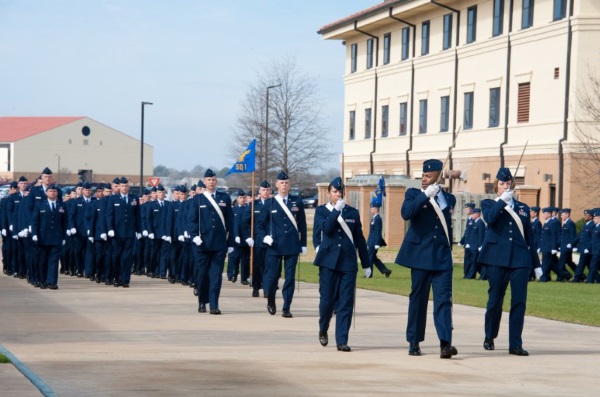
OTS is a 9 1/2 week program that is broken down into 4 phases:
Phase 1 – Indoc
In this phase, you’ll be indoctrinated into the Air Force lifestyle. Course work / Training include things like:
- Blue-Line ceremony
- In-Processing
- Uniform purchase
- Dorm Instruction
- Confidence Course
You’ll also learn the Airmans creed, get academically orientated, and learn military customs and courtesies.
Phase 2 – Development
In Phase 2, you’ll develop an understanding the fundamentals of leadership, military management, and arms handling.
You’ll learn things like:
- Problem solving skills
- Hand to hand combat
- M-9 Weapons Qualifications
You’ll also learn how to conduct military briefings, military law, and standards and accountability.
Phase 3 – Practical Application
In this phase, you’ll learn how to put all of the training you received from Phases 1 and 2 together.
Phase 3 is more of a practical application of your skills vs. learning new things.
However, you will learn things like:
- Small unit tactics
- Base defense field exercises
- Preparation for the arrival of the lower class
Some of the academic coursework in Phase 3 includes things like group dynamics, advocacy briefing measurement, and air and space system capabilities.
Related Article: Air Force Ranks And Pay
Phase 4 – Transition
The final phase of OTS is known as Phase 4. It involves transitioning you from the training environment into the active duty Air Force.
Some of the training and academic coursework include things like:
- Air Expeditionary Force Exercise
- First officer assignment
- Oath of office
It all culminates with your successful completion and graduation from the Air Force OTS.
Officer Route #2: Attend The US Air Force Academy

This route is a significantly more difficult method of joining the Air Force than the other methods described on this page.
Out of the nearly 12,000 applicants that the Air Force academy receives each year, only about 1,000 are accepted.
This may sound like a decent ratio / chance to get in, but to even just apply to the academy you have to:
- Meet the basic requirements: You must be an Unmarried US Citizen, at least 17 but not past your 23rd birthday by Jul 1 of the year you enter the academy.
- Complete and submit a pre-candidate questionnaire.
- Get a nomination from a qualified nominating authority. Nominating authorities include Congressional, Vice presidential, and military affiliated.
Here’s a few statistics from 2017 to show you how difficult it can be:

To be considered “competitive”, you should expect the following average academic scores:
Average SAT Scores
- SAT Verbal: 642
- SAT Math: 672
Average ACT Scores
- ACT English: 30
- ACT Reading: 30
- ACT Math: 30
- ACT Science Reasoning: 30
To learn more about how to apply to the US Air Force Academy, visit their official recruiting site here.
Officer Route #3: Join ROTC In College


Air Force ROTC is offered at over 1,100 colleges and Universities across the US, and is responsible for graduating the most officers than any other method discussed on this page.
One of the benefits of joining ROTC is that it affords potential candidates numerous financial scholarships and other financial incentives.
In fact, many students can graduate college completely debt free via ROTC programs.
Applying is easy, and finding schools that have an Air Force ROTC program has never been easier.
Visit the official Air Force ROTC website here to get started on your journey.
What People Get Wrong About How to Join the US Air Force
Many think you can join the Air Force immediately after walking into a recruiter’s office.
The process typically takes weeks to months, including initial screening, ASVAB testing, MEPS physical and moral evaluations, job selection, background checks, and contract signing, with potential delays for waivers or high-demand AFSCs.
Another assumption is that the Air Force has lower standards or accepts nearly everyone.
Standards remain selective: age 17-39 (with parental consent under 18), high school diploma or GED (limited GED waivers), minimum ASVAB scores by AFSC, passing the MEPS physical, and no major criminal or medical disqualifiers without approved waivers.
People often believe you need exceptional fitness before enlisting.
While good physical condition helps, the Air Force builds fitness during Basic Military Training (7.5 weeks at JBSA-Lackland); arriving prepared for the fitness test (push-ups, sit-ups, 1.5-mile run) improves success rates, but recruits start from varied fitness levels.
Some think all jobs are immediately available or that you can pick any AFSC freely.
Job availability depends on Air Force needs, ASVAB scores, physical qualifications, security clearance eligibility, and aptitude; popular or technical AFSCs fill quickly, requiring flexibility or waitlists in some cases.
Finally, a common misconception is that joining guarantees a specific base or rapid promotions.
Assignments are based on Air Force requirements, with first assignments often at training bases followed by operational locations; promotions follow time-in-grade, performance reports, and testing, with no guaranteed fast tracks but strong opportunities in critical fields.
Knowing these realities sets accurate expectations and prepares applicants for a successful enlistment journey.
Resources:
Find An Air Force recruiter Near You
