
Interest in KLOW peptide benefits centers on inflammation, skin appearance, tissue repair, and recovery. The blend commonly combines GHK-Cu, BPC-157, TB-500, and KPV, bringing together compounds investigated in several different areas of repair biology.
KPV is the addition that usually distinguishes KLOW from GLOW. Its inflammation-related research helps explain the interest in the four-peptide combination, although results from individual ingredients do not establish how the complete blend performs in people.
This guide examines the research, explains dosage terminology, and addresses the safety questions behind the marketing.
Key takeaways
- Check all four ingredients and their amounts; formulations can differ.
- Most relevant findings come from ingredient-level laboratory or animal research.
- A validated human dosage and reliable safety profile for the complete KLOW blend remain unestablished.
What Is the KLOW Peptide Blend?
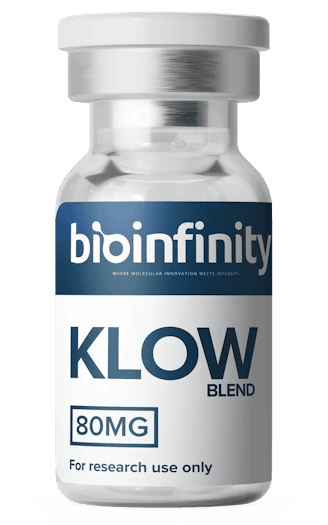
The KLOW peptide blend is a commonly marketed combination of four peptides. A “stack” generally means substances used together, while a “blend” usually describes ingredients packaged in one preparation.
| Ingredient | Research focus | Evidence consideration |
|---|---|---|
| GHK-Cu | Skin cells, collagen, and tissue remodeling | Topical and laboratory findings need context |
| BPC-157 | Experimental wound and tendon repair | Human evidence is limited |
| TB-500 | Thymosin-related repair pathways | Exact molecule matters |
| KPV | Inflammatory signaling and intestinal repair | Predominantly preclinical research |
GHK-Cu is a copper-binding tripeptide. BPC-157 is a synthetic peptide containing 15 amino acids. KPV consists of lysine, proline, and valine, corresponding to the final three amino acids of alpha-melanocyte-stimulating hormone, or alpha-MSH. [1]
TB-500 needs particular care: FDA identifies it as the thymosin beta-4 fragment LKKTETQ. Full-length thymosin beta-4, used in some wound studies, is a different molecule. [2]
Because these names cover different products, assessing a KLOW stack peptide preparation starts with its actual ingredient list. The label should identify each component and amount. Total milligrams alone cannot establish whether two products are equivalent, and a familiar blend name does not establish pharmaceutical standardization.
KLOW Peptide Benefits: What Does the Research Show?
The proposed benefits make more sense when each finding is matched to the compound and preparation studied. The following research explains why the ingredients attract attention; it does not validate the four-peptide combination as a treatment.
1. Potential Anti-Inflammatory Effects
KPV has been investigated for effects on signaling pathways that regulate inflammation.
In a study involving intestinal epithelial cells, immune cells, and mice, researchers found that KPV reduced inflammatory signaling involving NF-κB and MAP kinases. Cellular uptake involved the peptide transporter PepT1. Oral KPV also reduced inflammation in experimental mouse colitis. [1]
A separate investigation found reduced inflammatory changes and improved recovery in two mouse models of intestinal inflammation. This provides additional preclinical support for investigating KPV. [3]
Other KLOW ingredients also have inflammation-related research. For example, GHK-Cu reduced inflammatory and oxidative-stress measures in cell experiments and a mouse model of acute lung injury. [4]
These findings describe biological activity under specific experimental conditions. They leave unanswered whether combining the ingredients improves symptoms or produces useful effects beyond the individual compounds.
2. Gut and Intestinal-Barrier Research
Gut research is especially relevant to the rationale for adding KPV, but delivery matters.
One study packaged KPV in hyaluronic-acid-functionalized nanoparticles within an oral hydrogel. The system targeted intestinal cells and macrophages and improved outcomes in a mouse colitis model. [5]
Another study delivered KPV in a hydrogel that adhered to inflamed colon tissue. Researchers reported improved epithelial-barrier recovery after local administration in rats with chemically induced colitis. [6]
These were engineered delivery systems intended to reach inflamed intestinal tissue. Their results cannot establish that an injected KLOW blend treats ulcerative colitis, Crohn’s disease, IBS, or everyday bloating.
The practical question is whether a study evaluated the same condition, preparation, and delivery method as the product being discussed. “Gut support” is too broad to answer that question by itself.
3. Skin Firmness, Texture, and Collagen Support
GHK-Cu supplies much of the rationale for KLOW’s skin-related claims. A rat wound-chamber study found increased accumulation of collagen and other extracellular-matrix components. A separate investigation examined growth and growth-factor responses in cultured human fibroblasts. [7][8]
Human cosmetic findings require closer interpretation. In a randomized study with 13 completers after carbon-dioxide laser resurfacing, topical GHK-Cu improved patient satisfaction. However, objective assessments did not show additional improvement in wrinkles, redness resolution, or overall skin quality compared with the control regimen. [9]
This supports interest in skin biology while leaving uncertainty about visible results from KLOW injections. For a broader comparison of compounds discussed for age-related changes, see our guide to the best peptides for anti-aging.
4. Wound Healing and Tissue Repair
Topical BPC-157 improved wound-healing measures in rats with alkali burns. Thymosin beta-4 also accelerated repair in an experimental rat skin-wound study. [10][11]
There is some human research on a different preparation: a randomized trial in 73 people with venous ulcers suggested potential benefit from topical full-length thymosin beta-4. It did not examine the TB-500 fragment within KLOW. [12]
KPV also appears in repair research. A KPV-containing adhesive hydrogel improved healing-related outcomes in rats with chemotherapy-induced oral mucositis. The formulation also contained EGCG and a delivery matrix, so its overall effects cannot be assigned to KPV alone. [13]
Together, these studies justify further investigation of repair mechanisms. Evidence for an existing scar, surgical recovery, or a particular commercial blend must be assessed separately.
5. Tendon, Joint, and Exercise-Recovery Research
BPC-157 research includes increased migration and stress survival of rat-derived tendon cells. Such observations help explain interest in connective-tissue recovery. [14]
A small retrospective knee-pain study contacted 16 patients who had received BPC-157 alone or with thymosin beta-4. Most reported improvement, but there was no control group, and standardized measures of function were absent. [15]
Pain relief, cartilage regeneration, and faster rehabilitation are different outcomes. This limited report does not establish that KLOW improves any of them or that adding GHK-Cu and KPV improves recovery.
KLOW vs. GLOW: What Does Adding KPV Change?
The commonly marketed distinction is straightforward:
| Blend | Common ingredients | Additional research rationale |
|---|---|---|
| GLOW | GHK-Cu, BPC-157, TB-500 | Skin and tissue-repair research |
| KLOW | GLOW ingredients plus KPV | Adds KPV-focused inflammation and gut research |
This comparison describes the usual ingredient lists. Products can differ in their amounts, ratios, and molecular identity, so check the individual label.
Adding KPV expands the mechanisms being proposed. It also adds another substance whose contribution, interactions, and safety need evaluation. The available ingredient studies do not establish that four-component KLOW outperforms three-component GLOW.
For a meaningful comparison, ask what outcome matters and whether a study tested that outcome using the actual formulation. A longer ingredient list or larger total milligram number does not answer those questions. The same principle applies when comparing a preblended vial with separately supplied ingredients.
Consider reading our in-depth Glow Stack Peptide article to learn more about its benefits, dosage, side effects, and more.
KLOW Peptide Dosage: Understanding Vial Amounts and Ratios
There is no established, evidence-based standard KLOW peptide dosage for the complete four-ingredient combination. Published schedules on commercial websites should be evaluated as unvalidated protocols.
Understanding labels starts with separating these measurements:
| Measurement | What it tells you |
|---|---|
| Total vial content | Combined mass of the ingredients |
| Individual content | Amount of each peptide |
| Concentration | Amount per volume of solution |
| Administered amount | Quantity delivered on an occasion |
For example, a marketed formulation may contain 50 mg GHK-Cu and 10 mg each of BPC-157, TB-500, and KPV. That adds up to 80 mg in the vial. It describes the product’s composition, not a recommended dose.
With a fixed-ratio blend, increasing the amount used raises exposure to every ingredient together. You cannot adjust KPV independently while holding the other three amounts constant.
Syringe markings also require context. A volume marking becomes a peptide amount only when the concentration is known. Instructions for one product therefore cannot be transferred to another just because both use the KLOW name.
The same evidence gap applies to dosing frequency, cycle length, and maintenance schedules. A mathematically correct calculation cannot establish that a regimen is effective or safe.
Research routes are another source of confusion. A laboratory GHK-Cu study found that microneedle pretreatment substantially changed passage through skin, illustrating how delivery affects exposure. It did not establish a human KLOW injection dose. [16]
Anyone considering the blend should review the specific preparation, intended outcome, medications, and available alternatives with a licensed clinician.
KLOW Peptide Side Effects and Safety
The frequency and severity of KLOW peptide side effects have not been established in controlled studies of the full blend. An anecdotal symptom list cannot tell readers how often an adverse effect occurs or which ingredient caused it.
FDA identifies several ingredient-specific concerns:
- KPV: The agency reports that it has not identified human exposure data for KPV drug products administered by any route.
- BPC-157: Safety information is limited, with concerns involving possible immune reactions, impurities, and ingredient characterization.
- Injectable GHK-Cu: Aggregation and peptide-related impurities may contribute to immune reactions; human safety information is limited.
- TB-500 fragment: FDA reports insufficient human exposure data and potential concerns involving aggregation and impurities. [2]
Product quality also matters. FDA warns that compounded preparations can cause serious harm when contaminated or made with incorrect ingredient amounts. Compounded drugs do not undergo FDA premarket approval for safety, effectiveness, and quality. [17]
General injection risks include local pain, bleeding, and infection. Persistent swelling or other concerning symptoms warrant medical assessment. These general risks should be distinguished from a measured adverse-effect profile for KLOW. [18]
Medication interactions, longer-term use, pregnancy, breastfeeding, and significant existing conditions require particular care because relevant combination data are lacking. A certificate reporting chemical purity cannot establish clinical safety, and a short observation period may miss uncommon or delayed problems.
Service members can also consult our military banned supplements guide and confirm ingredient-specific requirements with their military healthcare team.
How Long Does KLOW Take to Work?
A reliable results timeline for the complete blend has not been established. Ingredient studies examine different conditions, preparations, and follow-up periods.
For example, the topical GHK-Cu laser-resurfacing study assessed cosmetic outcomes at 12 weeks. That is a study assessment point, not a prediction for KLOW users. [9]
When reviewing before-and-after reports, consider lighting, skincare changes, procedures, exercise, and concurrent treatment. A photograph or personal recovery story can describe an experience without showing which intervention caused it. Reports also need to account for people who saw no benefit; a selection of successful experiences cannot establish typical results.
Frequently Asked Questions
Is the KLOW Peptide Blend FDA-Approved?
KLOW is not an FDA-approved combination treatment. A prescription or a product supplied through a compounding pharmacy does not make the blend FDA-approved. FDA specifically distinguishes compounded drugs from medicines that have completed its approval process. [17]
Does KLOW Help With Weight Loss?
Convincing clinical evidence supporting KLOW for weight loss is lacking. Approved weight-management medications, including semaglutide and tirzepatide, have their own evidence and indications. Sharing the broad label “peptide” does not make KLOW interchangeable with those treatments. [19]
Can KLOW Be Combined With Other Peptides or GLP-1 Medications?
Different proposed mechanisms do not establish that a combination is safe. Reliable interaction studies of the full KLOW blend are lacking. A clinician should review the actual ingredients and medications; adding substances also makes benefits and adverse reactions harder to attribute.
Does an 80 mg KLOW Vial Mean an 80 mg Dose?
No. The 80 mg figure usually describes the total labeled contents across all ingredients. It does not specify an administered amount or an appropriate regimen. Individual ingredient quantities, concentration, and volume are separate measurements, and product formulations can vary.
Are Oral or Topical KPV Products Equivalent to KLOW?
No. They differ in composition and delivery. Research using oral nanoparticles or locally applied hydrogels shows why a particular delivery system matters. Those formulations cannot be assumed equivalent to a plain KPV product or an injected four-peptide blend. [5][6]
Conclusion
The research behind potential KLOW peptide benefits brings together skin biology, inflammation, and tissue-repair findings. KPV adds a distinctive body of intestinal and inflammatory research, but the complete blend still lacks established clinical dosing and a reliable safety profile.
Assess claims by identifying the exact compound, formulation, delivery method, and outcome studied. Those details provide a more useful basis for decisions than a blend name, total milligrams, or a dramatic testimonial.
References
- Dalmasso G, Charrier-Hisamuddin L, Nguyen HT, Yan Y, Sitaraman S, Merlin D. PepT1-mediated tripeptide KPV uptake reduces intestinal inflammation. Gastroenterology. 2008;134(1):166-78. ↩
- U.S. Food and Drug Administration. Certain Bulk Drug Substances for Use in Compounding that May Present Significant Safety Risks. Accessed September 13, 2026. ↩
- Kannengiesser K, Maaser C, Heidemann J, Luegering A, Ross M, Brzoska T, et al. Melanocortin-derived tripeptide KPV has anti-inflammatory potential in murine models of inflammatory bowel disease. Inflamm Bowel Dis. 2008;14(3):324-31. ↩
- Park JR, Lee H, Kim SI, Yang SR. The tri-peptide GHK-Cu complex ameliorates lipopolysaccharide-induced acute lung injury in mice. Oncotarget. 2016;7(36):58405-58417. doi:10.18632/oncotarget.11168. ↩
- Xiao B, Xu Z, Viennois E, Zhang Y, Zhang Z, Zhang M, et al. Orally Targeted Delivery of Tripeptide KPV via Hyaluronic Acid-Functionalized Nanoparticles Efficiently Alleviates Ulcerative Colitis. Mol Ther. 2017;25(7):1628-1640. doi:10.1016/j.ymthe.2016.11.020. ↩
- Zhao Y, Xue P, Lin G, Tong M, Yang J, Zhang Y, et al. A KPV-binding double-network hydrogel restores gut mucosal barrier in an inflamed colon. Acta Biomater. 2022;143:233-252. doi:10.1016/j.actbio.2022.02.039. ↩
- Maquart FX, Bellon G, Chaqour B, Wegrowski J, Patt LM, Trachy RE, et al. In vivo stimulation of connective tissue accumulation by the tripeptide-copper complex glycyl-L-histidyl-L-lysine-Cu2+ in rat experimental wounds. J Clin Invest. 1993;92(5):2368-76. ↩
- Pollard JD, Quan S, Kang T, Koch RJ. Effects of copper tripeptide on the growth and expression of growth factors by normal and irradiated fibroblasts. Arch Facial Plast Surg. 2005;7(1):27-31. ↩
- Miller TR, Wagner JD, Baack BR, Eisbach KJ. Effects of topical copper tripeptide complex on CO2 laser-resurfaced skin. Arch Facial Plast Surg. 2006;8(4):252-9. ↩
- Huang T, Zhang K, Sun L, Xue X, Zhang C, Shu Z, et al. Body protective compound-157 enhances alkali-burn wound healing in vivo and promotes proliferation, migration, and angiogenesis in vitro. Drug Des Devel Ther. 2015;9:2485-99. doi:10.2147/DDDT.S82030. ↩
- Malinda KM, Sidhu GS, Mani H, Banaudha K, Maheshwari RK, Goldstein AL, et al. Thymosin beta4 accelerates wound healing. J Invest Dermatol. 1999;113(3):364-8. ↩
- Guarnera G, DeRosa A, Camerini R. The effect of thymosin treatment of venous ulcers. Ann N Y Acad Sci. 2010;1194:207-12. doi:10.1111/j.1749-6632.2010.05490.x. ↩
- Shao W, Chen R, Lin G, Ran K, Zhang Y, Yang J, et al. In situ mucoadhesive hydrogel capturing tripeptide KPV: the anti-inflammatory, antibacterial and repairing effect on chemotherapy-induced oral mucositis. Biomater Sci. 2021;10(1):227-242. doi:10.1039/d1bm01466h. ↩
- Chang CH, Tsai WC, Lin MS, Hsu YH, Pang JH. The promoting effect of pentadecapeptide BPC 157 on tendon healing involves tendon outgrowth, cell survival, and cell migration. J Appl Physiol (1985). 2011;110(3):774-80. doi:10.1152/japplphysiol.00945.2010. ↩
- Lee E, Padgett B. Intra-Articular Injection of BPC 157 for Multiple Types of Knee Pain. Altern Ther Health Med. 2021;27(4):8-13. ↩
- Li H, Low YS, Chong HP, Zin MT, Lee CY, Li B, et al. Microneedle-Mediated Delivery of Copper Peptide Through Skin. Pharm Res. 2015;32(8):2678-89. doi:10.1007/s11095-015-1652-z. ↩
- U.S. Food and Drug Administration. Understanding the Risks of Compounded Drugs. Accessed September 13, 2026. ↩
- MedlinePlus, National Library of Medicine. Subcutaneous (SQ) injections. Medical Encyclopedia. Reviewed October 19, 2025. Accessed September 13, 2026. ↩
- National Institute of Diabetes and Digestive and Kidney Diseases, NIH. Prescription Medications to Treat Overweight & Obesity. Accessed September 13, 2026. ↩
