
The most discussed glow peptide benefits include firmer-looking skin, improved texture, tissue repair, and recovery support. These claims come largely from research on GLOW’s individual ingredients: GHK-Cu, BPC-157, and TB-500. Evidence that the complete blend reliably produces those outcomes in people remains limited.
That distinction matters when comparing products, interpreting before-and-after photos, or reading dosage advice. A promising result in a laboratory does not establish the same result from an injection sold online.
This guide explains the rationale behind the glow stack peptide, the strongest relevant findings, and the questions research has yet to answer.
Key takeaways
- GLOW commonly combines three peptides, but ingredient amounts vary between products.
- Research on specific ingredients and formulations should be evaluated individually.
- Human safety information is limited, and the FDA identifies concerns involving these compounds. [1]
What Is the Glow Stack Peptide?
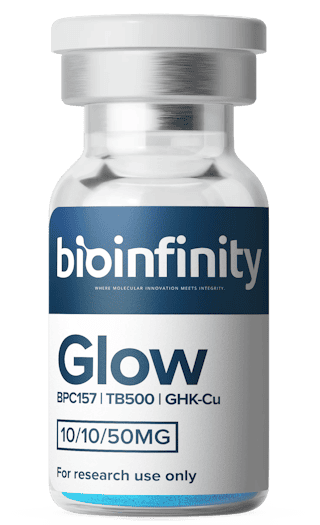
The glow stack peptide is a combination commonly marketed for skin appearance and tissue recovery. A “stack” describes compounds used together; a “blend” usually means they are packaged in the same preparation.
The ingredients generally include:
- GHK-Cu: A copper-binding tripeptide investigated for effects on skin cells and tissue remodeling.
- BPC-157: A synthetic, 15-amino-acid peptide studied primarily in experimental injury and repair models.
- TB-500: A name associated with thymosin beta-4-related products. The FDA identifies TB-500 as the seven-amino-acid fragment LKKTETQ; full-length thymosin beta-4 is a different molecule. [1]
The proposed rationale is that their activities could complement one another. Establishing that combination’s effectiveness, however, requires testing the actual combination.
Because the name covers different formulations, comparisons should begin with the ingredient list. Check the identity and amount of each component. A headline stating only the total milligrams leaves out information needed to compare two blends meaningfully.
The glow peptide blend also differs from a copper-peptide serum or an oral collagen supplement. Delivery changes exposure: one laboratory study found that microneedles substantially increased GHK-Cu passage through skin compared with intact skin. It did not test GLOW injections or establish a home microneedling protocol. [2]
Glow Peptide Benefits: What Does the Research Show?
The evidence is easiest to understand by separating the proposed outcome from the preparation actually studied.
| Proposed benefit | Relevant evidence | Main limitation |
|---|---|---|
| Skin firmness | GHK-Cu research on collagen and fibroblasts | Mostly laboratory evidence |
| Improved skin appearance | Small topical GHK-Cu human study | Objective results were mixed |
| Wound repair | Animal studies and a topical thymosin beta-4 trial | Different molecules and delivery methods |
| Recovery support | BPC-157 tendon research and limited human reports | Does not validate the complete stack |
| Inflammation support | Experimental cellular and animal findings | Clinical effects remain uncertain |
| Hair growth | Research involving related copper peptides | Compound identity matters |
1. Potential Support for Skin Firmness and Fine Lines
GHK-Cu provides much of the biological rationale behind GLOW’s skin claims.
In a rat wound-chamber experiment, GHK-Cu increased collagen and other components of the extracellular matrix—the material surrounding and supporting cells. Researchers also measured increased expression of type I and III collagen messenger RNA. [3]
A separate study of cultured human skin fibroblasts found that GHK-Cu accelerated cell growth and changed growth-factor production in irradiated cells. [4]
These findings explain the interest in skin repair and firmness. They do not quantify wrinkle reduction or demonstrate that injecting the combined stack rejuvenates otherwise healthy skin.
For a broader comparison of peptides discussed for skin health and age-related changes, see our guide to the best peptides for anti-aging.
2. Skin Texture and Overall Appearance
Human findings deserve particular attention, including results that are less dramatic than advertising suggests.
A randomized study with 13 completers compared skincare regimens with and without topical GHK-Cu after carbon-dioxide laser resurfacing. Patients using GHK-Cu reported greater satisfaction, but investigators found no significant additional improvement in objectively assessed wrinkles, redness resolution, or overall skin quality. [5]
The study was small and specific to post-laser care. It supports a cautious discussion of perceived appearance, while leaving substantial uncertainty about the benefits of GLOW injections.
3. Wound Healing and Scar-Related Research
Wound repair is an active area of ingredient research. Topical BPC-157 accelerated wound closure and improved several tissue-repair measures in rats with chemical burns. [6]
Thymosin beta-4 promoted repair in a rat skin-wound model, while another study investigated full-length thymosin beta-4 and its actin-binding fragment in aged or diabetic animals. [7][8]
A randomized trial in 73 people with venous ulcers suggested potential benefit from a specific topical thymosin beta-4 preparation. It evaluated the full-length peptide, not an injected GLOW blend. [9]
Faster closure of an experimental wound also differs from improving an established acne scar. Those outcomes should not be treated as interchangeable.
4. Soft-Tissue and Exercise-Recovery Research
BPC-157 has been studied for effects on tendon cells. One investigation found increased migration and stress survival in rat-derived tendon fibroblasts; another found increased growth-hormone receptor expression in cultured tendon cells. [10][11]
For more background on growth-hormone-related peptide research, our tesamorelin review examines a different compound, its proposed benefits, and the studies behind them.
Research involving vascular cells and rats with impaired limb circulation also identified effects on blood-vessel formation and VEGFR2 signaling. [12]
A small human knee-pain report described improvement after BPC-157-containing injections. That limited clinical observation does not establish the complete GLOW stack’s effectiveness for sports recovery. [13]
The relevant questions remain practical: does treatment improve function, shorten rehabilitation, or reduce reinjury in well-designed human trials?
5. Inflammation-Related Effects
Some ingredient studies suggest effects on inflammatory pathways. In a study involving cultured macrophages and mice with experimentally induced lung injury, GHK-Cu reduced certain inflammatory signals and oxidative-stress measures. [14]
This offers a possible mechanism for further investigation. It does not establish GLOW as a treatment for arthritis, autoimmune disease, acne, or persistent systemic inflammation.
Likewise, reducing a laboratory marker and improving a person’s symptoms are separate outcomes. Both need appropriate evidence.
6. Hair and Scalp Claims
Copper-peptide hair research requires careful reading. A frequently discussed laboratory study found increased growth of isolated human hair follicles using AHK-Cu, a related but distinct copper peptide. [15]
That finding cannot be assigned directly to GHK-Cu or the complete GLOW stack. Even experiments using human follicles outside the body do not establish clinical treatment success.
Hair regrowth should therefore be considered an unproven benefit of GLOW, particularly when marketing provides no study matching the actual product.
How Long Do Glow Peptides Take to Work?
There is no well-established results timeline for the complete GLOW blend. Different claims concern different processes, and ingredient studies use different formulations, populations, and outcome measurements.
For example, the topical post-laser GHK-Cu study assessed skin appearance at 12 weeks. That does not create a 12-week expectation for an injected stack. [5]
When evaluating glow peptides before-and-after reports, ask:
- Were lighting, camera position, makeup, and facial expression consistent?
- Did the person also change skincare, medication, weight, or sun exposure?
- Were procedures such as laser treatment performed?
- Was the actual formulation documented?
A photograph can illustrate someone’s experience without identifying what caused the change. Testimonials also cannot tell you how often a benefit occurs across everyone who tries a product.
A useful results report documents its starting point, changes in other treatments, and how outcomes were measured. It should also record people who saw no improvement. A gallery containing only successful experiences gives an incomplete picture of likely results.
Glow Peptide Dosage: Understanding the Numbers
An evidence-based standard dosage for the complete GLOW stack has not been established. Online schedules should not be confused with a regimen validated in controlled human trials.
Understanding product labels starts with four separate measurements:
| Measurement | What it describes |
|---|---|
| Total vial content | Combined mass of all ingredients |
| Individual ingredient content | Amount of each peptide in the vial |
| Concentration | Amount of an ingredient per volume of solution |
| Administered volume | Quantity of solution delivered |
For illustration, a vial labeled 50 mg GHK-Cu, 10 mg BPC-157, and 10 mg TB-500 contains 70 mg total. Those figures describe composition; they are not a recommended dose.
With a fixed-ratio blend, changing the volume changes the amount of every ingredient together. You cannot independently adjust one component.
A syringe marking also does not identify a peptide dose without knowing the concentration. This is why instructions cannot safely be transferred between differently formulated products simply because both are called GLOW.
Research on a topical preparation or a dose tested in animals does not establish an equivalent human injection dose. The same uncertainty applies to frequency, cycle length, and breaks between cycles.
Correct arithmetic answers how much material a solution contains. It does not establish whether that amount is effective, whether the ingredients remain suitable together, or whether the preparation is appropriate for a particular person.
Anyone considering use should discuss the actual product, evidence, and risks with a licensed clinician. Professional involvement does not convert an experimental regimen into an FDA-approved treatment.
Glow Peptide Side Effects and Safety
The full safety profile of the combined stack remains uncertain. A short list of minor symptoms on a seller’s website cannot establish how frequently serious reactions, interactions, or long-term problems occur.
The FDA identifies several concerns:
- BPC-157: Limited safety information, possible immune reactions, and difficulties involving impurities and ingredient characterization.
- Injectable GHK-Cu: Potential immune reactions associated with aggregation and peptide-related impurities, alongside limited human data.
- TB-500 fragment: Insufficient human exposure and safety information to characterize risk adequately. [1]
Product quality adds another issue. The FDA warns that contaminated compounded drugs or preparations containing incorrect ingredient amounts can cause serious harm. Compounded drugs are not FDA-approved, and their safety, effectiveness, and quality are not reviewed before marketing in the same way as approved drugs. [16]
For a prospective user, meaningful questions include the exact ingredients, manufacturing controls, evidence for the intended use, and what is known about interactions with existing medication. Pregnancy, breastfeeding, and significant medical conditions require individual medical assessment; an absence of published complications is not evidence of safety.
Safety findings also depend on follow-up. A small study lasting weeks may miss uncommon reactions or problems that emerge later. Tolerability of one ingredient, at one dose and by one route, should therefore be interpreted within those specific conditions when assessing a multi-ingredient product.
Service members researching these products should also review our military banned supplements list and confirm the status of the specific ingredients with their military healthcare team.
Glow Peptide Blend vs. GHK-Cu Alone and KLOW
These names generally describe different ingredient combinations:
| Option | Commonly marketed ingredients | Practical distinction |
|---|---|---|
| GHK-Cu alone | GHK-Cu | One active ingredient; route still matters |
| GLOW | GHK-Cu, BPC-157, TB-500 | Three ingredients in a stack or blend |
| KLOW | GLOW ingredients plus KPV | Adds another experimental component |
KPV has shown anti-inflammatory activity in intestinal cell experiments and mouse models of colitis. That research does not demonstrate that KLOW produces better skin results or treats human inflammatory bowel disease. [17]
The useful comparison is whether evidence supports the exact formulation and intended outcome. A longer ingredient list alone does not demonstrate superiority, and the quantities within similarly named products can differ.
Frequently Asked Questions
Is GLOW the Same as GHK-Cu?
No. GHK-Cu is one ingredient commonly included in GLOW. The full stack also generally contains BPC-157 and TB-500. A study of GHK-Cu alone cannot establish the effects of all three together.
Is GLOW Peptide FDA-Approved?
GLOW is not an FDA-approved combination treatment. A compounded preparation or clinician-supplied product should not be described as FDA-approved simply because a prescription is involved. The FDA explicitly distinguishes compounded drugs from approved medicines. [16]
Does GLOW Peptide Help With Weight Loss?
GLOW lacks convincing clinical evidence as a weight-loss treatment. Approved medications such as semaglutide and tirzepatide have separate evidence and indications; their results cannot be transferred to other substances because they are also peptides. [18]
If your weight-management goal involves preparing for enlistment, our guide to joining the military if you’re overweight explains the requirements and preparation steps to discuss with a recruiter.
Can GLOW Peptides Help With Acne or Gut Health?
Ingredient-level repair and inflammation research has generated interest, but it does not establish the complete stack as an effective treatment for acne, inflammatory bowel disease, or other gastrointestinal conditions.
Are Topical Copper Peptides the Same as GLOW?
No. A topical copper-peptide product has a different formulation and exposure pattern. Skin-delivery research illustrates why findings from a cream, microneedle system, and injected blend cannot automatically be exchanged. [2]
Conclusion
The most credible discussion of glow peptide benefits begins with promising ingredient research on skin biology and tissue repair. Evidence for the combined injectable stack is much less developed.
Understanding the studied molecule, delivery method, and outcome makes it easier to assess claims about benefits, dosage, and results. Treat the research as a basis for informed questions, and weigh it alongside safety uncertainties before making a treatment decision.
References
Links point to NIH/PubMed or FDA. Some study titles are shortened for readability.
- U.S. Food and Drug Administration. Safety concerns involving certain substances proposed for compounding. Current FDA guidance; accessed September 13, 2026. ↩
- Li H, et al. Microneedle-Mediated Delivery of Copper Peptide Through Skin. Pharm Res. 2015;32:2678–2689. doi:10.1007/s11095-015-1652-z. ↩
- Maquart FX, et al. GHK-Cu and connective-tissue accumulation in experimental rat wounds. J Clin Invest. 1993;92(5):2368–2376. doi:10.1172/JCI116842. ↩
- Pollard JD, Quan S, Kang T, Koch RJ. Copper tripeptide effects on normal and irradiated fibroblasts. Arch Facial Plast Surg. 2005;7(1):27–31. doi:10.1001/archfaci.7.1.27. ↩
- Miller TR, Wagner JD, Baack BR, Eisbach KJ. Effects of topical copper tripeptide complex on CO2 laser-resurfaced skin. Arch Facial Plast Surg. 2006;8(4):252–259. doi:10.1001/archfaci.8.4.252. ↩
- Huang T, et al. BPC-157 and alkali-burn wound healing in animal and cell experiments. Drug Des Devel Ther. 2015;9:2485–2499. doi:10.2147/DDDT.S82030. ↩
- Malinda KM, et al. Thymosin beta4 accelerates wound healing. J Invest Dermatol. 1999;113(3):364–368. doi:10.1046/j.1523-1747.1999.00708.x. ↩
- Philp D, et al. Thymosin beta-4 and its actin-binding fragment in experimental wound repair. Wound Repair Regen. 2003;11(1):19–24. doi:10.1046/j.1524-475x.2003.11105.x. ↩
- Guarnera G, DeRosa A, Camerini R. The effect of thymosin treatment of venous ulcers. Ann N Y Acad Sci. 2010;1194:207–212. doi:10.1111/j.1749-6632.2010.05490.x. ↩
- Chang CH, et al. BPC-157 effects on tendon outgrowth, cell survival, and cell migration. J Appl Physiol. 2011;110(3):774–780. doi:10.1152/japplphysiol.00945.2010. ↩
- Chang CH, Tsai WC, Hsu YH, Pang JH. BPC-157 and growth-hormone receptor expression in tendon fibroblasts. Molecules. 2014;19(11):19066–19077. doi:10.3390/molecules191119066. ↩
- Hsieh MJ, et al. BPC-157, angiogenesis, and VEGFR2 signaling. J Mol Med (Berl). 2017;95(3):323–333. ↩
- Lee E, Padgett B. Intra-Articular Injection of BPC 157 for Multiple Types of Knee Pain. Altern Ther Health Med. 2021;27(4):8–13. ↩
- Park JR, Lee H, Kim SI, Yang SR. GHK-Cu in experimental lipopolysaccharide-induced acute lung injury. Oncotarget. 2016;7(36):58405–58417. doi:10.18632/oncotarget.11168. ↩
- Pyo HK, et al. The effect of tripeptide-copper complex on human hair growth in vitro. Arch Pharm Res. 2007;30(7):834–839. doi:10.1007/BF02978833. ↩
- U.S. Food and Drug Administration. Understanding the Risks of Compounded Drugs. Accessed September 13, 2026. ↩
- Dalmasso G, et al. PepT1-mediated tripeptide KPV uptake reduces intestinal inflammation. Gastroenterology. 2008;134(1):166–178. doi:10.1053/j.gastro.2007.10.026. ↩
- National Institute of Diabetes and Digestive and Kidney Diseases, NIH. Prescription Medications to Treat Overweight & Obesity. Accessed September 13, 2026. ↩
