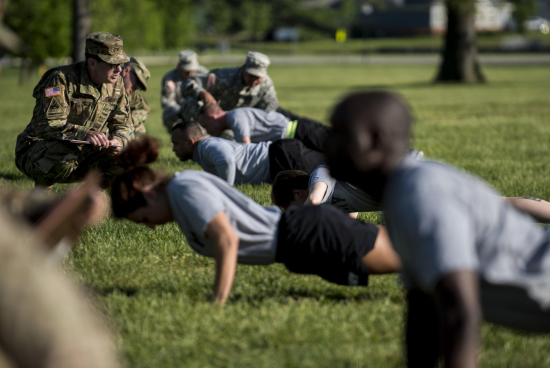
No matter which branch of the U.S. military you plan to join, arriving at basic training in poor physical condition will make an already demanding experience much harder.
You do not need to look like a bodybuilder before you ship out. However, you should be comfortable running, performing repeated bodyweight exercises, and continuing to work when you are tired.
This free 30-day military calisthenics workout plan can be followed online or downloaded as a printable PDF. It uses bodyweight exercises, running, and progressive conditioning to help men and women prepare for the physical demands of basic training. It includes details on:
- Push-up performance
- Pulling strength
- Core endurance
- Lower-body strength
- Running ability
- Cardiovascular conditioning
- Full-body work capacity
Most workouts require no equipment. A pull-up bar and resistance band are helpful but optional.
This is a general preparation program rather than an official training plan for one particular branch. Military fitness tests differ substantially, and several branches updated their testing programs in 2025 and 2026. Always compare your progress against the current standards for the branch you intend to join.
Ready to begin? Jump directly to the free military calisthenics workout PDF ↓
Table of Contents
30-Day Military Workout at a Glance
The plan uses five training days and two recovery days during most weeks.
Each week includes:
- Two or three military calisthenics workouts
- Two running or cardiovascular workouts
- At least one complete rest day
- Progressive increases in volume or intensity
- A lighter final week before your last fitness assessment
The goal is not to destroy yourself during every workout. It is to complete 30 days of consistent training while gradually improving your performance.
Beginners should use the easier exercise variations and lower repetition ranges. More advanced candidates can complete additional rounds or use harder variations.
Download the Free Military Calisthenics Workout PDF
Download or print the complete 30-day military calisthenics plan so you can follow each workout without returning to this page every day.
The free PDF includes the full four-week training schedule, including strength circuits, running workouts, active-recovery days, rest days, and fitness assessments. The plan can be adjusted for beginners, intermediate trainees, advanced trainees, men, and women.
Download the Free Military Calisthenics Workout PDF →
Download the Printable Military Calisthenics Workout Log →
What Is a Military Calisthenics Workout?

Military calisthenics is a style of physical training based primarily on bodyweight exercises.
Common exercises include:
- Push-ups
- Pull-ups
- Bodyweight squats
- Lunges
- Planks
- Mountain climbers
- Burpees
- Running
- Sprinting
These exercises are useful because they can be performed almost anywhere and can be organized into circuits that develop muscular endurance and cardiovascular conditioning at the same time.
Military calisthenics should not be confused with advanced gymnastics-style calisthenics. You do not need to perform handstands, muscle-ups, human flags, or other complicated skills to prepare for basic training.
Your priorities should be mastering basic movements, using proper form, and performing repeated exercises without excessive rest.
Will Calisthenics Prepare You for Every Military Fitness Test?
Calisthenics provides a strong foundation, but no single workout program perfectly matches every branch’s test.
For example:
- The Army Fitness Test includes a deadlift, hand-release push-ups, sprint-drag-carry, plank, and two-mile run.
- The Air Force assessment includes cardiovascular, push-up, core, and body-composition components.
- The Navy Physical Readiness Test assesses aerobic fitness, push-ups, and core endurance.
- The Marine Corps uses both a Physical Fitness Test and a Combat Fitness Test.
- The Coast Guard implemented a service-wide Physical Fitness Test in July 2026.
The common denominator is that recruits need cardiovascular endurance, upper-body strength, core stability, and the ability to work repeatedly under fatigue.
This program builds that general foundation. Once you know which branch you are joining, add direct practice for its specific test events.
Related articles:
- Army Fitness Test standards
- Air Force PT test standards
- Navy PRT standards
- Marine Corps PFT standards
- Coast Guard PT test standards
Equipment Needed
You can complete most of the plan with:
- Athletic shoes
- Comfortable workout clothing
- A stopwatch or phone timer
- A safe place to run
- Water
Optional equipment includes:
- Pull-up bar
- Resistance band
- Exercise mat
- Running track
- Hill or set of stairs
Do not improvise pull-ups from an unstable door, table, tree branch, or other object that might break.
When a pull-up bar is unavailable, use resistance-band rows, prone swimmer pulls, or reverse snow angels. These alternatives help strengthen the back, but you should still practice real pull-ups when you have safe access to a bar.
Choose Your Starting Level
Use the following guidelines throughout the plan.
| Exercise | Beginner | Intermediate | Advanced |
|---|---|---|---|
| Push-ups | Incline or knee push-ups | Standard push-ups | Standard or hand-release push-ups |
| Pulling | Band rows or assisted pull-ups | Assisted or strict pull-ups | Strict pull-ups |
| Circuit rounds | 2 rounds | 3 rounds | 4 rounds |
| Plank | 20-30 seconds | 30-45 seconds | 45-60 seconds |
| Running | Walk/run intervals | Continuous easy running | Faster continuous running |
| Rest between rounds | 90-120 seconds | 60-90 seconds | 30-60 seconds |
Choose the level that allows you to maintain proper form.
You can also combine levels. For example, you may be an intermediate runner but still need beginner-level pull-up assistance.
Military Calisthenics for Women
Women can follow the same 30-day military calisthenics plan shown on this page. The primary exercises, including push-ups, pull-ups, squats, lunges, planks, running, and conditioning circuits, do not require an entirely separate workout program.
Select your starting level according to your current ability rather than your sex. A woman who already runs and performs standard push-ups may begin at the intermediate or advanced level, while someone new to strength training should begin with the beginner modifications.
Women who are still developing upper-body strength can use:
- Incline or knee push-ups before progressing to standard push-ups
- Resistance-band rows or assisted pull-ups
- Slow pull-up lowering repetitions
- Longer rest periods between upper-body sets
- Two circuit rounds before progressing to three or four
The running, lower-body, core, and recovery portions of the printable military calisthenics plan can be completed as written. Increase repetitions, running speed, and circuit volume gradually as your fitness improves.
If you are preparing to join a particular military branch, compare your progress with that branch’s current fitness-test events and scoring standards.
Before Starting the 30-Day Plan
Do not begin the first workout at maximum intensity if you have been inactive for several months.
Consider speaking with a healthcare professional before beginning if you:
- Have an existing injury
- Experience chest pain or unexplained shortness of breath
- Have a heart, lung, joint, or neurological condition
- Recently had surgery
- Have been advised to limit physical activity
- Are pregnant or recently gave birth
Stop the workout if you experience sharp pain, dizziness, confusion, faintness, or unusual difficulty breathing.
Muscle fatigue and mild soreness can be normal. Sudden, severe, or worsening pain is not something you should attempt to push through.
Warm-Up Before Every Workout
Begin each training session with a five- to ten-minute dynamic warm-up.
Complete:
- Brisk walk or easy jog: 2 minutes
- Arm circles: 10 forward and 10 backward
- Leg swings: 10 per leg
- Walking lunges: 8 per leg
- Inchworms: 5
- Bodyweight squats: 10
- Easy push-ups: 5
- High knees: 20 seconds
A dynamic warm-up prepares your joints and muscles for movement. Military performance specialists also recommend progressing workouts according to your current fitness level rather than immediately jumping into high-volume training.
Save longer static stretches for the end of the workout, when your muscles are already warm.

Week One: Build the Foundation
The first week introduces the primary movements and establishes your current fitness level.
Do not worry about producing an impressive score on Day 1. The purpose of the baseline assessment is to give you something meaningful to compare against on Day 30.
Day 1: Baseline Fitness Assessment
After warming up, record your performance in the following exercises:
- Maximum proper push-ups in one minute
- Maximum strict or assisted pull-ups
- Maximum forearm plank, up to three minutes
- Timed one-mile run or walk/run
Rest for three to five minutes between events.
Use the same exercise versions when you repeat the assessment on Day 30. For example, if you perform incline push-ups today, perform incline push-ups at the same height during the final test.
Record your results rather than relying on memory.
Day 2: Full-Body Military Calisthenics Circuit
Complete two to four rounds:
- Push-ups: 8–15
- Bodyweight squats: 15–20
- Pull-ups or band rows: 3–8
- Reverse lunges: 8 per leg
- Forearm plank: 20–45 seconds
- Mountain climbers: 20 total
Rest for 60 to 120 seconds after each round.
Do not race through the exercises. Use a controlled range of motion and stop a set when your form begins to break down.
Day 3: Easy Running or Walk/Run Training
Complete 20 to 30 minutes of easy cardiovascular exercise.
Beginners can alternate:
- Jog for 1 minute
- Walk for 2 minutes
- Repeat for 20 to 30 minutes
Intermediate and advanced candidates should run continuously at a pace that still allows them to speak in short sentences.
This is not a time trial.
Finish with five minutes of walking and light stretching.
Day 4: Push, Pull, and Core Workout
Complete:
- Push-ups: 5 sets at approximately half of your Day 1 maximum
- Pull-ups, assisted pull-ups, or band rows: 4 sets
- Pike push-ups: 3 sets of 6–10
- Forearm plank: 3 sets of 20–45 seconds
- Side plank: 3 sets of 20–30 seconds per side
- Dead bugs: 3 sets of 8–10 per side
Rest for approximately one minute between sets.
Stopping before complete muscular failure allows you to accumulate more quality repetitions without turning every workout into another fitness test.
Day 5: Lower Body and Short Intervals
Complete three sets of:
- Bodyweight squats: 15
- Walking or reverse lunges: 10 per leg
- Glute bridges: 15
- Calf raises: 20
After the strength exercises, complete six intervals:
- Run quickly for 20 seconds
- Walk for 100 seconds
The fast portion should feel strong and controlled, not like an all-out sprint.
Day 6: Active Recovery
Complete 20 to 30 minutes of light activity, such as:
- Walking
- Easy cycling
- Gentle swimming
- Mobility work
- Light stretching
You should finish feeling better than when you started.
Day 7: Complete Rest
Do not perform a formal workout.
Focus on:
- Eating balanced meals
- Drinking enough water
- Preparing for the next week
- Getting seven to nine hours of sleep
Sleep plays an important role in physical performance, muscle recovery, coordination, and injury prevention.
Week Two: Increase Your Training Volume
Week Two increases the number of repetitions, circuit rounds, or running time.
Increase only what you can complete with good form. Doing more poor-quality repetitions is not an improvement.
Day 8: Full-Body Calisthenics Circuit
Complete two to four rounds:
- Push-ups: 10–18
- Bodyweight squats: 20
- Pull-ups or band rows: 4–10
- Alternating lunges: 10 per leg
- Plank shoulder taps: 10 per side
- Mountain climbers: 30 total
- Burpees or step-back burpees: 5–8
Rest for 60 to 90 seconds after each round.
Day 9: Running Intervals
After warming up, complete six rounds:
- Run at a challenging pace for 1 minute
- Walk or jog easily for 2 minutes
Beginners may use 30 seconds of faster running followed by two minutes of walking.
Finish with five to ten minutes of easy walking or jogging.
Day 10: Active Recovery
Complete:
- Easy walking: 20–30 minutes
- Hip-flexor stretch
- Calf stretch
- Chest stretch
- Upper-back mobility
- Ankle mobility
Spend approximately 20–30 seconds in each stretch after your walk.
Day 11: Upper Body and Core Endurance
Complete:
- Push-ups: 5 sets at 55–65% of your Day 1 maximum
- Pull-ups or rows: 5 sets
- Close-grip push-ups: 3 sets of 5–10
- Reverse snow angels: 3 sets of 10–15
- Forearm plank: 3 sets of 30–60 seconds
- Side plank: 3 sets per side
- Slow mountain climbers: 3 sets of 10 per side
Use incline push-ups for the close-grip variation if necessary.
Day 12: Legs, Stairs, or Hills
Complete three to four rounds:
- Bodyweight squats: 20
- Reverse lunges: 10 per leg
- Single-leg glute bridges: 8 per leg
- Calf raises: 20
- Wall sit: 30–60 seconds
Then complete one of the following:
- Six short hill repetitions
- Six stair climbs
- Six 20-second flat-ground accelerations
Walk back or recover for 60–120 seconds between efforts.
Day 13: Longer Easy Run
Complete 25 to 35 minutes at an easy pace.
Beginners should continue using walk/run intervals. Intermediate and advanced candidates can run continuously.
Your pace should be considerably slower than your one-mile baseline pace.
Avoid suddenly increasing both running speed and distance during the same workout. Rapid increases in training load can contribute to overuse injuries.
Day 14: Complete Rest
Take the day off from structured exercise.
Some mild soreness may remain, but you should not begin Week Three with severe pain or exhaustion.
Week Three: Improve Military Work Capacity
Week Three is the most demanding portion of the program.
The circuits are longer, and the running workouts require more sustained effort. Adjust the number of rounds when necessary rather than sacrificing form.
Day 15: Calisthenics Progress Check
Do not repeat the complete Day 1 assessment yet.
Instead, complete:
- Push-ups: 3 sets at 60% of your Day 1 maximum
- Pull-ups or rows: 3 moderately difficult sets
- Plank: 2 sets at approximately 75% of your Day 1 time
- Easy one-mile run
Compare how the exercises feel against the first week.
The same number of repetitions should now feel more manageable. That is progress even when your maximum score has not yet been retested.
Day 16: Military Conditioning Circuit
Complete three to five rounds:
- Push-ups: 12–20
- Jump squats or regular squats: 10–15
- Pull-ups or band rows: 4–10
- Alternating reverse lunges: 10 per leg
- Hand-release push-ups: 5–10
- Forearm plank: 30–60 seconds
- Mountain climbers: 30 total
- Burpees or step-back burpees: 6–10
Rest for 60–90 seconds between rounds.
Beginners should use regular squats and step-back burpees.
Day 17: One-Minute Running Intervals
Complete eight rounds:
- Run hard for 1 minute
- Walk or jog for 2 minutes
The faster intervals should be challenging, but you should be able to complete the final interval at approximately the same pace as the first.
Starting too quickly and slowing dramatically is a sign that the opening pace was too aggressive.
Day 18: Active Recovery
Complete 20 to 30 minutes of easy movement.
Pay particular attention to:
- Calves
- Ankles
- Hips
- Hamstrings
- Shoulders
- Upper back
Do not attempt to stretch through sharp pain.
Day 19: Push-Up, Pull-Up, and Core Volume
Complete:
- Push-ups: 6 sets at approximately 50–60% of your maximum
- Pull-ups or rows: 5 sets
- Pike push-ups: 3 sets of 8–12
- Plank shoulder taps: 3 sets of 10 per side
- Side plank: 3 sets of 30–45 seconds per side
- Dead bugs: 3 sets of 10 per side
Rest for 45–90 seconds between sets.
The objective is accumulating good repetitions, not reaching failure during the first few sets.
Day 20: Lower Body and Shuttle Training
Complete four rounds:
- Bodyweight squats: 20
- Walking lunges: 12 per leg
- Glute bridges: 15
- Calf raises: 20
- Wall sit: 45–60 seconds
Then mark two points approximately 25 yards apart.
Complete six shuttle repetitions:
- Run to the opposite marker
- Touch the ground
- Return to the starting point
- Rest for 60–90 seconds
Accelerate and decelerate under control. Do not perform the drill on wet grass, loose gravel, or another slippery surface.
Day 21: Complete Rest
This rest day is important because the final week includes a mixture of test-specific conditioning and reduced training volume.
Take additional recovery time if you have persistent joint pain, unusual fatigue, declining performance, or difficulty sleeping. These can be warning signs that your workload is exceeding your ability to recover.
Week Four: Test Preparation and Taper
The final week is not designed to be the hardest week.
You will complete several challenging sessions at the beginning of the week, followed by reduced volume so you are reasonably rested for the Day 30 assessment.
Day 22: Full-Body Military Calisthenics Workout
Complete three to four rounds:
- Push-ups: 15–20
- Squats: 20–25
- Pull-ups or rows: 5–10
- Reverse lunges: 10 per leg
- Plank: 45–60 seconds
- Mountain climbers: 30 total
- Burpees or step-back burpees: 8
- Fast run: 100 yards
Rest for 60–90 seconds after each round.
Use fewer repetitions when necessary to maintain consistent performance from the first round through the last.
Day 23: Goal-Distance Run
Choose the distance most relevant to your branch or current fitness level.
Options include:
- One mile
- 1.5 miles
- Two miles
- Three miles
Run at a controlled but challenging pace.
This is not necessarily an all-out time trial. The goal is learning how to pace yourself across the full distance without starting too quickly.
Record your total time and your approximate pace.
Day 24: Active Recovery
Complete:
- Easy walking: 20–30 minutes
- Light mobility work
- Optional gentle cycling or swimming
Avoid intense running, jumping, or high-volume push-ups.
Day 25: Test-Style Conditioning Circuit
Complete three to five rounds:
- Hand-release or standard push-ups: 10
- Pull-ups or rows: 5
- Bodyweight squats: 15
- Walking lunges: 8 per leg
- Plank: 30 seconds
- Shuttle run: 50 yards total
Rest for one minute between rounds.
Move efficiently, but do not allow speed to ruin your technique.
Day 26: Easy Cardio and Strides
Complete 20 to 25 minutes of easy running or walk/run intervals.
Afterward, perform four controlled strides:
- Run quickly for 15–20 seconds
- Walk for 60–90 seconds
- Repeat four times
A stride is a smooth acceleration rather than an all-out sprint.
Day 27: Light Full-Body Workout
Complete two easy rounds:
- Push-ups: 8–10
- Squats: 12–15
- Pull-ups or rows: 3–5
- Reverse lunges: 6 per leg
- Plank: 20–30 seconds
You should finish the session feeling like you could have completed another round.
Day 28: Complete Rest
Take the entire day off.
Prepare your shoes, clothing, timer, water, and testing location for Day 30.
Day 29: Pre-Test Shakeout
Complete:
- Easy walk or jog: 10–15 minutes
- Bodyweight squats: 10
- Easy push-ups: 5
- Short plank: 20 seconds
- Gentle dynamic mobility
Do not perform a hard workout or attempt to determine whether you have improved.
Save that effort for the final assessment.
Day 30: Final Fitness Assessment
Repeat the same assessment and exercise variations used on Day 1:
- Maximum proper push-ups in one minute
- Maximum strict or assisted pull-ups
- Maximum forearm plank, up to three minutes
- Timed one-mile run or walk/run
Use the same sequence, rest periods, testing surface, and equipment whenever possible.
Compare:
- Total push-ups
- Pull-up or row performance
- Plank time
- One-mile time
- Exercise form
- Perceived effort
A successful month does not require dramatic improvement in every category.
You may notice that you:
- Complete more repetitions
- Run the same pace with less effort
- Recover more quickly between exercises
- Maintain better form
- Experience less soreness
- Feel more confident during longer workouts
Those are all meaningful signs of improved fitness.
Track Your 30-Day Results
Use the printable workout log to compare your Day 1 and Day 30 results, including push-ups, pull-ups, plank time, running pace, and overall workout performance.
How to Perform the Main Exercises
Push-Ups
Begin in a straight-arm plank position with your hands slightly wider than shoulder width.
Keep your:
- Head neutral
- Core braced
- Hips aligned with your shoulders
- Feet together or slightly separated
Lower your body under control until your chest approaches the ground, then press back to the starting position.
Do not allow your hips to sag or rise before your chest.
Use incline push-ups when you cannot yet maintain proper form from the floor.
Hand-Release Push-Ups
Lower your body until your chest and thighs contact the ground.
Briefly lift your hands from the floor, return them to position, and press your body upward as one unit.
Do not lift your chest while leaving your hips on the ground.
Pull-Ups
Begin from a controlled hanging position.
Pull until your chin clears the bar without:
- Kicking
- Swinging
- Bending excessively at the hips
- Using momentum
Lower under control.
Use an assistance band or assisted pull-up machine when necessary.
Bodyweight Squats
Stand with your feet approximately shoulder-width apart.
Push your hips slightly backward and bend your knees while keeping your entire foot in contact with the ground.
Descend only as far as you can maintain control, then stand by driving through your feet.
Your knees should generally track in the same direction as your toes.
Lunges
Step forward or backward far enough that you can lower your hips without your front heel lifting from the ground.
Keep your torso controlled and press through the front foot to return to the starting position.
Reverse lunges are often easier for beginners to control than forward lunges.
Forearm Plank
Place your forearms on the ground with your elbows beneath your shoulders.
Brace your abdomen and maintain a straight line from your head to your heels.
Stop the set when:
- Your hips begin to sag
- Your lower back arches
- Your hips rise substantially
- You can no longer breathe normally
A shorter plank with good form is more useful than a longer plank performed in a poor position.
Burpees
From a standing position:
- Place your hands on the ground.
- Step or jump into a plank.
- Return your feet toward your hands.
- Stand and reach overhead.
More advanced candidates may add a push-up and vertical jump.
Beginners should use the step-back version.
No-Equipment Military Workout Substitutions
A lack of gym access should not prevent you from completing the plan.
Use these substitutions:
| Original Exercise | No-Equipment Alternative |
|---|---|
| Pull-ups | Prone swimmer pulls or reverse snow angels |
| Band rows | Prone Y-T-W raises |
| Hill sprints | Flat-ground intervals |
| Stair climbs | Reverse lunges or step-ups on a stable surface |
| Exercise mat | Folded towel or carpeted floor |
| Stopwatch | Phone timer |
Back exercises performed on the floor do not perfectly reproduce a pull-up. Practice hanging and pulling from a safe bar whenever one becomes available.
How to Improve Your Running for Basic Training
Many candidates make one of two mistakes:
- They run as hard as possible every time.
- They avoid running until shortly before they ship.
A better approach combines:
- Easy running
- Faster intervals
- Goal-distance practice
- Rest and recovery
Easy runs build your ability to continue moving for longer periods. Intervals expose you to faster speeds. Goal-distance runs teach pacing.
Running should be part of a balanced program that also includes strength and mobility work. Static stretching immediately before running is generally less useful than a dynamic warm-up and can temporarily reduce performance.
Do not increase your distance, speed, and frequency all at once.
Candidates who are completely new to running may need longer than 30 days to prepare safely.
Beginner and Advanced Modifications
Beginner Modifications
Use:
- Incline push-ups
- Assisted pull-ups or band rows
- Regular squats instead of jump squats
- Step-back burpees
- Walk/run intervals
- Two circuit rounds
- Longer rest periods
Completing the beginner version consistently is better than attempting the advanced version for several days and becoming injured or exhausted.
Advanced Modifications
Advanced candidates may:
- Complete four or five circuit rounds
- Use hand-release push-ups
- Add strict pull-ups
- Shorten rest periods slightly
- Use jump squats
- Increase running pace
- Select the longer goal distance on Day 23
Do not add every advanced modification at once.
Even well-conditioned candidates need recovery between demanding sessions.
What People Get Wrong About Military Workout Preparation
Training to Failure Every Day
A fitness test may require maximum effort, but regular training should not consist entirely of maximum-effort sets.
Repeatedly training to failure can reduce the quality of later sets and make it difficult to recover before the next workout.
Practicing Only Push-Ups and Running
Push-ups and running are important, but candidates also need:
- Pulling strength
- Strong legs
- Core stability
- Sprinting ability
- Movement control
- General work capacity
Balanced training may also reduce the likelihood that one weak area limits your performance.
Ignoring Exercise Form
Poor repetitions are not interchangeable with good repetitions.
Military tests use specific movement standards, and repetitions may not count when the required range of motion is not completed.
Learn the official form for your branch before test day.
Increasing Running Too Quickly
Running more is not always better.
Sudden increases in mileage or intensity can overload muscles, tendons, and bones before they have time to adapt.
Build your running gradually and take persistent pain seriously.
Skipping Recovery Days
Recovery is part of the program, not wasted time.
Additional exercise is not automatically productive when your performance is declining and your body has not recovered from the previous session.
Waiting Until the Final Month
Thirty days can produce noticeable improvements, particularly for beginners, but it cannot replace several months of consistent preparation.
Start earlier whenever possible.
Nutrition, Hydration, and Recovery
You do not need a complicated military diet to support this plan.
Focus on:
- Eating regular, balanced meals
- Including a protein source with meals
- Consuming carbohydrates to support running and conditioning
- Eating fruits and vegetables
- Drinking water throughout the day
- Limiting excessive alcohol
- Avoiding crash diets
- Getting seven to nine hours of sleep
Federal physical activity guidance recommends combining aerobic exercise with muscle-strengthening work rather than relying on only one type of training.
Candidates who must lose weight before joining should begin early and use a sustainable approach.
Related Article – How To Join The Military If You’re Overweight
Frequently Asked Questions
Is This Military Calisthenics Workout Free?
Yes. The complete 30-day military calisthenics workout is available free on this page. You can also download the accompanying PDF and printable workout log at no cost.
Can I Download the Military Calisthenics Workout as a PDF?
Yes. The free PDF contains the complete 30-day workout schedule, including strength circuits, running sessions, recovery days, rest days, and fitness assessments.
Download the Free Military Calisthenics Workout PDF →
Can Women Follow This Military Calisthenics Workout?
Yes. Women can follow the same 30-day plan and select beginner, intermediate, or advanced modifications according to their current fitness level. The exercises and circuit structure can be scaled without creating a completely separate program.
What is the best military calisthenics workout?
The best military calisthenics workout combines pushing, pulling, leg exercises, core training, and cardiovascular conditioning.
A complete workout might include push-ups, pull-ups, squats, lunges, planks, mountain climbers, and running intervals.
The exact number of repetitions should reflect your current fitness level.
Can you prepare for basic training in 30 days?
You can improve your fitness in 30 days, particularly if you are already moderately active.
However, someone beginning from a completely sedentary starting point may need several months to prepare safely.
Thirty days should be viewed as a focused starting block rather than a guarantee that you will meet every requirement.
Can beginners complete this workout?
Yes.
Beginners should use incline push-ups, assisted pulling exercises, walk/run intervals, regular squats, step-back burpees, and two circuit rounds.
Progress to harder variations only after you can maintain proper form.
Do I need a gym for this military workout?
No.
The majority of the plan uses bodyweight exercises and running.
A pull-up bar and resistance band are useful because pulling exercises can be difficult to reproduce without equipment, but neither is required to begin.
Should I do push-ups every day?
Most beginners do not need to perform demanding push-up workouts every day.
Muscles and connective tissues need time to recover. This program spaces higher-volume upper-body sessions throughout the week while including lighter days and rest days.
Should I run every day before basic training?
Running every day is unnecessary for most beginners and may increase your chance of developing an overuse injury.
This plan alternates easy running, faster intervals, strength training, active recovery, and rest.
What should I do if I cannot perform a pull-up?
Begin with assisted pull-ups, resistance-band rows, slow lowering repetitions, or other controlled back exercises.
Continue improving your grip and pulling strength, and practice on a safe pull-up bar whenever possible.
Does this plan prepare me for the Army Fitness Test?
The plan can improve your push-ups, plank, running ability, and general conditioning.
However, the Army Fitness Test also includes a three-repetition deadlift and sprint-drag-carry. You will need access to appropriate equipment and direct practice to prepare fully for those events.
Does this workout prepare me for Marine Corps boot camp?
It provides a foundation for push-ups, pull-ups, planks, running, and general conditioning.
Marine candidates should also prepare specifically for the current Marine Corps Physical Fitness Test, Combat Fitness Test, and the greater running volume they may encounter during recruit training.
What should I do after completing the 30 days?
Review your Day 1 and Day 30 results.
Continue the program for another month by:
- Adding repetitions gradually
- Increasing circuit rounds
- Improving running pace
- Extending easy runs
- Practicing branch-specific events
- Maintaining at least one rest day each week
Do not repeatedly restart at the easiest Week One volume unless you need additional recovery.
Final Thoughts
A military calisthenics workout does not need to be complicated.
The most important factors are:
- Consistency
- Proper form
- Progressive training
- Running practice
- Balanced conditioning
- Adequate recovery
Use the first assessment to establish your starting point, complete the 30-day plan at an appropriate level, and repeat the same assessment at the end.
You may not become fully prepared for every demand of basic training in one month, but you should arrive stronger, better conditioned, and more familiar with the exercises you are likely to encounter.