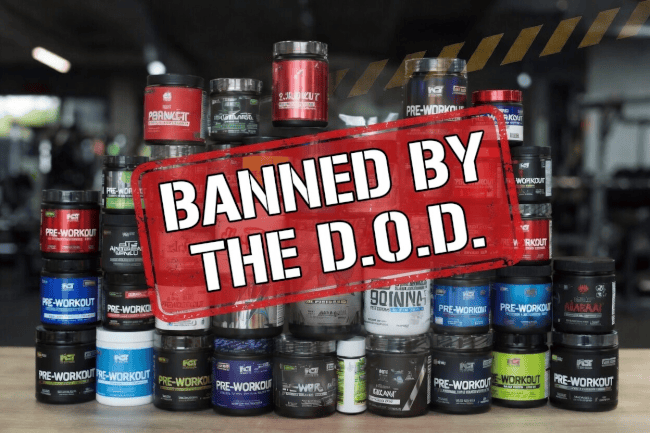
Dietary supplements are widely used by service members, but the U.S. military does not allow many products that are legally sold to civilians.
There is also a common misconception that the military maintains one official “banned supplements list.” In reality, the U.S. Department of Defense relies on guidance from Operation Supplement Safety (OPSS), the FDA, and internal readiness standards to identify high-risk, prohibited, or discouraged ingredients.
This means a supplement can be:
- ❌ Banned (illegal or explicitly prohibited)
- ⚠️ High-risk (linked to safety concerns or hidden ingredients)
- ⚪ Allowed (generally considered safe when used appropriately)
Many popular pre-workouts, fat burners, and “natural” supplements fall into the high-risk category, especially those containing stimulants, hormone-altering compounds, or unapproved ingredients.
Below, you’ll find the most complete and up-to-date military banned supplements list, including:
- Ingredients that are prohibited or flagged by the military
- Pre-workout supplements that may be banned or unsafe
- Answers to common questions like “Is Bucked Up banned?” or “Can you take ashwagandha in the military?”
This guide is designed for active-duty service members, applicants, and military families who want to stay compliant, avoid failed drug tests, and protect their readiness.
Table of Contents
What People Get Wrong About “Banned” Supplements in the Military
Many service members assume that if a supplement is legal for civilians, it must also be allowed in the military. That’s not how it works.
Here are the biggest misconceptions:
❌ Myth #1: If it’s legal, it’s allowed in the military
The U.S. Department of Defense can restrict supplements that are legal for civilians but pose risks to performance, safety, or drug testing. A product doesn’t have to be illegal to be off-limits.
❌ Myth #2: “Natural” supplements are always safe
Many “natural” ingredients, especially ones found in pre-workouts and fat burners, are flagged or restricted due to safety concerns, unapproved status, or misleading labeling. Natural does not mean approved, even though it may sound like it is.
❌ Myth #3: If it’s sold at GNC or Amazon, it’s safe for military use
Retail availability does not guarantee compliance with military standards. Some widely sold supplements contain hidden or high-risk ingredients that could impact readiness or trigger a failed drug test.
❌ Myth #4: The military has one official banned supplements list
There is no single master list. Instead, the military relies on guidance from Operation Supplement Safety (OPSS), FDA warnings, and internal policies to identify banned and high-risk substances.
❌ Myth #5: Supplement rules don’t change
Supplement policies evolve as new research and safety data emerge. Service members are responsible for staying up to date, and not relying on outdated advice or product marketing.
1. Acacia rigidula

Status: ❌ Banned / High-Risk in the Military
What is Acacia rigidula?
Acacia rigidula (also known as “Blackbrush”) is a plant-based stimulant traditionally found in southwest Texas and northern Mexico. It has been marketed in weight loss and pre-workout supplements for its potential to increase energy, metabolism, and athletic performance.
Why is Acacia rigidula banned in the military?
Acacia rigidula is not recognized by the U.S. Food and Drug Administration as a valid dietary ingredient. More importantly, some supplements labeled as containing Acacia rigidula have been found to include BMPEA, a synthetic stimulant with amphetamine-like effects.
Because of this:
- Products may be misleadingly labeled
- Supplements can be considered adulterated
- There is a potential risk to health and military readiness
As a result, supplements containing Acacia rigidula are considered high-risk and effectively banned for military personnel.
Common supplements that may contain Acacia rigidula include:
- Fastin-XR (Hi-Tech Pharmaceuticals)
- Fastin-RR (Hi-Tech Pharmaceuticals)
- Lipodrene (Ephedra Free, Hi-Tech Pharmaceuticals)
- Conquer (iForce Nutrition / Tribravus Enterprises)
- Critical FX (Train Naked Labs)
- Sudden Impact (Train Naked Labs)
- Phoenix Extreme (Better Body Sports)
- Core Burner (Human Evolution Supplements)
- Undisputed (Nubreed Nutrition — recalled pre-workout)
- JetFuel T-300 (GAT Supplements — older versions)
- Yellow Scorpion (Hi-Tech Pharmaceuticals)
- Black Widow (Hi-Tech Pharmaceuticals — some versions)
- Stimerex-ES (Hi-Tech Pharmaceuticals)
Military risk level: ⚠️ High
- Possible hidden stimulants (like BMPEA)
- Potential drug test concerns
- Not compliant with military supplement guidance
Learn more:
2. Aconite
Status: ❌ Banned in the Military
What is Aconite?
Aconite, also known as “Wolfsbane,” is a plant used in some traditional medicine practices. It has been marketed for potential benefits related to heart conditions, as well as nerve and joint pain relief.
Why is Aconite banned in the military?
All species of Aconite contain a powerful, fast-acting toxin known as aconitine. This compound can be dangerous even in small amounts and may be absorbed through ingestion or skin contact.
Due to its toxicity:
- It can cause serious poisoning or death
- It poses a clear health and safety risk
- It is listed in the U.S. Food and Drug Administration Poisonous Plant Database
Because of these risks, Aconite is considered unsafe and is prohibited for military personnel.
Common supplements that may contain Aconite:
- Fu Zi (processed Aconite root, sometimes sold as an herbal supplement ingredient)
Military risk level: High
- Toxic even in small doses
- Risk of severe poisoning
- Not compliant with military safety standards
Learn more:
3. Aegeline
Status: ❌ Banned in the Military
What is Aegeline?
Aegeline is a compound found naturally in the Aegle marmelos tree (Bael) or produced synthetically. It has been marketed in supplements for weight loss and muscle-building purposes.
Why is Aegeline banned in the military?
Aegeline is not recognized by the U.S. Food and Drug Administration as a valid dietary ingredient. It has also been linked to cases of acute liver injury.
Because of this:
- Supplements containing Aegeline are considered adulterated
- There are documented safety concerns, including liver damage
- The ingredient does not meet dietary supplement requirements
As a result, Aegeline is prohibited for military personnel.
Common supplements banned by the military that may contain Aegeline:
- OxyELITE Pro
- Versa-1
- Enhanced (Physique Enhancing Science / PES)
- Alphamine (Physique Enhancing Science / PES)
Military risk level: High
- Risk of liver toxicity
- Not FDA-approved for supplements
- Not compliant with military standards
Learn more:
- https://www.opss.org/article/aegeline-why-it-problem
- https://www.fda.gov/food/food-safety-modernization-act-fsma/annual-report-congress-use-mandatory-recall-authority-2014
4. Aromatase Inhibitors
Status: ❌ Banned in the Military
What are Aromatase Inhibitors?
Aromatase inhibitors (such as Arimistane and ATD) are compounds that prevent the conversion of testosterone into estrogen. They are sometimes marketed in bodybuilding supplements to support testosterone levels.
Why are Aromatase Inhibitors banned in the military?
Aromatase inhibitors are pharmaceutical drugs used to treat conditions like breast and ovarian cancer. They are not appropriate as dietary supplement ingredients.
Because of this:
- They are classified as drugs, not supplements
- They are prohibited by organizations like the World Anti-Doping Agency (WADA)
- They are included on military prohibited ingredient lists
As a result, they are banned for use by military personnel.
Common supplements that may contain Aromatase Inhibitors:
- Arimistane (Hi-Tech Pharmaceuticals standalone product)
- Arimidrol (VMI Sports)
- Arima-XD (VMI Sports)
- Novedex-XT (Hi-Tech Pharmaceuticals)
- Eradicate (Blackstone Labs)
- Arimistane Plus (various brands, including Fusion Supplements)
- VERSA-1 (older USPlabs — sometimes included in stacks)
Military risk level: High
- Hormonal disruption
- Classified as drug compounds
- Not allowed under military policy
Learn more:
- https://www.opss.org/article/aromatase-inhibitors-can-military-service-members-use-them
- https://www.fda.gov/inspections-compliance-enforcement-and-criminal-investigations/warning-letters/performance-nutrition-formulators-llc-dba-vmi-sports-543959-05182018
5. BMPEA
Status: ❌ Banned in the Military
What is BMPEA?
BMPEA (beta-methylphenethylamine) is a synthetic stimulant designed to have effects similar to amphetamines. It is often marketed in supplements for energy and appetite suppression.
Why is BMPEA banned in the military?
BMPEA does not meet the definition of a dietary ingredient under FDA guidelines and is considered illegal in supplements.
Additionally:
- It is often mislabeled as Acacia rigidula
- It is not a natural plant extract despite labeling claims
- Products containing it are considered misbranded
Because of these issues, BMPEA is prohibited for military personnel.
Common supplements that may contain BMPEA:
- Fastin-XR (Hi-Tech Pharmaceuticals)
- Fastin-RR (Hi-Tech Pharmaceuticals)
- Lipodrene (Ephedra Free / various versions, Hi-Tech Pharmaceuticals)
- Conquer (iForce Nutrition / Tribravus Enterprises)Critical FX (Train Naked Labs)
- Sudden Impact (Train Naked Labs)
- Phoenix Extreme (Better Body Sports)
- Core Burner (Human Evolution Supplements)
- Undisputed (Nubreed Nutrition — recalled version)
- JetFuel T-300 (GAT Supplements — older versions)
- JetFuel Superburn (GAT Supplements — older versions)
- Black Widow (Hi-Tech Pharmaceuticals — some versions)
- Stimerex-ES (Hi-Tech Pharmaceuticals — some versions)
- Yellow Scorpion (Hi-Tech Pharmaceuticals)
- Dexaprine XR (iForce Nutrition)
- Aro Black Series Burn (various retailers)
Military risk level: High
- Amphetamine-like stimulant effects
- Mislabeling concerns
- Potential drug testing risks
Learn more:
6. Cannabidiol
Status: ❌ Banned in the Military
What is Cannabidiol (CBD)?
Cannabidiol (CBD) is a compound derived from the Cannabis sativa plant or produced synthetically. It is commonly marketed for pain relief, anxiety, and inflammation.
Why is CBD banned in the military?
The U.S. Food and Drug Administration does not allow CBD to be marketed as a dietary supplement.
In addition:
- The military prohibits CBD use under the Uniform Code of Military Justice (UCMJ)
- Products may contain trace amounts of THC
- There is a risk of failing a drug test
Because of this, CBD products are banned for military personnel.
Common supplements that may contain CBD:
- cbdMD Broad Spectrum CBD Oil Tinctures (often used pre-workout for focus/calm energy)
- cbdMD Full Spectrum CBD Softgels
- cbdMD Broad Spectrum CBD Gummies
- Joy Organics CBD Gummies or Tinctures (popular for pre-workout calm)
- Cornbread Hemp CBD Gummies or Distilled CBD Oil
- Just Live CBD Pain Relief Cream or Tincture (pre-workout topical/application)
- ReThink CBD + CBG Energy & Focus Capsules/Gummies
- NanoCraft CBD Energy Water or Performance products
- ZenLeaf CBD Pre-Workout Powder (older dedicated formula)
- Venga CBD Recovery Balm or similar athlete topicals (used pre-workout for joint prep)
Military risk level: High
- Drug test risk (THC contamination)
- Not allowed under military policy
- Regulatory issues
Learn more:
7. DMAA
Status: ❌ Banned in the Military
What is DMAA?
DMAA (1,3-dimethylamylamine) is a stimulant originally developed as a nasal decongestant. It has amphetamine-like effects and is often marketed in pre-workouts and fat burners.
Why is DMAA banned in the military?
DMAA has been declared illegal for use in dietary supplements by the U.S. Food and Drug Administration since 2013.
Because of this:
- It is considered an unapproved ingredient
- It has been linked to serious health risks (including cardiovascular issues)
- It poses a readiness and safety concern
As a result, DMAA is banned for military personnel.
List of supplements that may contain DMAA that are banned by the military:
- Crack (Dark Labs, including Crack OG, Crack Gold Limited Edition, Crack Barbarian variants)
- Final Call (BS Supplements)
- Wild Fire (SoCal Supps)
- Venom (Dark Earth Research)
- Herolean (Dark Labs — often used as a high-stim pre-workout/fat burner hybrid)
- Legit Pre (Legit Pharm)
- Kill Switch (Death Row Formulations)
- Killer Instinct (Renegade Labs)
- Firestorm (various mentions in high-stim circles)
- Mesomorph (APS Nutrition — older/original versions)
- Jack3d (USP Labs — original classic formula)
- OxyELITE Pro (USP Labs — original versions, sometimes stacked)
- Swole Labs Assiduous
Military risk level: High
- Strong stimulant effects
- Cardiovascular risk
- Not compliant with FDA or military guidance
Learn more:
8. DMBA
Status: ❌ Banned in the Military
What is DMBA?
DMBA (1,3-dimethylbutylamine), also known as AMP Citrate, is a stimulant similar to DMAA. It is commonly found in pre-workout and weight-loss supplements.
Why is DMBA banned in the military?
DMBA is not approved as a dietary ingredient by the U.S. Food and Drug Administration.
Because of this:
- Its safety has not been established
- It is considered illegal in dietary supplements
- It may pose serious health risks
As a result, DMBA is prohibited for military personnel.
Common supplements that may contain DMBA:
- Frenzy (Driven Sports)
- MD2 Meltdown (VPX Sports / Vital Pharmaceuticals)
- Redline White Heat (VPX Sports)
- Contraband (Iron Forged Nutrition)
- Evol (Genomyx LLC)
- Decimate Amplified (Genomyx LLC)
- AMPitropin (Lecheek Nutrition)
- AMPilean (Lecheek Nutrition)
- OxyphenXR AMP’D (Beta Labs)
- Unstoppable (various mentions in adverse event reports)
Military risk level: High
- Stimulant-related health risks
- Unapproved ingredient
- Not compliant with military policy
Learn more:
9. DMHA
Status: ❌ Banned / High-Risk in the Military
What is DMHA?
DMHA (also known as Octodrine or 1,5-DMHA) is a stimulant used in some dietary supplements, particularly pre-workouts and fat burners.
Why is DMHA banned in the military?
DMHA is considered a new dietary ingredient without sufficient evidence demonstrating safe use, according to the U.S. Food and Drug Administration.
Because of this:
- It is not approved for use in supplements
- Safety data is limited
- It may pose health and performance risks
As a result, DMHA is considered high-risk and effectively banned for military personnel.
Common supplements that may contain DMHA:
- Crack OG / Crack Pre-Workout (Dark Labs)
- Crack Primal Edition (Dark Labs)
- Crack Barbarian Edition (Dark Labs)
- Maniaco (Dark Labs)
- Flame (Dark Labs, various versions)
- Herolean (Dark Labs — often used as high-stim pre/fat burner hybrid)
- Wild Fire (SoCal Supps)
- Final Call (BS Supplements)
- Legit Pre (Legit Pharm)
- Doomsday (Koka Labs)
- Zeus (God Status Labz)
- El Jefe Limited Edition (ASC Supplements / Xtremis)
- Mesomorph (APS Nutrition / Hi-Tech — certain versions)
- Convict (Condemned Labz)
Military risk level: High
- Stimulant effects
- Limited safety data
- Potential compliance issues
Learn more:
10. Ephedra

Status: ❌ Banned in the Military
What is Ephedra?
Ephedra (also known as ephedrine or ephedra alkaloids) is a stimulant that was commonly used in weight-loss and performance supplements. It has been associated with serious side effects, including heart attack and stroke.
Why is Ephedra banned in the military?
Ephedra-containing supplements are illegal in the United States because they are considered adulterated by the U.S. Food and Drug Administration.
Because of this:
- It cannot be legally sold as a dietary supplement
- It has been linked to severe cardiovascular risks
- It poses a significant safety concern
As a result, Ephedra is banned for military personnel.
Common supplements that may contain Ephedra:
- Lipodrene (Hi-Tech Pharmaceuticals — Ephedra version)
- Stimerex-ES (Hi-Tech Pharmaceuticals)
- Black Widow (Hi-Tech Pharmaceuticals)
- Yellow Scorpion (Hi-Tech Pharmaceuticals)
- Ultimate Orange (Hi-Tech Pharmaceuticals — certain versions with ephedra)
- Megadrine (various older formulations)
- EPH 100 (Hard Rock Supplements)
- Yellow Bullet (various versions)
- Diablos (original or ephedra-containing versions)
- Ephedra Shred (various brands)
Military risk level: High
- Serious cardiovascular risk
- Illegal ingredient in supplements
- Not compliant with military standards
Learn more:
11. HCG
Status: ❌ Banned in the Military
What is HCG?
HCG (human chorionic gonadotropin) is a prescription hormone used to treat infertility and certain hormonal conditions. It is sometimes marketed illegally as a weight-loss aid.
Why is HCG banned in the military?
HCG is a prescription drug and is not approved by the U.S. Food and Drug Administration for over-the-counter use or weight loss.
Because of this:
- It cannot be legally sold as a dietary supplement
- Products marketed for weight loss are considered fraudulent
- Use without a prescription is not allowed
As a result, HCG is prohibited for military personnel.
Common supplements that are marketed as ‘natural HCG mimics’:
- BioGenetic Laboratories hCG Alternative
- HCG Activator Natural HCG Alternative
- iSatori hCG Alternative
- HCG Drops (various homeopathic brands)
- HCG for Men Performance Formula
- HCGenerate (N2BM / Need to Build Muscle)
- Pure hCG Alternative (various generic brands)
- hCG Alternative Weight Loss Support (BioGenetic Labs variants)
- HCG Mimic / Activator blends (various Amazon/private label products)
Note: These OTC products do not contain real HCG. Most are marketed for weight loss (often tied to the controversial hCG diet) or as natural mimics using herbs, amino acids, or proprietary blends.
Military risk level: High
- Hormonal effects
- Prescription-only drug
- Not compliant with military policy
Learn more:
12. Hemp
Status: ❌ Banned in the Military
What is Hemp?
Hemp is a variety of the Cannabis sativa plant used in products such as protein powders, oils, and supplements.
Why is Hemp banned in the military?
Although hemp-derived products may be legal for civilians, the military prohibits their use due to drug testing concerns.
Because of this:
- It is difficult to distinguish THC from hemp vs. marijuana in testing
- There is a risk of unintentional THC exposure
- The military enforces a zero-tolerance policy
As a result, hemp products are banned for military personnel.
Common supplements that may contain Hemp:
- Nutiva Organic Hemp Protein Powder
- Manitoba Harvest Hemp Yeah! Organic Protein Powder (including Max Protein variants)
- Anthony’s Organic Hemp Seed Protein Powder
- NOW Sports Plant Protein Complex (hemp-inclusive blend)
- Bob’s Red Mill Hemp Protein Powder
- Food to Live Organic Hemp Protein Powder
- Just Hemp Foods Protein Powder
- 365 Everyday Value Organic Hemp Protein Powder
- EvoHemp Protein Powder
- Huel Complete Protein (hemp-blended plant protein)
Military risk level: High
- Risk of failing a drug test
- THC contamination concerns
- Not allowed under military policy
Learn more:
13. HGH
Status: ❌ Banned in the Military (without prescription)
What is HGH?
HGH (human growth hormone) is a prescription medication used to treat growth disorders and certain medical conditions. It is often marketed illegally for anti-aging or performance enhancement.
Why is HGH banned in the military?
HGH is approved by the U.S. Food and Drug Administration only for specific medical uses under a doctor’s supervision.
Because of this:
- Non-prescribed use is illegal
- It is considered a performance-enhancing drug
- It is not allowed in supplement form
As a result, HGH use outside of a valid prescription is prohibited for military personnel.
Common supplements that position themselves as HGH-releasers:
- HGH-X2 (CrazyBulk)
- HyperGH 14X
- GenF20 Plus
- Provacyl
- SeroVital
- GF-9 (Novex Biotech)
- GenFX
- Force Factor Prime HGH Secretion Activator
- Nugenix GH-Boost
- PGH-1000 (Anabolic Research)
Note: These products do not contain actual human growth hormone (HGH). They use amino acids, herbs, or blends marketed to stimulate your body’s own HGH production.
Military risk level: High
- Hormonal manipulation
- Illegal without prescription
- Not compliant with military regulations
Learn more:
14. IGF
Status: ❌ Banned in the Military
What is IGF-1?
IGF-1 (insulin-like growth factor 1) is a hormone produced in the body that plays a role in growth and development. Synthetic versions are sometimes marketed for performance enhancement.
Why is IGF-1 banned in the military?
Synthetic IGF-1 is a prescription drug and is not approved for use in dietary supplements by the U.S. Food and Drug Administration.
Because of this:
- It is classified as a drug, not a supplement
- It is banned by organizations like WADA
- It is not approved for performance enhancement use
As a result, IGF-1 is prohibited for military personnel.
Common supplements that position themselves as growth-hormone (IGF-1) releasers:
- Nutra IGF+ (GDR Labs)
- Hi-Tech Pharmaceuticals Pro IGF-1
- Primal Muscle 191XT
- Bucked Up Deer Antler Velvet Spray
- Pure IGF Premium / Pure Factors Extreme Pro IGF
- PGH-1000 (Anabolic Research)
- GenF20 Plus
- HyperGH 14X
- Nugenix GH-Boost
- Secretropin (SRx)
Note: These products do not contain actual synthetic IGF-1 (which is a prescription-only drug). They are marketed using ingredients like deer antler velvet, amino acids, or blends claimed to support or increase natural IGF-1 levels.
Military risk level: High
- Hormonal effects
- Prescription-only use
- Not compliant with military standards
Learn more:
15. Isopropylnorsynephrine
Status: ❌ Banned in the Military
What is Isopropylnorsynephrine?
Isopropylnorsynephrine (also known as Betaphrine) is a stimulant that does not meet the FDA definition of a dietary ingredient.
Why is it banned in the military?
There is limited safety data and reports of adverse cardiovascular effects associated with its use.
Because of this:
- It is not legally permitted in supplements
- It may increase heart-related risks
- It is considered an unapproved ingredient
As a result, it is prohibited for military personnel.
Common supplements that may contain Isopropylnorsynephrine:
- Dexaprine XR (iForce Nutrition)
- Friction (various mentions in high-stim circles)
- Black Magic BZRK
- Wrecked Enraged (certain versions)
- Gorilla Minda2 AM
- Tennessee Pre Smokey Mountain Lemonade
- Cannibal Ferox (Chaos and Pain — certain versions)
- God of Fire (Centurion Labz — some thermogenic pre-workout variants)
- Try The Line (Steel Supplements)
- Synephrine MAX / pure powder versions (often stacked into custom pre-workouts)
Military risk level: High
- Cardiovascular concerns
- Unapproved ingredient
- Not compliant with military policy
Learn more:
16. Kratom
Status: ⚠️ Discouraged / High-Risk in the Military
What is Kratom?
Kratom (Mitragyna speciosa) is a plant native to Southeast Asia that has opioid-like effects. It is used for pain relief, mood enhancement, and energy.
Why is Kratom restricted in the military?
Kratom is not currently part of standard DoD drug testing, but it is strongly discouraged due to safety concerns.
Because of this:
- It has been linked to addiction and dependence
- There are reports of serious side effects, including death
- It may impact readiness and performance
As a result, Kratom is considered high-risk and discouraged for military personnel.
Common brands that market and sell Kratom:
- Jack Botanicals
- Happy Hippo Herbals
- Happy Go Leafy
- Super Speciosa
- Kona Kratom
- Star Kratom
- Kraken Kratom
- Kats Botanicals
- Club 13
- Coastline Kratom
- Choice Botanicals
Military risk level: High
- Addiction potential
- Safety concerns
- Not recommended under military guidance
Learn more:
17. Methylsynephrine
Status: ❌ Banned in the Military
What is Methylsynephrine?
Methylsynephrine (also known as Oxilofrine) is a stimulant sometimes included in dietary supplements and marketed as a vitamin or energy booster.
Why is Methylsynephrine banned in the military?
It does not meet the definition of a dietary supplement ingredient under U.S. Food and Drug Administration guidelines.
Because of this:
- Products containing it are considered adulterated
- It is illegal in dietary supplements
- It may pose cardiovascular risks
As a result, it is prohibited for military personnel.
Common supplements that may contain Methylsynephrine:
- Fastin (Hi-Tech Pharmaceuticals)
- HyperDrive 3.0 (ALR Industries)
- Ephedra Free Shredder (TBN Total Body Nutrition)
- Methyl Drive 2.0 (ANS Advanced Nutrition Systems)
- Exile (American Muscle Sports / American Metabolix)
- Drop Factor (MTS Nutrition)
- Phenadrine (APS Nutrition)
- Tummy Tuck (TBN Total Body Nutrition)
- Lean Pills (Line One Nutrition)
- China White 25 Ephedra (Cloma Pharma)
Military risk level: High
- Stimulant-related risks
- Illegal ingredient in supplements
- Not compliant with military standards
Learn more:
18. Phenibut
Status: ❌ Banned in the Military
What is Phenibut?
Phenibut is a synthetic compound developed in Russia that affects the central nervous system. It is marketed for anxiety, sleep, and cognitive support.
Why is Phenibut banned in the military?
Phenibut does not meet the FDA definition of a dietary ingredient and is illegal to market as a supplement.
Because of this:
- It is classified as a drug, not a supplement
- It can cause dependence and withdrawal issues
- Products containing it are considered adulterated
As a result, Phenibut is prohibited for military personnel.
Common supplements that may contain Phenibut:
- Addall XR
- Atomixx Limitless
- Phenibut XT (various brands)
- Phenibut HCL powder/capsules (bulk supplement products)
- Sleep Walker (Innovative Labs – older formulations)
- Kavinace (NeuroScience – reformulated/removed later)
Military risk level: High
- Dependency risk
- Central nervous system effects
- Not compliant with military policy
Learn more:
19. Picamilon
Status: ❌ Banned in the Military
What is Picamilon?
Picamilon (also known as Pikatropin) is a synthetic compound combining niacin and GABA. It was developed in Russia as a prescription drug for neurological conditions and is sometimes marketed as a nootropic supplement.
Why is Picamilon banned in the military?
Picamilon is not approved as a drug in the United States and does not meet the definition of a dietary supplement ingredient under U.S. Food and Drug Administration guidelines.
Because of this:
- Products containing it are considered misbranded
- It is illegal in dietary supplements
- It does not meet regulatory standards
As a result, Picamilon is prohibited for military personnel.
Common supplements that may contain Picamilon:
- Pump Igniter (Top Secret Nutrition – older formulations)
- DBM Endurance World Champion Countess
- Picamilon capsules (various nootropic brands)
- Picamilon powder (bulk supplement products)
Military risk level: High
- Unapproved drug compound
- Mislabeling concerns
- Not compliant with military policy
Learn more:
20. Racetams
Status: ❌ Banned in the Military
What are Racetams?
Racetams are a class of synthetic compounds developed as early as the 1960s. They are commonly marketed as nootropics intended to enhance memory, focus, and cognitive performance.
Why are Racetams banned in the military?
Racetams do not meet the definition of a dietary supplement ingredient under U.S. Food and Drug Administration regulations.
Because of this:
- They are classified as unapproved drugs
- They cannot be legally sold as supplements
- Safety and efficacy data are limited
As a result, racetams are prohibited for military personnel.
Common supplements that may contain Racetams:
- Piracetam
- Aniracetam
- Oxiracetam
- Pramiracetam
- Phenylpiracetam
- Coluracetam
- Fasoracetam
- Nefiracetam
- Levetiracetam (prescription drug)
- Brivaracetam (prescription drug)
Military risk level: High
- Synthetic drug compounds
- Regulatory violations
- Not compliant with military standards
Learn more:
21. Redotex
Status: ❌ Banned in the Military
What is Redotex?
Redotex is a prescription weight-loss drug manufactured in Mexico that has been sold illegally in the United States as a supplement.
Why is Redotex banned in the military?
Redotex contains controlled substances regulated by the DEA and is not approved by the U.S. Food and Drug Administration.
Because of this:
- It can cause a positive drug test
- It is considered a misbranded and unapproved drug
- It poses serious legal and health risks
As a result, Redotex is prohibited for military personnel.
Common supplements that may contain Redotex:
- Redotex (same brand name product)
Military risk level: High
- Drug test risk
- Controlled substance content
- Illegal in the U.S.
Learn more:
22. Salvia divinorum


Status: ❌ Banned in the Military
What is Salvia divinorum?
Salvia divinorum is a plant native to Mexico and Central America that contains a powerful hallucinogenic compound. It is sometimes referred to as “Sally D.”
Why is Salvia divinorum banned in the military?
Although not federally controlled in all cases, Salvia divinorum is prohibited due to its psychoactive effects and lack of approved medical use.
Because of this:
- It can impair judgment and performance
- It has hallucinogenic effects
- It is not approved for safe use
As a result, it is banned for military personnel.
Common supplements that may contain Salvia divinorum:
- Salvia divinorum dried leaf (various brands)
- Salvia extract (standardized extracts like 10x, 20x, 40x)
- Purple Sticky Salvia (Salvia extract line)
- Salvia tinctures (liquid extracts)
Military risk level: High
- Hallucinogenic effects
- Performance impairment
- Not compliant with military policy
Learn more:
23. SARMs
Status: ❌ Banned in the Military
What are SARMs?
Selective androgen receptor modulators (SARMs) are synthetic compounds that mimic the effects of testosterone and are marketed for muscle growth and performance enhancement.
Why are SARMs banned in the military?
SARMs are not approved for human use by the U.S. Food and Drug Administration and do not meet dietary supplement regulations.
Because of this:
- They are considered unapproved drugs
- They are banned by organizations like NCAA and WADA
- They pose significant health and hormonal risks
As a result, SARMs are prohibited for military personnel.
Common supplements that may contain SARMs:
- Ostarine (MK-2866)
- Ligandrol (LGD-4033)
- Stenabolic (SR9009)
- SR9011
- GW0742
- Andarine (S4)
- Testolone (RAD-140)
- Cardarine (GW-501516)
- YK-11
- S23
- LGD-3303
- ACP-105
- BMS-564929
- MK-0773
Military risk level: High
- Hormonal disruption
- Drug test risk
- Not compliant with military standards
Learn more:
24. Tianeptine
Status: ❌ Banned in the Military
What is Tianeptine?
Tianeptine (also known as Tianaa) is a prescription drug in some countries that has been marketed in the U.S. as a supplement for mood enhancement and opioid-related effects.
Why is Tianeptine banned in the military?
Tianeptine does not meet the definition of a dietary ingredient under U.S. Food and Drug Administration guidelines and is considered unsafe.
Because of this:
- It is an unapproved drug in the U.S.
- It has been associated with serious adverse effects
- It is considered an unsafe additive
As a result, it is prohibited for military personnel.
Common supplements that may contain Tianeptine:
- Tianaa Red
- Tianaa White
- Tianaa Green
- Zaza Red
- Zaza Silver
- Pegasus Red
- Pegasus Silver
- TD Red
- TD Mega
- Neptune’s Fix
Military risk level: High
- Safety concerns
- Addiction potential
- Not compliant with military policy
Learn more:
Frequently Asked Questions
Are Peptides Allowed in the Military?
The Department of Defense does not publish a single, comprehensive list covering all peptides. However, many peptides are restricted or prohibited because they are unapproved drugs, prescription-only substances, or ingredients that do not meet FDA dietary supplement definitions.
Service members are advised to avoid peptide products unless specifically prescribed by a licensed medical provider and approved through military medical channels.
Examples of peptides that have raised regulatory or policy concerns include:
- BPC-157
- TB-500 (Thymosin Beta-4)
- CJC-1295
- Ipamorelin
- Sermorelin
- Tesamorelin
- GHRP-2
- GHRP-6
- Hexarelin
- AOD-9604
- Melanotan II
- PEG-MGF (Mechano Growth Factor)
- IGF-1 LR3
What pre workout supplements are approved by the military?
The military does not officially ‘approve’ any specific pre-workout brands or products. Instead, any pre-workout is allowed only if it contains zero ingredients from the current DoD Prohibited Dietary Supplement Ingredients List on OPSS.org.
Safe options generally include simple, transparent formulas with caffeine, beta-alanine, citrulline, and creatine. That being said, you must check every ingredient individually. High-stim or proprietary-blend products carry higher risk of hidden banned substances.
The safest approach is to use the OPSS Scorecard or third-party tested products (e.g., Informed-Sport certified).
Is Kava illegal in the military?
Yes, kava is prohibited for service members. It was added to the DoD Prohibited Dietary Supplement Ingredients List due to its potential to impair mental state, alertness, and military readiness.
Even though it is legal for civilians in many places, DoD policy restricts any substance that could alter consciousness or affect performance.
Is Bucked Up banned by the military?
Bucked Up as a brand is not automatically banned, and some of its products are sold on base. However, certain formulations (especially those with deer antler velvet or other flagged ingredients) may contain or risk containing prohibited substances like IGF-1.
Always verify every ingredient against the latest OPSS DoD Prohibited List before using any Bucked Up product.
Is Deer Antler Velvet banned in the military?
Deer antler velvet itself is not on the DoD prohibited list. However, many products containing it also include or may be contaminated with IGF-1 (insulin-like growth factor-1), which is prohibited.
Without third-party testing, there is no guarantee a deer antler velvet supplement is free of banned substances, so caution is strongly advised.
Is ashwagandha banned in the military?
No, ashwagandha is not prohibited by the DoD and does not appear on the prohibited ingredients list. It should not cause a positive drug test when used at normal doses.
As with any supplement, choose reputable brands and confirm the full ingredient list against OPSS.
Are prohormones illegal in the military?
Yes, prohormones (also called ‘legal steroids’ or androgen precursors) are prohibited. They are considered unapproved drugs or anabolic agents and often fall under WADA/DoD banned categories.
Use can lead to positive drug tests, hormonal disruption, health risks, and serious administrative or legal consequences under the UCMJ.
Are SARMs illegal in the military?
Yes, Selective Androgen Receptor Modulators (SARMs) are illegal for military members. They are unapproved drugs (not dietary supplements), banned by the FDA for human use, and explicitly prohibited under DoD policy.
SARMs carry significant health risks (liver damage, hormonal suppression, cardiovascular issues) and can result in career-ending consequences.
Is creatine banned in the military?
No, creatine is not banned by the DoD and is generally considered safe and allowed when used at standard doses (3–5g daily). Some special operations selection programs temporarily restrict all supplements, including creatine, for fairness or health reasons during training.
For regular duty, creatine is one of the most accepted performance supplements.
Important Disclaimer: This information is for educational purposes and reflects guidance as of 2026. Regulations can change. Always check the official DoD Prohibited Dietary Supplement Ingredients List on OPSS.org and consult your chain of command or military healthcare provider before using any supplement.
References
DoDI 6130.06, Use of Dietary Supplements in the DoD