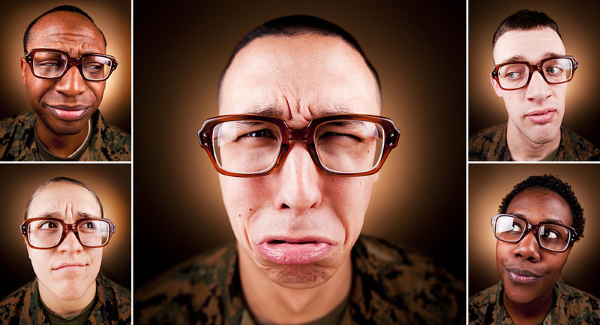
Birth Control Glasses, better known as BCGs, are the infamous black-rimmed, thick-lensed glasses the military issues to recruits who need vision correction.
They earned their nickname because of how unattractive they are.
The joke is that no one would ever want to get romantically involved with someone wearing them.
This 2026 guide explains the real history behind BCGs, why the military chose this design, whether they are still issued today, and the truth behind the long-running military meme.
Related Article – Vision Requirements For Each Military Branch
Table of Contents
What Are Birth Control Glasses?


Birth control glasses is a phrase that jokingly refers to standard-issue S9 eyeglasses frames.
These frames are issued to military recruits or personnel in need of corrective lenses for their vision.
They are part of the standard gear issued during Basic Training.
Traditionally, S9s have consisted of thick, brown plastic frames and large lenses so they would be less likely to break.
However, their look was considered so unattractive for the wearer that people began calling them “birth control glasses.”
This nickname implied that any chance of connection with the opposite sex while wearing these glasses was almost nonexistent.
The inception of BCGs took place during World War II when there was an unprecedented need for U.S. forces.
Poor eyesight was not an eliminating factor for those going into military service.
Unfortunately, many of these service members with less-than-optimal vision had their glasses broken and faced difficulty in purchasing new ones.
This prompted a directive to provide eyeglasses, repairs, and replacements to military personnel in need of them.
At that point, the U.S. Army decided to develop glasses for its soldiers.
Initially, the Army approached nine suppliers to meet the huge demand for eyeglasses.
However, the difficulty in maintaining that many contracts led to the selection of Bausch & Lomb as the company who would provide the quality and quantity of glasses needed by American troops.
These S9 regulation prescription glasses (also nicknamed “rut prevention glasses”) were standard issue until 2012.
At that point, the Department of Defense acknowledged that many service members were rejecting such GI eyewear once enlisted due to the uncomfortable feel and unattractive look of the frames and lenses.
This has led to expanded choices among military personnel for eyewear.
Related Article – Military Pilot Vision Requirements
Types Of “Birth Control Glasses”

Adequate vision has always been associated with military readiness and has historically been part of physical standards required for service.
However, it wasn’t until 1917 that the U.S. Army developed a program to assist soldiers in need of corrective eyewear.
At that time, the charge was just 10% over what the government was charged for frames and lenses.
This created the need for optical manufacturing units.
Within a year, the Army allowed glasses to be issued for free to enlisted personnel.
Unfortunately, the program for government-issued eyewear at no cost was eliminated in 1922.
Military physicians would still prescribe corrective lenses for those who needed them, but they were no longer issued free of charge.
Initially, military eyeglasses were made from metal, including silver and nickel.
After World War II, the U.S. Army changed to silver cellulose acetate for government-issued frames.
In 1968, the military began issuing black cellulose acetate frames which continued into the mid-1970s.
The S9 spectacles which became infamously known as birth control glasses were introduced in the mid-1970s.
These brown acetate frames remained standard government-issue eyewear until 2012.
Today, military personnel still have the option of wearing S9 eyeglasses with their sturdy brown frames.
In fact, these frames are called S9 Brown “BCG” and they are manufactured by Rochester Optical.
Though the BCG frames are no longer issued during Basic Training, some troops choose to adopt their look once they are enlisted.
This is perhaps for a “retro” or “vintage” look.
What Kinds Of Glasses Does The Military Issue Now?
The military is now offering a new design of eyewear with the hope that service members will retain and care for their glasses more consistently than they would for BCGs.
The new 5A standard-issue eyeglasses have replaced the S9 model.
The 5A frames have been tested for strength and comfort and are considered more stylish with their sleeker black frames.
This current basic issue eyewear is intended to resemble slimmer and lighter “civilian” glasses for a more contemporary look.
In addition, the goal is for service members to wear their new 5As more regularly for improved performance and training, even after boot camp.
Rochester Optical is the manufacturer of standard issue eyewear for the U.S. Armed Forces.
Called the R-5A, these eyeglass frames are made of durable plastic and are available in brown and black.
The frames are unisex, with a rectangular shape that allows for digital progressive lenses.
Compared to BCGs, the R-5As are considered stylish and comfortable as well as durable.
For active-duty service members, reservists, and National Guard members who meet the criteria, the military has approved ten frames that are more representative of current styles worn by civilians and sold in commercial markets.
These frames consist of a variety of materials and colors, including black and gray.
They are available through military providers under the Frame of Choice Spectacle Program.
What People Get Wrong About Birth Control Glasses (BCGs)
Many civilians and even some new recruits assume BCGs were intentionally designed to be ugly as a form of punishment or to reduce romantic distractions during training.
In reality the design was chosen purely for durability, low cost, and the ability to withstand the rough conditions of basic training and field exercises.
The “birth control” nickname came later as a humorous observation from the troops themselves.
Another widespread myth is that the military still forces every recruit who needs glasses to wear the classic black BCGs.
In 2026 most branches have moved away from the old style for active duty personnel and now allow more modern frames or even contact lenses in many cases.
The classic BCGs are mainly reserved for initial issue at basic training when recruits have no other options.
Some people believe the glasses are completely discontinued and no longer exist.
They are still manufactured and issued when necessary, though far fewer recruits end up with them than in previous decades because more arrive with contacts or their own approved frames.
Many assume that once you leave basic training you can immediately throw the BCGs away.
In reality you are usually required to keep them until you can get your own prescription glasses or contacts approved through the military health system.
A frequent error is thinking the nickname is offensive or banned.
The term “BCGs” is embraced across the military with self-deprecating humor.
You will still hear it used constantly in barracks, on ranges, and in memes.
Finally some veterans believe the glasses were uniquely ugly compared to civilian options.
The truth is they were modeled after standard safety glasses of the era.
They just looked especially bad when issued in mass quantities to tired, stressed recruits.
Understanding these realities helps people see BCGs for what they really are: a practical, budget-friendly solution that accidentally became one of the most enduring and hilarious pieces of military culture in 2026.
Conclusion
Though the unattractive frames of “birth control glasses” are no longer issued, recruits in Basic Training must still wear government-issued eyeglasses for vision correction during this time.
Contact lenses are not approved for wear at any point during Basic Training.
After graduation from Basic Training, military members can wear civilian glasses while in uniform if they meet regulation standards.
Of course, standardization of military dress and regulation appearance is prioritized by all branches of the U.S. military.
However, some concessions have been made across time.
The switch from S9 BCGs, for example, to 5A GI frames reflects the military’s progress in considering the personal comfort of troops in addition to their professional look.
To ensure compliance with regulations, recruits who become enlisted personnel have the option to continue wearing their GI eyewear.
If enlisted troops prefer alternative frames, they should have a clear understanding of the guidelines for approved eyewear determined by their military branch.
References / Resources
S9 BCG Military Frame with RX Lenses
See Also
What To Bring To Navy Boot Camp