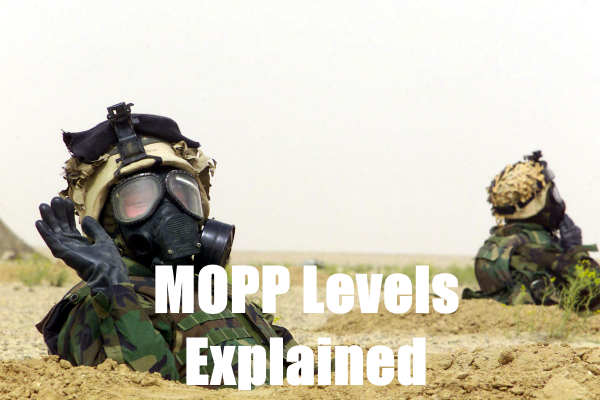
Mission Oriented Protective Posture (MOPP) levels are used by the U.S. Armed Forces to establish readiness and protection measures against nuclear, biological, and chemical threats.
MOPP levels define how and when protective equipment is worn or carried based on assessed risk.
These procedures are integrated into military training and operations to support personnel safety during hazardous conditions.
Understanding MOPP levels and associated gear is a required part of force protection preparedness.
Related Article – 5 Force Protection Levels (FPCON) Explained
Table of Contents
What is MOPP?

Mission Oriented Protective Posture (MOPP) keeps soldiers safe in the event of a chemical attack.
In general, recruits are introduced to MOPP gear early in basic training to prepare for such an attack.
Consequently, MOPP levels offer lifesaving procedures during a crisis or emergency.
Thus, MOPP levels are introduced to provide the proper gear in the event of a nuclear, chemical, or biological attack.
Modern warfare calls for the need to remain well protected against biological or chemical assaults.
Therefore, U.S. Armed Forces traditionally provide the following gear to keep military personnel safe from danger:
- Protective Mask (or Gas Mask)
- Mask Carrier
- Overgarments
- M9 Detector
- Protective Gloves
- Overboots
These protective measures are instituted to keep soldiers safe from nuclear, chemical, and bacteriological agents.
Once you receive your MOPP gear during basic training, it’s important to change the air filters on the gas mask periodically.
Moreover, military personnel should always decontaminate MOPP equipment after use.
In the past, MOPP over-garments were manufactured with layers of activated charcoal.
The charcoal is designed to provide a protective layer under the garment.
However, the current MOPP gear has replaced charcoal with lightweight carbon beads.
MOPP Levels


MOPP levels are designed to indicate the level of threat regarding a nuclear, biological, or chemical attack (NBC).
MOPP levels are part of longstanding military protective posture procedures.
As a result, MOPP levels traditionally correspond to a direct threat of an NBC attack.
MOPP levels may allude to the number of troops required to keep an area safe from an NBC threat. These MOPP levels range from 0-4.
The MOPP levels are determined based on current chemical or biological threats.
For this reason, MOPP levels may elevate in a very short period of time.
Therefore, military personnel are expected to maintain MOPP equipment and be prepared to use it if directed.
#1. MOPP Ready
MOPP Ready indicates that military personnel should remain prepared for potential escalation.
Therefore, active-duty troops are expected to carry a protective mask.
Moreover, troops should keep a set of protective gloves, a suit, and boots nearby.
It’s required in the event the MOPP levels rapidly increase from “Ready” to levels 0-4.
Military personnel are expected to have MOPP gear available within prescribed readiness timelines.
Furthermore, a second set of MOPP equipment is necessary within a 6-hour range.
#2. MOPP Level Zero
MOPP Zero represents “no threat at all” to a nuclear, biological, or chemical (NBC) attack.
As a result, it’s the basic awareness level for the potential of an NBC assault.
At this level, troops are expected to have MOPP gear within reach.
MOPP Level Zero enables military personnel to remain vigilant of an active threat while carrying on traditional operations.
Thus, MOPP equipment may be necessary to wear within a moment’s notice.
While the threat of a chemical attack remains unlikely it’s crucial to keep MOPP gear nearby.
These items include the protective gas mask, suit, gloves, and boots.
Additionally, military personnel are expected to remove contact lenses and other items that are not compatible with MOPP gear.
#3. MOPP 1
MOPP 1 is a status that requires swift action to remain safe against a nuclear, biological, or chemical threat.
Consequently, MOPP 1 requires the use of a protective over-garment.
Furthermore, military personnel are expected to carry the rest of the ensemble in the event of a disaster.
MOPP 1 indicates an attack may happen or that contamination has already occurred.
Nevertheless, MOPP 1 does not suggest a direct, imminent threat to military personnel.
#4. MOPP 2
MOPP 2, or “alarm yellow”, indicates a heightened security risk.
MOPP level 2 requires military personnel to wear the protective suit and boots.
Moreover, the other MOPP gear (gas mask, gloves) must be carried as they may be required without notice or a warning.
It’s important to note that MOPP 2 does not indicate that an NBC attack is imminent.
Rather, MOPP 2 notifies military personnel to have protective gear ready within a moment’s notice.
#5. MOPP 3
MOPP 3 is utilized in situations where there is a potential hazard from vapor or contact contamination.
Additionally, MOPP 3 can reflect other issues that pertain to the safety and health of military personnel.
MOPP 3 requires that soldiers wear all protective equipment aside from the gloves.
Notwithstanding, safety gloves are expected to be carried.
The MOPP level suggests that a nuclear, biological, or chemical threat is high.
#6. MOPP 4
MOPP 4 (of all the MOPP levels) is the only one to require a full covering of protective gear.
Therefore, military personnel are required to wear over-garment, gloves, mask, hood, and overboots.
MOPP 4 is enacted to keep a military base or personnel safe from harm or danger.
It’s anticipated that anyone wearing MOPP gear pass through a decontamination line.
The decontamination line is designed to get troops and gear to a safe spot while providing non-contaminated attire.
MOPP 4 represents a serious threat to the security and welfare of military personnel in the area.
In general, MOPP 4 is reserved for situations that involve an active or imminent NBC attack.
MOPP Levels & Gear


It’s important to familiarize yourself with Mission Oriented Protective Posture (MOPP) gear during basic training.
Basic training is your only opportunity to ask questions about the gear as well as make sure you are properly fitted.
There are horror stories of recruits being tested for MOPP equipment with tear gas only to reap the effects of the nasty gas.
As a result, military personnel are expected to have MOPP gear on hand in the event the level is elevated.
Furthermore, personnel should make sure that they know how to properly use the equipment in the event of a disaster.
During basic training, recruits are introduced to the following MOPP gear:
Protective Mask
A protective mask, or gas mask, filters harmful chemical and biological agents.
Moreover, the gas mask is designed to eradicate dangerous particles in the air before reaching the wearer.
Thus, the protective mask provides clean breathing even in an unhealthy environment.
However, the gas mask is only effective when fitted properly to eliminate any chance of harmful agents entering the protective barrier.
Regardless, a protective mask may not filter out lethal gases such as carbon monoxide.
Mask Carrier
The mask carrier is provided to service members to prevent the gas mask from being damaged.
Military personnel traditionally use the mask carrier as part of their battle gear for easy access.
The mask carrier includes a few accessories like a technical manual and chemical detection papers.
Additionally, the carrier may carry an extra filter or spare parts for the protective mask.
Lastly, the mask carrier should include a nerve agent antidote kit (NAAK).
Protective Suit
The over-garments for MOPP levels keep you safe from harmful biological or chemical agents.
In general, the protective suit is referred to as a Joint Service Lightweight Integrated Suit Technology (JSLIST).
The clothing is specifically designed to keep an individual safe from an NBC attack.
The protective suit is fitted to be worn over a traditional uniform.
As a result, the suit is designed to allow maximum airflow (for cooling purposes) while keeping chemical and biological agents free from the skin.
In the past, the U.S. Armed Forces utilized charcoal lining as a protective barrier.
However, more recent MOPP gear has replaced charcoal with lightweight carbon beads.
Often, military personnel attach M9 Detector Paper on the suit to identify chemical agents they may come into contact with on the battlefield.
M9 Detector
The M9 Detector allows military personnel to identify harmful agents they may come across in the field.
In general, soldiers attach M9 Detector Paper to an outfit.
Military personnel have a variety of places they may plant the M9 Detector on the body.
Nevertheless, most opt to place the M9 Detector Paper on the dominant arm and leg.
Further detection works by planting M9 Detector Paper on the opposite wrist and shin area.
Military personnel also generally plant M9 Detectors on the lower levels of vehicles for further detection.
Protective Gloves
Safety gloves are provided to military personnel for various MOPP levels.
In general, military personnel are expected to have protective gloves in possession or nearby.
The safety gloves are usually designed with highly durable rubber.
For this reason, they serve combat operations the best.
The protective gloves keep your skin protected from harmful agents.
Overboots
Overboots are the remaining piece of protective gear required for various MOPP levels.
The boots — like the gloves — are composed of a highly durable rubber.
The boots keep your feet and skin free from harmful biological or chemical agents.
What People Get Wrong About MOPP Levels
A common misconception is that MOPP levels only apply during active chemical attacks.
MOPP levels are also used during heightened threat conditions and precautionary periods when no attack has occurred.
Some believe that higher MOPP levels always indicate an imminent attack.
Elevated MOPP levels can be implemented based on intelligence assessments, environmental conditions, or command directives.
Another misunderstanding is that MOPP gear is only issued during deployments.
Service members are typically issued MOPP equipment during training and are required to maintain readiness regardless of assignment.
There is also confusion about uniformity across branches.
While MOPP principles are standardized, specific implementation may vary by service, unit, and operational environment.
Finally, some assume MOPP levels are static once declared.
MOPP levels can be raised or lowered quickly as threat assessments change.
Conclusion
The various MOPP levels keep military personnel free from danger and harm.
Nuclear, biological, and chemical hazards continue to be addressed in military preparedness planning.
For this reason, the U.S. Armed Forces designate MOPP gear to keep individuals protected.
Depending on the MOPP level, military personnel are expected to utilize MOPP equipment or have it nearby.
MOPP gear ranges from over-garments to gas mask, gloves, and boots.
You are expected to understand the various MOPP levels as well as respond with the appropriate attire.
Doing so can keep you safe and protected in the event of an NBC attack.