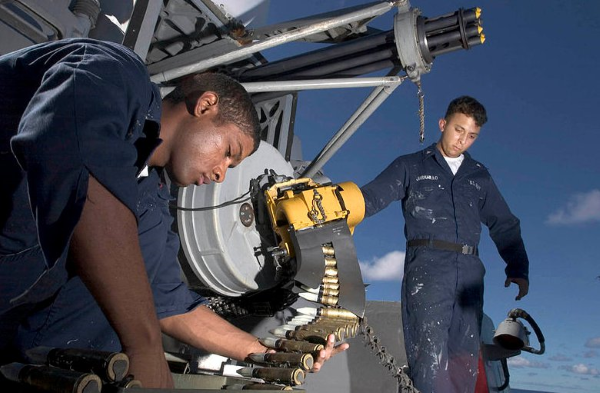
Fire Controlmen (FC) play a critical role in the Navy’s combat effectiveness by operating, maintaining, and repairing the sophisticated systems that detect, track, and engage targets with missiles, guns, and torpedoes.
They work on advanced radar, computer networks, weapon control consoles, and electronic equipment aboard surface ships, submarines, and at shore facilities.
The rating combines electronics troubleshooting, computer systems knowledge, mechanical aptitude, and real-time decision-making under high-pressure conditions.
Whether calibrating radar for air defense, aligning missile launchers, or diagnosing faults during live-fire exercises, FCs ensure weapons systems perform reliably when needed most.
This technical career demands precision, continuous learning on evolving technology, and the ability to collaborate in tight-knit teams.
In this updated guide for 2026, we detail the FC rating responsibilities, entry requirements, training pipeline, typical duties, current pay structure, advancement paths, and how these skills open doors to strong civilian opportunities in electronics, defense contracting, and systems engineering.
Related Article – Navy Master At Arms (MA): Career Details
Navy Fire Controlman Requirements and Qualifications
These are some of the mental and physical capabilities and other job requirements that it takes to become a Navy Fire Controlman:
Educational Requirements
- High School Diploma
- GED
ASVAB Requirements
- Minimum combined ASVAB Score of 222 on Arithmetic Reasoning, General Science, Math Knowledge and Electronics Information
Additional Qualifications
- Be between the ages of 17 and 34 unless in possession of a waiver
- Be a United States Citizen
- Must be able to speak clearly
- Must have at least average physical strength and have good manual dexterity
- Successful completion of 8 weeks of Navy Basic Recruit Training held at Great Lakes Naval Training Center which is located on the western shore of Lake Michigan, close to Chicago. (Not required of those with prior military experience or training)
- Completion of a current Single Scope Background Investigation (SSBI) that will allow an enlisted person to obtain a Secret or higher level security clearance
Training and Career Path to Become a Navy Fire Controlman
Here are the various stages of training required to be able to fulfill the position of a Fire Controlman in the US Navy.
Navy Technical Training Information
The Navy A school to become a Navy Fire Controlman takes place at Naval Station Great Lakes outside of Chicago, Illinois.
This technical school lasts approximately 20 weeks long.
On the Job Training
Further hands-on training will be required for any new recruit once they get to their first shipboard duty assignment or once they are assigned to a Navy base.
This on the job training will focus more closely on the specific fire control equipment that the recruit will be tasked with working, operating, and maintaining.
How Much Are US Navy Fire Controlman Paid?
US Navy Controlman’s pay is based on an enlisted member’s current rank and the amount of time they have spent in the military.
Most new US Navy Fire Controlman will start out at a pay grade between Seaman Recruit (E-1) and Seaman (E-3) unless they have prior military experience.
Here is the current paytable for Navy enlisted based on rank and time in service:
| Insignia | Pay Grade | Rank | Abbreviation | 2026 Minimum Monthly Pay (<2 Years) |
|---|---|---|---|---|
| N/A | E-1 | Seaman Recruit | SR | $2,407.20 (after 4 months; $2,225.70 for first 4 months) |
 | E-2 | Seaman Apprentice | SA | $2,697.90 |
 | E-3 | Seaman | SN | $2,836.80 |
 | E-4 | Petty Officer Third Class | PO3 | $3,142.20 |
 | E-5 | Petty Officer Second Class | PO2 | $3,342.90 |
 | E-6 | Petty Officer First Class | PO1 | $3,401.10 |
 | E-7 | Chief Petty Officer | CPO | $3,932.10 |
 | E-8 | Senior Chief Petty Officer | SCPO | $5,656.50 (starts at over 8 years) |
 | E-9 | Master Chief Petty Officer | MCPO | $6,910.20 (starts at over 10 years) |
 | E-9 | Fleet/Command Master Chief Petty Officer | FMCPO/CMCP | $6,910.20 (starts at over 10 years) |
 | E-9 | Master Chief Petty Officer of the Navy | MCPON | $6,910.20 (starts at over 10 years) |
Advancement through the Seamen ranks (E-1 to E-3) is done simply by time in grade and higher enlisted positions use (E-4 and above) a combination of testing, job knowledge, and time in grade for advancement through them.
Related Article – Navy Yeoman (YN): Career Details
Miscellaneous Pay, Allowances, and Incentives
Here are some supplemental forms of pay that navy enlisted members may be entitled to depending on their individual job situation:
- Housing allowance for those that live off base (BAH)
- Subsistence allowance (Food – BAS)
- Temporary duty pay
- Hazardous duty pay
- Sea duty pay (Separation pay)
- 100% paid healthcare
- Tuition reimbursement
What’s Life Like as a Navy Fire Controlman?
Grace under pressure and strict attention to detail are requirements for anyone that works as a Navy Fire Controlman.
You must also be physically fit and have good manual dexterity.
Teamwork and superior communication skills are also a must when someone is working as a Fire Controlman in the US Navy.
Some of the tasks that Navy Fire Controlman are asked to handle include:
- Perform maintenance and repairs on fire control related digital computer equipment, control subsystems, and main systems
- Operate and maintain surface-to-air missile systems, surface-to-surface missile systems, and gun control systems
- Repair and maintain micro/minicomputers on associated fire control peripheral equipment, data conversion units, data display equipment, and data link terminal equipment
- Test performance and maintain readiness on all assigned fire control systems and related support equipment
Since this is a mainly shipboard position, Navy Fire Controlman can expect vast opportunities to see the world that also require being away from home for extended periods of time.
So it’s not an ideal Navy career for those with wives and children.
Job Reviews
Here is what a few enlisted members who serve in the Navy as Fire Controlman had to say about their work on the website Glassdoor.com:


Here is a YouTube video that describes some of what it’s like to be a US Navy Fire Controlman.
What People Get Wrong About US Navy Fire Controlman (FC)
Many assume Fire Controlmen spend most of their time simply pushing buttons or monitoring screens like video game operators.
In practice, the job involves extensive hands-on maintenance, troubleshooting complex electronic and computer systems down to the component level, using test equipment, schematics, and technical manuals to repair or replace faulty parts in radar, fire control computers, weapon interfaces, and networks.
Another misconception is that FC is a low-stress, indoor-only rating with little physical demand.
While much work occurs in air-conditioned spaces, FCs frequently perform repairs in confined, noisy, or hot ship compartments, handle heavy equipment during installations, and deploy for extended periods where quick fixes under operational stress are common.
People often think entry requires advanced electronics experience or a college degree in engineering.
The Navy trains you from the ground up; requirements include ASVAB line scores (AR+MK+EI+GS=223 or VE+AR+MK+MC=223), normal color perception, Secret clearance eligibility, and meeting physical standards—no prior experience or degree needed.
Some believe training is short or basic compared to other technical ratings.
After boot camp, FCs complete “A” School (about 27-30 weeks at Great Lakes or other sites) covering electronics fundamentals, radar principles, computer systems, weapon control theory, and hands-on labs, followed by “C” Schools for specific systems like Aegis or missile launchers.
Finally, a common view is that civilian transitions are limited due to the specialized military focus.
Skills in radar/electronics repair, systems integration, troubleshooting high-tech equipment, and security clearance translate directly to high-paying roles in defense contractors, aerospace firms, telecommunications, power utilities, or federal agencies, often with certifications boosting advancement.
Understanding these aspects helps candidates approach the rating with realistic expectations for a challenging, high-impact technical career.
US Navy Fire Controlman Civilian Career Opportunities
There is some demand for Ex-Navy Fire Controlman to work in training and government contracting positions.
Many of these positions are located at naval bases working alongside those who are still members of the US Navy.
The electronic and computer component repair skills that an Ex-Navy Fire Controlman possesses can also be beneficial in a civilian career.
Related Article – Navy Musician (MU): Career Details
One has to keep in mind that a valid security clearance will also be a foot in the door for many job positions that Ex-Navy Fire Controlman have the skills to fill.
Here are some civilian employers that are known to hire Ex-Navy Fire Controlman
- General Dynamics – Dahlgren, VA
- ICI Services Corporation – Norfolk, VA
- BAE Systems, Inc. – Pascagoula, MS
- XLA – San Diego, CA
- Huntington Ingalls Industries – Newport News, VA
- ClearanceJobs – Virginia Beach, VA
References:
