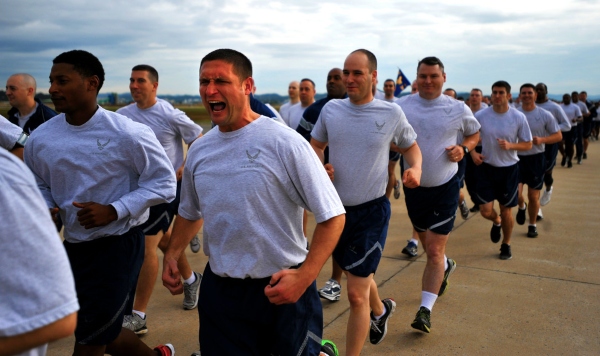
The Air Force Physical Fitness Assessment (PFA) underwent a major overhaul in 2026.
This guide covers the latest Air Force PT test standards effective for official scored testing starting July 1, 2026 (with diagnostic testing from March 1–June 30, 2026).
Whether you’re preparing to enlist, active duty, or simply want to stay fit for the mission, this page has everything: exact components, scoring, minimums by age/gender, WHtR details, preparation tips, and a full FAQ section.
Related Article – 30-Day Plan To Lose Weight For The Military
What Is the New Air Force PFA in 2026?


The Air Force now uses a four-component, 100-point system that better measures total fitness and long-term health.
Testing occurs twice per year (biannual), regardless of previous scores.
Point Distribution:
- Cardiorespiratory Fitness: 50 points
- Body Composition (Waist-to-Height Ratio): 20 points
- Muscular Strength (Push-ups or Hand-Release Push-ups): 15 points
- Muscular Core Endurance (Sit-ups, Reverse Crunches, or Plank): 15 points
Passing Requirements:
Composite score of ≥75 points AND meet the minimum component score in every event.
Scores are categorized as:
- Excellent: ≥90
- Satisfactory: 75–89.9
- Unsatisfactory: <75
Key Changes from Pre-2026 Standards
The 2026 overhaul of the Air Force Physical Fitness Assessment (PFA) represents one of the most significant updates to the service’s fitness program in over a decade.
These changes shift the focus from a narrow endurance-and-strength test to a more holistic assessment of combat readiness, long-term health, and injury prevention.
Here are the major differences between the old (pre-2026) standards and the current 2026 PFA:
1. Cardio Event: From 1.5-mile run to 2-mile run or HAMR flexibility
Old: Only the 1.5-mile timed run was allowed (no alternatives).
New: Primary option is now a 2-mile run, but you can choose the 20-meter High Aerobic Multi-shuttle Run (HAMR) for every test. No mandatory 2-mile run requirement remains.
Rationale: The 2-mile distance better measures sustained aerobic capacity relevant to operational demands; HAMR adds accessibility (indoor-friendly, less impact on joints) and allows full choice biannually.
2. Core Endurance: Sit-ups replaced with multiple flexible options
Old: Only timed sit-ups (1 or 2 minutes depending on cycle) were scored.
New: Three choices: 1-minute sit-ups, 2-minute cross-leg reverse crunches, or timed forearm plank hold.
Rationale: Planks and reverse crunches reduce lower-back strain risk and better assess functional core stability used in real-world tasks (lifting, carrying, rucking); Airmen can pick the option that suits their physiology or any minor injuries.
3. Muscular Strength: Push-ups gain a hand-release alternative
Old: Standard 1-minute push-ups only.
New: 1-minute traditional push-ups OR 2-minute hand-release push-ups (Note: chest must touch ground, hands lift off floor between reps).
Rationale: HRPU ensures full range of motion and reduces cheating; the extra time accommodates the stricter form while still testing upper-body strength effectively.
4. Body Composition Reintroduced as a Scored Component
Old: No scored body composition (abdominal circumference was advisory/waiver-related only in later years).
New: Waist-to-Height Ratio (WHtR) is now worth 20 points. It’s measured separately, up to 5 days before/after other events.
Rationale: WHtR is a stronger predictor of cardiometabolic health risk than BMI; re-adding it emphasizes long-term wellness and readiness over short-term test performance alone.
5. Testing Frequency: From annual to biannual
Old: One official test per year (with possible mid-year diagnostic in some units).
New: Official scored testing every six months, year-round.
Rationale: More frequent assessments encourage consistent fitness habits, allow earlier intervention for trends, and align with DoD-wide emphasis on sustained readiness.
6. Scoring System: Rebalanced 100-point composite with component minimums
Old: 100 points total, but heavy emphasis on run (60 points) and push-ups/sit-ups; no strict per-component minimums in later scoring.
New: Evenly weighted components (50 cardio / 20 WHtR / 15 strength / 15 core), with required minimums in each, no passing by averaging alone.
Rationale: Prevents “gaming” the test (e.g., maxing run but failing core); ensures balanced fitness across domains critical to mission performance.
7. Transition Period and Implementation Timeline
Old: Changes rolled out abruptly in past updates.
New: March 1–June 30, 2026 was diagnostic-only (no scores counted toward records); full official scoring began July 1, 2026.
Rationale: Gave Airmen time to adapt to new events/options, train appropriately, and reduce failure rates during the switchover.
These updates make the PFA more inclusive, scientifically grounded, and mission-relevant while giving service members greater choice in how they demonstrate fitness.
Overall, the 2026 changes aim to build a healthier, more resilient force capable of meeting future operational demands.
Related Article – Air Force Jobs List
Air Force PFA Components & Exercise Options
You choose the version that works best for you on test day.
(Except one 2-mile run per year may still apply in some cases, but latest guidance allows full choice of 2-mile or HAMR every six months.)
1. Cardiorespiratory (50 pts)
2-mile run OR 20-meter High Aerobic Multi-shuttle Run (HAMR).
2. Muscular Strength (15 pts)
1-minute push-ups OR 2-minute hand-release push-ups (HRPU – full chest to ground + hands off floor).
3. Core Endurance (15 pts)
1-minute sit-ups OR 2-minute cross-leg reverse crunches OR forearm plank (timed hold).
4. Body Composition (20 pts)
Waist-to-Height Ratio (WHtR) measured separately (up to 5 days before the rest of the test).
Formula: Waist (inches at navel) ÷ Height (inches).
2026 WHtR Standards (Body Composition Scoring)
| Risk Category | WHtR Range | Points |
|---|---|---|
| Low Risk (Excellent) | ≤ 0.49 | 20 |
| Moderate Risk | 0.50 – 0.59 | 19 – 12.5 (scaled) |
| High Risk | ≥ 0.60 | 10 – 0 |
Minimum to Maximum Performance Standards by Age & Gender (2026)
(These are thresholds for minimum passing points vs. maximum 15/50 points. Full point-by-point charts are in the official AFPC PDF.)
Cardio – 2-Mile Run (minimum time for passing points vs. max 50 pts)
Males
Under 25: 19:45 / ≤13:25
25–29: 19:45 / ≤13:55
30–34: 20:06 / ≤13:42
35–39: 20:44 / ≤13:42
40–44: 21:09 / ≤14:05
(and slower with age)
Females
Under 25: 22:30 / ≤15:30 (approx.)
25–29: 22:30 / ≤15:30
30–34: 23:30 / ≤15:50
(etc. – full details in official charts)
Push-ups (1 min) / Hand-Release Push-ups (2 min) – min to max for 15 pts
Males Under 25: 30 / ≥67 push-ups or 15 / ≥40 HRPU
Females Under 25: 15 / ≥47 push-ups or 6 / ≥31 HRPU
(Standards ease slightly with age; full age breakdowns available in the scoring PDF.)
Core Options – min to max for 15 pts
Males Under 25:
Sit-ups: 39 / ≥58 (1 min)
Reverse Crunches: 38 / ≥49 (2 min)
Plank: 1:25 / ≥3:35 (215 sec)
Females Under 25:
Sit-ups: 35 / ≥54
Reverse Crunches: 11 / ≥47
Plank: 1:25 / ≥3:30 (210 sec)
(Older age groups have lower minimums and max thresholds.)
Full Official Scoring Charts (PDF)
Download the latest 37-page scoring tables here: AFPC PT Charts New – 50-20-15-15 with 2-Mile (Sep 2025)
How to Prepare for the 2026 Air Force PT Test

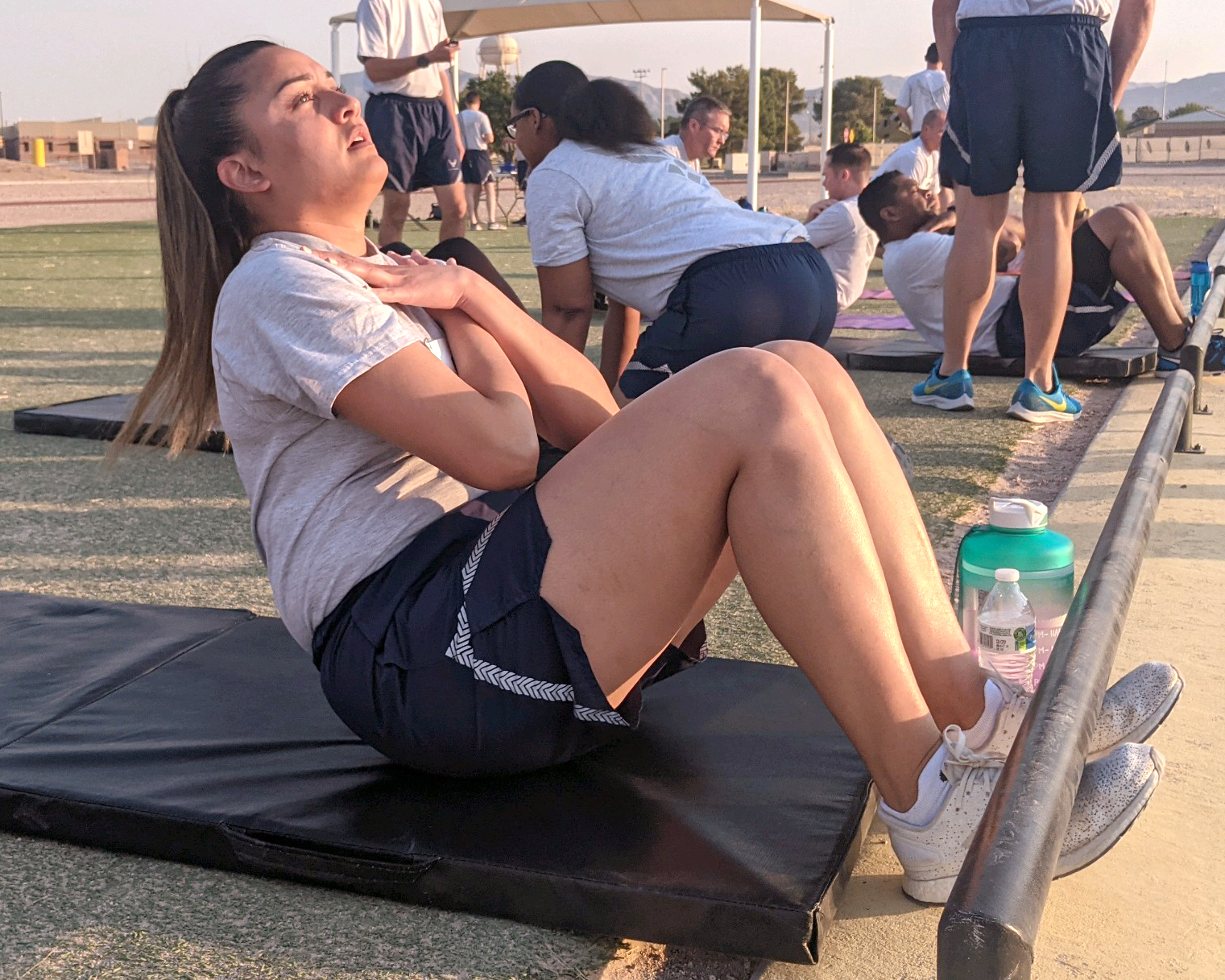
Train the test: Practice both run and HAMR, all core options, and perfect form.
Measure WHtR monthly — aim for ≤0.49.
Build a balanced program: cardio 3–4x/week, strength 3x/week, core daily.
Altitude adjustment: Add ~1 minute per mile above 5,000 ft.
Use the free USAF PT Calculator apps and official myFSS tools.
Frequently Asked Questions (FAQ) – Air Force PT Test 2026
Below are some of the most common questions we receive about the Air Force PT Test:
What is the overall passing score for the new 2026 Air Force Physical Fitness Assessment (PFA)?
You must achieve a composite score of at least 75 out of 100 points.
You also need to meet the minimum performance threshold in every individual component, no “averaging out” weak areas.
Scores are grouped as Excellent (≥90), Satisfactory (75–89.9), or Unsatisfactory (<75).
Can I choose the HAMR instead of the 2-mile run for every test, or is the run still required at least once a year?
Yes. You can now choose either the 2-mile run or the 20-meter High Aerobic Multi-shuttle Run (HAMR) for every PFA.
The previous requirement to complete the 2-mile run at least once per year was removed in the January 2026 update.
This gives full flexibility for both biannual tests.
How and when is the Waist-to-Height Ratio (WHtR) measured?
WHtR is measured by dividing your waist circumference (at the navel, in inches) by your height (in inches).
It can be done up to 5 days before or after the other PFA components, and there’s no need to do it the same day.
Aim for ≤0.49 for maximum points (low risk/excellent category); ≥0.60 scores lower and indicates higher risk.
Are the standards the same for males and females, or do they differ by gender and age?
Standards differ by gender and age group for push-ups, core exercises, and run/HAMR times to account for physiological differences.
WHtR categories are largely sex-neutral, though health risk interpretation may consider slight gender factors.
Full age/gender-specific point scales are in the official AFPC scoring charts PDF.
What happens if I get an unsatisfactory score on the PFA?
An unsatisfactory score (<75 composite or failing a component minimum) triggers an automatic fitness improvement program.
Your commander may get involved, and it can affect performance reports, promotions, assignments, or reenlistment eligibility.
Repeated failures may lead to administrative actions, so use the diagnostic period to train up.
Are there alternatives or exemptions if I have an injury or medical condition?
Yes. Medical profiles can authorize modified components (e.g., 2-km walk instead of run/HAMR, adjusted reps, or plank focus).
Submit documentation through your Unit Fitness Program Manager or medical provider for approval.
Temporary exemptions are common; permanent ones require higher-level review.
When does official scored testing actually begin under the new standards?
Official scored PFAs start July 1, 2026.
March 1 through June 30, 2026, is diagnostic only (no scores count toward records, but results help you prepare).
Fitness testing was paused briefly before March to support the transition.
How often will I have to take the PFA after July 2026?
Every six months (biannual), no matter your previous score.
Testing cycles typically run March–September and September–March, but exact windows depend on your unit schedule.
Does the new PFA apply to recruits, MEPS, or Basic Military Training (BMT)?
Yes. The updated standards align for all accessions in 2026, including enlistment screening at MEPS and BMT requirements.
Recruits should train to the new options (e.g., HAMR, plank) for best preparation.
Are altitude adjustments available for the run or HAMR?
Yes. Official scoring tables include time adjustments for bases above 5,000 feet elevation.
Your fitness monitor applies these automatically based on location.
Will my PFA score appear on my performance brief or affect promotions?
Yes. Under the new program, PFA results (including component breakdowns) are documented on performance briefs.
Promotion boards review them, so consistent satisfactory or excellent scores support career progression.
Can I still earn special recognition like “Excellent” or unit awards?
Absolutely. The new system recognizes Excellent scorers (≥90 composite) and may include updated tiered awards based on balanced performance across components.
Units often highlight top performers for morale and recognition.
Where can I get the most accurate, up-to-date scoring charts and calculators?
Download the official 37-page AFPC PT Charts PDF (released September 2025, with any 2026 tweaks): AFPC PT Charts – New 50-20-15-15 with 2-Mile.
Use myFSS tools or approved PT calculator apps for personalized estimates.
What if I have more questions about implementation in my unit?
Contact your Unit Fitness Program Manager (UFPM) or chain of command—they have the latest guidance from AFPC and AFMAN 36-2905.
Official resources like afpc.af.mil/Fitness or myFSS Knowledge Articles have detailed FAQs too.
Final Thoughts & Next Steps
The 2026 Air Force PT test is designed to build a fitter, healthier, more combat-ready force while giving you flexibility in how you demonstrate it.
Start training to the new standards today, especially the 2-mile run or HAMR, plank option, and getting your WHtR under 0.49.
Need personalized help? Contact your Unit Fitness Program Manager, use the official AFPC resources, or speak with an Air Force recruiter if you’re joining.
Bookmark this page and check back for any minor updates as the July 1 rollout approaches.