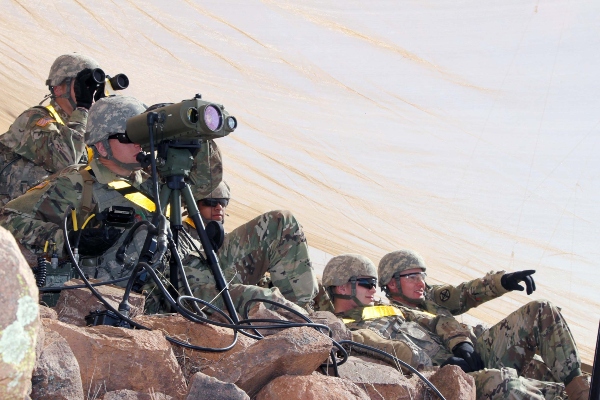
Army Joint Fire Support Specialists, designated as MOS 13F, serve as forward observers supporting Army fire support operations.
The role focuses on coordinating and communicating target information to artillery and other supporting elements during training and combat operations.
MOS 13F requires technical proficiency, attention to detail, and the ability to operate under demanding conditions.
This article outlines the qualifications, training, duties, pay structure, and career considerations associated with Army MOS 13F.
Related Article – List of Army Bases in the US
Education, Qualifications, Training, and Duty Stations

Army Joint Fire Support Specialists support the Army artillery team, which is out in the field during combat.
The forward observer specialist needs to use computers as well as manual calculations in order to determine target locations.
As a result, there is some education, qualifications, and training required.
Education
The U.S. Army will consider anyone with a high school diploma or GED for starters.
If you are interested in the Army, you should consult a nearby recruiting office.
Army recruiting offices are located all over the nation, and a rep can also contact you over the phone.
The recruiter will explain that the next step is to complete the Armed Services Vocational Aptitude Battery (ASVAB).
The series of tests are used to determine what military MOS listing is most appropriate for your skills.
If you are interested in MOS 13F, you need to have a score of at least 96 on Field Artillery (FA).
The other subtests you must complete on the ASVAB are Arithmetic Reasoning (AR), Mathematics Knowledge (MK), Coding Speed (CS), and Mechanical Comprehension (MC).
Your AFQT score on the ASVAB, a combination of your scores on Arithmetic Reasoning, Mathematical Knowledge, Word Knowledge, and Paragraph Comprehension, must be a minimum of 31 to join the Army.
Related Article – Army Fire Control Specialist (MOS 13j): Career Details
Qualifications
After completing the ASVAB and scoring 96 in Field Artillery (FA), it is time to meet other job requirements of an Army Joint Fire Support Specialist (MOS 13F).
There is a Secret security clearance required to become MOS 13F.
The process of gaining a Secret security clearance requires a very thorough investigation into your personal character and conduct.
Because of their duties acting as forward observers, Army Fire Support Specialists also must have good eyesight.
This includes having normal depth perception, no colorblindness, and distant visual acuity are all important.
It should be noted that the vision requirements allow you to use corrective lenses to qualify.
Though not mandatory, the Army mentions that MOS 13F should work well in a team, be physically fit, and be mentally prepared to work under high pressure, along with the ability to multi-task.
An interest in cannon and rocket operations is an added bonus, but not completely necessary.
Training
All new Army recruits begin with boot camp, which is officially called Basic Combat Training (BCT).
Basic Combat Training lasts for 10 weeks before progressing to Advanced Individual Training (AIT).
AIT for Army Joint Fire Support Specialists (MOS 13F) takes place at Fort Sill in Oklahoma and lasts for 11 weeks.
Like all other Advanced Individual Training in the Army, learning is a combination of in-classroom and on-the-field training.
You will learn how to operate guns, missiles, and rocket systems.
There is also training for artillery tactics, techniques, and procedures.
A huge duty of an Army Joint Fire Support Specialist is to compute target locations, which you will also receive training on at Fort Sill.
Related Article – US Army Grooming Standards
Duty Stations
Those serving in the Army in MOS 13F can expect to be potentially based at one of the following duty stations:
Inside the Continental US (CONUS)
- Fort Bliss, TX
- Fort Campbell, KY
- Fort Carson, CO
- Fort Cavazos, TX
- Fort Drum, NY
- Fort Hunter Liggett, CA
- Fort Johnson, LA
- Fort Leonard Wood, MO
- Fort Liberty, NC
- Fort Moore, GA
- Fort Riley, KS
- Fort Sill, OK
- Fort Stewart, GA
- Joint Base Lewis-McChord, WA
Outside the Continental US (OCONUS)
- Fort Wainwright, AK
- Joint Base Elmendorf-Richardson, AK
- USAG Ansbach, Germany
- USAG Bavaria, Germany
- USAG Hawaii
- USAG Humphreys, South Korea
- USAG Yongsan-Casey, South Korea
What does an Army Fire Support Specialist Do?

Joint Fire Support Specialists are a member of the field artillery team in the U.S. Army.
As a result, they deal with high-powered weapons like rockets and missiles that support ground infantry and tank units during combat.
Intelligence Gathering
While MOS 13F personnel work closely with fire support assets, their primary responsibility is observing and communicating target data to supporting units.
The most important form of intelligence is locating targets and processing artillery units and brigade maneuvers to act accordingly.
As a result, MOS 13F will establish a communications system, which they can operate during battle.
There is also the need to use intelligence to encode and decode messages.
Related Article – Army Field Artillery Firefinder Radar Operators (MOS 13R): Career Details
Enemy Targets
Army Joint Fire Support Specialists use observation equipment and approved targeting tools to determine target locations through forward observation.
The objective is to determine target location using computers or manual calculations, aspects you will be trained on during AIT.
Soldiers in MOS 13F will also provide backup in combat situations where they may need to request or adjust field artillery, mortar, or naval gunfire.
Additionally, soldiers are sometimes called upon for suppressive and screening fire.
Clerical Work
Though it may not sound as exciting as action in the field, Army Joint Fire Support Specialists spend a good deal of time doing clerical duties.
These tasks may not seem urgent or interesting yet are critical to the overall welfare of the U.S. Army.
Consequently, a specialist will spend time preparing fire support situation plans and maps, building status charts, capability overlays, and target lists.
Additionally, Army Joint Fire Support Specialists may spend time training subordinates during downtime.
There is also a need to maintain vehicles, generators, and artillery during downtime.
Related Article – Army HIMAR Crewmember (MOS 13M): Career Details
What does an Army Fire Support Specialist make?

The U.S. Army does not determine pay based on your Military Occupation Specialty (MOS).
Instead, pay is factored based on 1) Army rank, and 2) years of service.
Here is a general idea of what you might expect to earn based on Army rank:
| Insignia | Pay Grade | Rank | Abbreviation | Minimum Monthly Pay |
|---|---|---|---|---|
| E-1 (less than 4 months) | Private | PVT | $2,226 | |
| E-1 (after 4 months) | Private | PVT | $2,407 | |
 | E-2 | Private Second Class | PV2 | $2,698 |
 | E-3 | Private First Class | PFC | $2,837 |
 | E-4 | Specialist or Corporal | SPC | $3,142 |
 | E-5 | Sergeant | SGT | $3,342 |
 | E-6 | Staff Sergeant | SSG | $3,401 |
 | E-7 | Sergeant First Class | SFC | $3,932 |
 | E-8 | Master Sergeant | MSG | $5,657 |
 | E-8 | First Sergeant | 1SG | $5,657 |
 | E-9 | Sergeant Major | SGM | $6,910 |
 | E-9 | Command Sergeant Major | CSM | $6,910 |
 | E-9 | Sergeant Major of the Army | SMA | $6,910 |
Benefits
Even though some complain that the U.S. Military does not pay great, the number of benefits is excellent:
- Medical Insurance
- Retirement
- Vacation Time (PTO)
- Special Pay
- Education: Army members can earn full tuition, merit-based scholarships, allowances for books and fees, plus an annual stipend for living expenses.
- Housing: Allowances for living expenses, utilities, and maintenance.
- Food: Allowance for the on-base dining hall and access to tax-free department and grocery stores
Job Reviews
The job reviews on Indeed.com and GlassDoor.com are largely positive related to Army Joint Fire Support Specialist (MOS 13F).

Another poster summarized it very well:

Related Article – Army APFT Test Standards For Males and Females
Civilian Job Opportunities
There is no direct civilian career equivalent of an Army Joint Fire Support Specialist (MOS 13F).
However, many of the leadership skills and team-building exercises you complete in the military serve well in any chosen career path.
What People Get Wrong About Army Joint Fire Support Specialist (MOS 13F)
A common misconception is that Joint Fire Support Specialists primarily operate artillery weapons themselves. In reality, the role focuses on observation, communication, and coordination rather than firing systems directly.
Another misunderstanding is that MOS 13F involves constant combat engagement. While the position can involve deployment to combat environments, a significant portion of the job includes planning, calculations, and communication tasks.
Some people assume the role is purely technical and does not require physical endurance. In practice, Joint Fire Support Specialists must meet the same physical demands as other combat-support roles.
There is also confusion that MOS 13F is limited to artillery units. In reality, Joint Fire Support Specialists may work alongside infantry, armor, and joint forces depending on mission requirements.
Summary
Army Joint Fire Support Specialists (MOS 13F) are critical to on-the-field combat operations.
The most important duty of MOS 13F forward observers is to gather intelligence and locate enemy targets.
Resources:
- https://www.goarmy.com/careers-and-jobs/browse-career-and-job-categories/combat/fire-support-specialist.html
- https://www.indeed.com/cmp/U.S.-Army/reviews?fjobtitle=Support+Specialist&fcountry=ALL
