
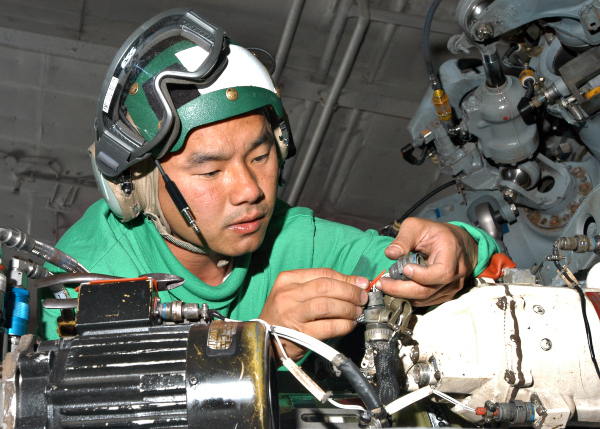
Aviation Electrician’s Mates (AE) keep Navy and Marine Corps aircraft flying safely by maintaining and repairing critical electrical and electronic systems.
They troubleshoot, test, adjust, and repair components like generators, alternators, batteries, wiring harnesses, lighting, ignition systems, instruments, navigation equipment, and avionics on fixed-wing and rotary-wing platforms.
AEs work in hangars, on flight decks, or at expeditionary sites, often in high-noise, confined spaces, using multimeters, oscilloscopes, schematics, and technical manuals to diagnose faults and ensure systems meet operational standards.
The rating demands strong electrical knowledge, mechanical aptitude, attention to safety (especially around live circuits and aircraft fuel), and the ability to perform under tight maintenance schedules.
Whether supporting carrier-based fighters, helicopters, or maritime patrol aircraft, AEs directly impact mission success and aircrew safety.
In this updated guide for 2026, we cover entry requirements, the training pipeline, typical duties, current pay structure, advancement opportunities, and how AE experience leads to excellent civilian careers in aviation maintenance, electrical systems, and aerospace.
Education, Qualifications, and Training


It takes some time and hard work to join the U.S. Navy.
Every sailor in the Navy has a military job or Navy rating.
Serving the Navy as an Aviation Electrician’s Mate (AE) is a fulfilling purpose but you’ll need to meet the necessary education requirements and training before qualifying for AE.
Related Article – Navy Electricians Mate (EM): Career Details
Education
The United States Navy has educational requirements you need to meet before enlistment.
Sailors are required to have a high school diploma or GED equivalent.
Furthermore, all new sailors must complete the Armed Services Vocational Aptitude Battery (ASVAB).
Recruits that are interested in Aviation Electrician’s Mate (AE), have two options on the ASVAB:
- Receive a combined ASVAB test score of 222 on Arithmetic (AR), Electronics Information (EI), General Science (GS), and Mathematics Knowledge (MK).
- Or receive a combined ASVAB test score of 222 on Arithmetic (AR), Mathematics Knowledge (MK), Mechanical Comprehension (MC), and Verbal Expression (VE).
Qualifications
In addition to requirements for the Armed Services Vocational Aptitude Battery (ASVAB), there are other qualifications of AE.
Sailors that want to serve the Navy as an Aviation Electrician’s Mate (AE) must receive secret security clearance.
The security clearance is granted through the U.S. Department of Defense and involves a fairly thorough background check.
The background check examines your personal character, finances, and criminal record.
Furthermore, the Department of Defense may contact references as well as examine any history of alcohol or drug abuse.
Navy Aviation Electrician’s Mates are also required to have correctable vision to 20/20 with normal color perception (no colorblindness).
While not a direct requirement you also need to feel comfortable about spending lengthy amounts of time away from home and family.
The work conditions are often remote at sea or land, and much of the work performed is outdoors in different weather.
Training
After qualifying for Aviation Electrician’s Mate (AE) through the ASVAB and other requirements it is time to begin training.
All new recruits of the U.S. Navy, regardless of rating, start at Navy Boot Camp.
Boot camp takes place at Navy Recruit Training Command in Illinois and lasts eight weeks.
If you survive boot camp than you transition to training related to your Navy rating.*
Aviation Electrician’s Mates (AE) attend A School at the Naval Aviation Technical Training Center (Pensacola, Florida).
Some Navy AE may receive alternate training at the Naval Aviation Station in Jacksonville, Florida.
Secondary “C” School Training for Aviation Electrician’s Mates takes place around the nation.
The most popular location for “C” School Training for AE is in Oceana, Virginia and Lemoore, California.
*It is important to note that the Navy rating is not guaranteed for new recruits.
Recruits training for AE are considered “volunteers” and therefore technically enlist in the Navy as “Aviation Sailors (AV)”.
What this means is Aviation Sailors can technically get assigned as Aviation Electronics Technicians (AT) instead of Aviation Electrician’s Mates (AE) following graduation.
What does a Navy Aviation Electrician’s Mate (AE) Do?


Aviation Electrician’s Mates (AE) are the designated electricians of the Navy.
As a result, Navy Aviation Electrician’s Mates handle a wide variety of electrical and navigational components of aircraft.
The sailors are also trained on related computer systems and other types of state-of-the-art equipment.
It is not uncommon for an Aviation Electrician’s Mate (AE) to volunteer or receive an assignment as part of the aircrew.
The in-flight duties of an AE may include operating the radar systems or weapons systems.
Aviation Electrician’s Mates may participate in missions using turbojets, propeller aircraft, or helicopters.
Job Duties of Aviation Electrician’s Mates (AE)
The official job description for Navy Rating Aviation Electrician’s Mate (AE) is as follows:
- Maintain electrical and instrument systems, including power generation, conversion, and distribution.
- Inspect and maintain aircraft batteries and electrical components.
- Maintain interior and exterior lighting on the aircraft.
- Handle electrical control of aircraft systems, including hydraulics, landing gear, utilities, and power plant engines.
- Supervision of automatic flight control and stabilization systems.
- Detailing aircraft compass systems, altitude reference systems, and inertial navigational systems.
It is worthwhile to mention that several credentials are available to Navy Aviation Electrician’s Mates shortly after completing Class “A” Technical School.
The credentials may lead to promotional opportunities within the ranks of Aviation Electrician’s Mates, or to another Navy rating.
Related Article – Navy Personnel Specialist (PS): Career Details
What does a Navy Aviation Electrician’s Mate (AE) make?

,_replaces_wiring_on_a_P-3C_Orion_engine.jpg)
The United States Navy compensates sailors based on military rank and years of service.
Therefore, your Navy rating (in this case Aviation Electrician’s Mate) is not applicable to your base salary.
Here is a general idea as to what you can expect to earn in the Navy based on military rank:
| Insignia | Pay Grade | Rank | Abbreviation | 2026 Minimum Monthly Pay (<2 Years) |
|---|---|---|---|---|
| N/A | E-1 | Seaman Recruit | SR | $2,407.20 (after 4 months; $2,225.70 for first 4 months) |
 | E-2 | Seaman Apprentice | SA | $2,697.90 |
 | E-3 | Seaman | SN | $2,836.80 |
 | E-4 | Petty Officer Third Class | PO3 | $3,142.20 |
 | E-5 | Petty Officer Second Class | PO2 | $3,342.90 |
 | E-6 | Petty Officer First Class | PO1 | $3,401.10 |
 | E-7 | Chief Petty Officer | CPO | $3,932.10 |
 | E-8 | Senior Chief Petty Officer | SCPO | $5,656.50 (starts at over 8 years) |
 | E-9 | Master Chief Petty Officer | MCPO | $6,910.20 (starts at over 10 years) |
 | E-9 | Fleet/Command Master Chief Petty Officer | FMCPO/CMCP | $6,910.20 (starts at over 10 years) |
 | E-9 | Master Chief Petty Officer of the Navy | MCPON | $6,910.20 (starts at over 10 years) |
Benefits
The U.S. Navy has several benefits included with a monthly salary:
- Medical Insurance
- Affordable Life Insurance
- Retirement
- Vacation Time
- Special Pay
- Education: Sailors can earn full-tuition, merit-based scholarships, allowances for books and fees, plus an annual stipend for living expenses.
- Housing: Allowances for living expenses, utilities, and maintenance.
- Food: Allowance for the on-base dining hall and access to tax-free department and grocery stores.
Job Reviews
You can read a variety of job reviews about Navy Aviation Electrician’s Mate (AE) on job sites like Indeed.com:

The common theme is Navy AE work is demanding with long hours and plenty of responsibilities.
However, for most sailors, the pros greatly outweigh the cons.

One huge advantage of the U.S. Navy is that sailors commonly travel more compared to soldiers in other military branches.
It takes plenty of teamwork to survive in the U.S. Navy, particularly serving as an Aviation Electrician’s Mate (AE).

Related Article – Navy Aircrew Survival Equipmentman (PR): Career Details
Civilian Job Opportunities
The work you perform as an Aviation Electrician’s Mate (AE) is pretty specific to the military.
However, the experience and discipline you receive can translate well to a variety of careers in aviation.
Navy AE are trained electricians so it is common for ex-military to work in a related field, even if the aircraft or settings are different.
What People Get Wrong About US Navy Aviation Electrician’s Mate (AE)
Many assume AE is mostly swapping batteries or changing light bulbs with basic electrical work.
In practice, AEs handle complex avionics systems, troubleshoot integrated flight controls, autopilot, radar altimeters, environmental systems, and power distribution networks, often requiring component-level repairs, soldering, and use of advanced diagnostic equipment on modern aircraft.
Another misconception is that the job is low-physical-demand hangar-only work.
AEs frequently work on flight decks during launch/recovery cycles, in hot or cold conditions, climb into tight aircraft compartments, lift heavy components, and deploy to forward operating bases or carriers where rapid turnaround repairs are critical under operational pressure.
People often think entry requires prior aviation or electrical experience or a college degree.
The Navy provides complete training; requirements include ASVAB line scores (AR+MK+EI+GS=222 or VE+AR+MK+MC=222), normal color perception, Secret clearance eligibility, and meeting physical standards—no prior experience or degree needed.
Some believe training is short or generic without aircraft-specific focus.
After boot camp, AEs complete “A” School (about 20-24 weeks at NAS Pensacola) covering electrical fundamentals, avionics theory, wiring, instruments, and systems, followed by “C” School or fleet replacement squadron training for specific aircraft types like F/A-18, MH-60, P-8, or E-6.
Finally, a common view is that civilian transitions are limited to entry-level mechanic jobs.
AE skills in aircraft electrical systems, troubleshooting avionics, FAA-equivalent inspections, and security clearance transfer to high-paying roles with airlines, defense contractors (Boeing, Lockheed Martin), FAA-certified repair stations, or power utilities, often starting at $60,000+ with A&P certification pathways or vendor-specific training boosting salary and advancement.
Understanding these realities helps candidates prepare for a technically challenging, high-impact career essential to naval aviation readiness.
Summary
A Navy Aviation Electrician’s Mate (AE) has several responsibilities on aircraft.
Aviation Electrician’s Mates supervise, maintain, and repair electrical and instrument systems related to the aircraft.
Navy AE are skilled at resolving power generation, conversion, and distribution issues.
An Navy Aviation Electrician’s Mate (AE) may also volunteer as a member of the aircrew, handling radar or weapons systems.
Resources:
- https://www.cool.navy.mil/usn/enlisted/ae.htm
- https://www.indeed.com/cmp/U.S.-Navy/reviews?fjobtitle=Electrician
