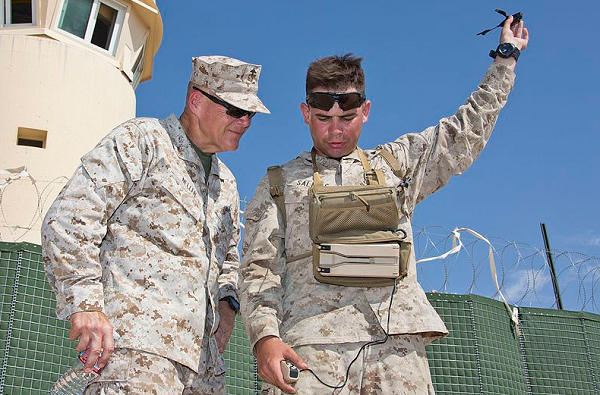
Marine Corps Unmanned Aircraft System Operators (MOS 7314) support aviation and ground operations by remotely piloting and managing unmanned aircraft systems.
This role involves planning, coordinating, and executing UAS missions in support of Marine Air-Ground Task Force operations.
MOS 7314 requires specialized training, technical proficiency, and adherence to aviation and medical standards.
The sections below outline qualifications, training, job duties, pay structure, and civilian career considerations for Marine Corps UAS Operators.
Related Article – Marine Corps MOS List: Details on all 125 USMC Jobs
Qualifications and Training
ASVAB score requirements for MOS 7314 are determined by current Marine Corps enlistment standards.
Interested recruits will also require a Secret security clearance, as well as normal color vision.
Recruits must be 17-28 years old, have a high school diploma, be a U.S. citizen, and meet the height, weight, and body fat requirements.
MOS 7314 requires passing an aviation-related flight physical in accordance with applicable Navy and Marine Corps medical standards.
Recruits will attend the Marine Corps Recruit Depot Parris Island or Marine Corps Recruit Depot San Diego.
The coursework consists of completing the Unmanned Aircraft Systems Operator Common Core Course using one of the following paths:
RQ-21: Complete the UAS RQ-21 Aerial Vehicle Operator course at MCAS Cherry Point, NC.
MQ-9: Complete formal training at the USAF Remotely Piloted Aircraft Course Basic Sensor Operator School at Randolph AFB, TX, and the USAF MQ-9 Enlisted Course Initial Qualification Training (IQT) at Holloman AFB, NM.
Related Article –Army Unmanned Aerial Vehicle (UAV) Operator (MOS 15W)
What does a Marine UAS Operator do?

Unmanned Aircraft have been around since World War I, and advances in technology have led to their use in major combat and contingency operations today.
UASs are usually recovered and reused after each mission.
Unmanned aircraft consist of rotary-wing, fixed-wing, or lighter-than-air vehicles and can be controlled by line-of-sight or beyond-line-of-sight communications.
Each unmanned aircraft has different payloads that change the performance options of the aircraft.
Payloads are the sensors, relays, and weapons (lethal and non-lethal) that can be on the aircraft.
The UAS Operator is involved with mission planning, payload control, and communication procedures.
They are located at the ground control station (GCS).
Ground control stations can be anything from a laptop computer to a van or fixed facility.
UAS Operators control the launch, navigation, and recovery of the aircraft.
They will operate payloads using optical sensors including electro-optical, laser marking, laser targeting, and infrared.
Operators conduct call-for-fire to construct indirect fire missions and deliver both direct and indirect fires.
The UAS Operators are part of the aircrew and will remotely pilot the vehicle.
They execute remote video terminal operations.
UAS Operators use laser marking and targeting systems.
Operators will also prepare mission reports.
They are required to use techniques and procedures in the performance of terminal guidance operations.
UAS Operators are divided into groups based on the UAS assets they cover:
- Groups 1 and 2-Unmanned Aerial Vehicles less than 55 pounds and fly below 3,500 feet
- Group 3- Unmanned Aerial Vehicles up to 1,320 and fly up to 18,000 feet.
- Group 4- Unmanned Aerial Vehicles more than 1,320 pounds and above 18,000 feet.
- Group 5-Heavier and higher Unmanned Aerial Vehicles than Group 4 with the ability to stay in the air longer with higher payloads.
UAS Operators aim to enhance intelligence, surveillance, and reconnaissance (ISR) capabilities.
What does a Marine UAS Operator get paid?
UAS Operators are paid based on rank and time of service.
Marine Corps pay is based on rank, time in service, and current military pay tables.
Base pay does not include benefits or other additional pay options.
The table below provides an outline for Marine Corps pay based on rank.
| Insignia | Pay Grade | Rank | Abbreviation | 2026 Minimum Monthly Pay |
|---|---|---|---|---|
| E-1 +4 months | Private | PVT | $2,226 | |
| E-1 (after 4 months) | Private | PVT | $2,407 | |
 | E-2 | Private First Class | PFC | $2,698 |
 | E-3 | Lance Corporal | LCpl | $2,837 |
 | E-4 | Corporal | Cpl | $3,142 |
 | E-5 | Sergeant | Sgt | $3,343 |
 | E-6 | Staff Sergeant | SSgt | $3,401 |
 | E-7 | Gunnery Sergeant | GySgt | $3,932 |
 | E-8 | Master Sergeant | MSgt | $5,657 |
 | E-8 | First Sergeant | 1stSgt | $5,657 |
 | E-9 | Master Gunnery Sergeant | MGySgt | $6,910 |
 | E-9 | Sergeant Major | SgtMaj | $6,910 |
 | E-9 | Sergeant Major Of The Marine Corps | SgtMaj | $6,910 |
Benefits
Military benefits are generally noted as one of the positive attributes when looking at reviews.
The Marine Corps provides enlisted Marines with free housing, including utilities and maintenance. Meals and a clothing allowance are also included.
The Corps also provides both housing and subsistence allowances for marines authorized to live off base.
It also provides opportunities such as tuition assistance programs that allow most individuals to attend college for little to nothing out of pocket.
Other benefits include medical, dental, sick time, vacation, retirement, and low-cost life insurance.
Related Article –Marine Air Traffic Controller (MOS 7257): Career Details
Job Reviews
Most reviews rate the position 4/5 stars.
This MOS allows individuals to work with technology that is constantly advancing.
Working with new technology requires additional training, but also learning new, valuable skills.
This position can be challenging mentally but can be very interesting as well.
A review from a UAV Operator (UAS) can be found below.

Civilian Career Opportunities
Working as a UAS Operator provides skills in drone and avionics technology.
Related civilian careers include Aerospace Engineering and Operations Technicians, Aviation Analysts, Flight Engineers, and Electro-Mechanical Technicians.
Potential positions with the Department of Homeland Security are available using the skills learned in this MOS.
Marines can also take advantage of USMAP, which provides apprenticeship opportunities towards additional civilian careers.
What People Get Wrong About Marine Corps UAS Operator (MOS 7314)
One common misconception is that MOS 7314 involves only flying unmanned aircraft.
In practice, UAS Operators are responsible for mission planning, system coordination, payload operation, reporting, and communication procedures in addition to piloting.
Another misunderstanding is that the role functions independently from other units.
UAS Operators work as part of an aircrew and integrate closely with aviation, intelligence, and ground elements to support assigned missions.
Some people assume that unmanned aircraft operations do not require aviation medical standards.
MOS 7314 requires specific flight physical qualifications and ongoing medical evaluations similar to other aviation-related roles.
There is also confusion about the term UAS versus UAV.
Unmanned Aircraft Systems refer to the entire system, including the aircraft, ground control stations, communications links, and payloads, not just the air vehicle itself.
Finally, the position is sometimes viewed as limited to one platform.
Training and assignments may vary based on aircraft type, mission requirements, and evolving operational needs.
Summary

A Marine Corps UAS Operator (MOS 7314) conducts unmanned aircraft system missions in support of MAGTF.
As part of Occupational Field 73, Navigators and Unmanned Aircraft System Officers/Operators, operators are considered aircrew members and remotely pilot vehicles.
Marines in this MOS must have a Secret security clearance and meet all physical/medical evaluation requirements.
Available reviews of this MOS rate it positively.
Civilian careers related to the skills learned can be found in avionics and technology.
Related Article –Marine Aviation Operations Specialist (MOS 7041): Career Details
References
