Cryptologic Technician Technical (CTT) is a highly specialized Navy rating focused on collecting, analyzing, and exploiting electronic intelligence from radar and other signals sources.
CTTs operate advanced sensors and systems aboard ships, submarines, aircraft, and shore sites to detect threats, provide tactical guidance, support anti-ship missile defense, and contribute to indications and warning for fleet commanders and national agencies.
They track radar emissions, perform technical analysis, jam enemy signals when needed, and produce classified reports that feed into national intelligence databases.
The role demands strong technical aptitude, attention to classified material handling, quick decision-making, and the ability to work in secure environments under pressure.
With Top Secret/SCI clearance required, CTTs play a vital behind-the-scenes role in maritime and joint operations.
In this updated guide for 2026, we cover entry requirements, the training pipeline, typical duties, current pay structure, advancement paths, and how CTT experience leads to excellent civilian opportunities in intelligence, cybersecurity, and signals analysis.
Navy CTT Requirements and Qualifications

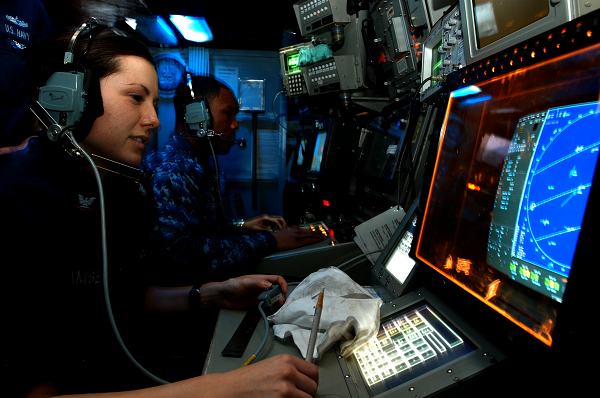
_Seaman_Jennifer_Pastor_stands_watch_at_the_Surface_Electronics_Emission_Console_(SLQ-32)_in_the_combat_information_center_aboard_the_amphibious_command_ship_USS_Blue.jpg)
A high school diploma or its equivalent is necessary to enlist in the Navy.
For those who desire a career as a CTT, it is required to be a United States citizen and meet the requirements for a Top Secret/Sensitive Compartmented Information security clearance.
Also, Cryptologic Technicians use a tremendous amount of advanced technology, so an interest in the field is essential.
Furthermore, an aptitude for math, highly detailed work, as well as good speaking, listening, and writing skills, are helpful.
The ASVAB score requirements are a total score of 162 between verbal expression, mathematical knowledge, and general science with a four-year enlistment.
For a six-year enlistment, the necessary score is 223 between arithmetic reasoning, mathematics knowledge, electronics information, and general science.
Training and Career Path
After boot camp, Navy CTT formal training is called Class “A” Technical, and this training takes place in Pensacola, Florida.
This 12-week course covers many subjects, including:
- Radar systems
- Analog and digital collection devises
- Radar analysis equipment
- Systems of reporting
- Intelligence analysis
- Data processing
- Computer
- Security
- Principles of radio-wave modulation
The training is done as a group and with direct instruction using computer simulation and live events.
After Class “A,” Class “C” Technical School, also in Pensacola, is seven to 10 weeks long.
With a combination of one-on-one and group instructions, graduates dive into submarines, ships, and airborne collection devices.
Furthermore, graduates study how to use radar analysis equipment.
Also, there are opportunities for advancement based on performance in this career.
Often, these advancements lead to training and credential in other occupations, which is a valuable experience.
Related Article – Is Navy Boot Camp Hard?
Navy CTT Job Details


Other than the collection and analysis of signals and intelligence on land and at sea, a Navy CTT performs other duties.
A CTT will know details of emerging and existing threats against the Navy.
Also, the CTT will track targets of interest and help determine tactics in the event of an attack and provide on-going tactical support.
If you go into this career, you will also perform technical analysis of radar signals and use this information to brief others and write technical reports.
Furthermore, the data and analysis gathered are highly classified and helps build national databases used by several different agencies.
Working Conditions for a Navy CTT
The duties of a Navy CTT are performed worldwide. There are operational facilities that need technicians in the United States, Japan, Hawaii, Australia, and Great Britain, just to name a few.
Also, A Navy CTT might find themselves on ships, submarines, or aircraft.
Navy CTTs are frequently attached to Navy special warfare units, as well.
Furthermore, technicians might work on a team or independently either in an office, lab, or other secure space.
Sea/Shore Rotation
The sea/shore rotation for a Navy CTT is 36/36.
Therefore, what this rotation means is you would spend 36 months at sea, followed by 36 months onshore.
With that said, the first sea rotation is for 42 months due to the length of the initial training.
Related Article – List Of Navy Bases In The US
Pay and Benefits
The benefits enjoyed by a Navy CTT is the same as all enlisted members.
Benefits include a competitive wage and access to very low-cost medical care for service members and their families.
Also, the Navy offers the benefit of life insurance.
One of the most popular benefits the navy offers is training and education opportunities.
Because of these opportunities, service members can earn degrees and professional credentials that carry into the civilian world.
The Navy bases pay on rank and length of service.
| Insignia | Pay Grade | Rank | Abbreviation | 2026 Minimum Monthly Pay (<2 Years) |
|---|---|---|---|---|
| N/A | E-1 | Seaman Recruit | SR | $2,407.20 (after 4 months; $2,225.70 for first 4 months) |
 | E-2 | Seaman Apprentice | SA | $2,697.90 |
 | E-3 | Seaman | SN | $2,836.80 |
 | E-4 | Petty Officer Third Class | PO3 | $3,142.20 |
 | E-5 | Petty Officer Second Class | PO2 | $3,342.90 |
 | E-6 | Petty Officer First Class | PO1 | $3,401.10 |
 | E-7 | Chief Petty Officer | CPO | $3,932.10 |
 | E-8 | Senior Chief Petty Officer | SCPO | $5,656.50 (starts at over 8 years) |
 | E-9 | Master Chief Petty Officer | MCPO | $6,910.20 (starts at over 10 years) |
 | E-9 | Fleet/Command Master Chief Petty Officer | FMCPO/CMCP | $6,910.20 (starts at over 10 years) |
 | E-9 | Master Chief Petty Officer of the Navy | MCPON | $6,910.20 (starts at over 10 years) |
Related Article: Navy Enlisted And Officer Ranks And Pay
Job Reviews
There are a wide variety of reviews for this position on both Indeed.com and Glassdoor.com.
However, negative reviews tend to revolve around the stress of deployment and sea duty.


Civilian Career Opportunities
When you are planning for your career in the Navy, it makes sense to consider what you can do with your Navy training in the civilian world.
Fortunately, as a Navy CTT, there are plenty of civilian jobs to consider.
Also, many of the jobs pay very well.
The following are three higher-paying jobs, although the lower-paying jobs in this field still pay $56,000 or more.
Because of this pay potential, the Navy CTT is worth considering.
Computer and Information Systems Managers
Computer and Information Systems Managers plan and coordinate data processes, information systems, and programming as a part of their job description.
Also, this field expects to grow by 11 percent over the next eight years.
Typically, those in this career have a bachelor’s degree and at least five years of experience.
Lastly, typical wages for this career are 142,530.00.
Database Administrators
A database administrator implements and tests computer databases and security systems that protect computers.
This field expects growth of nine percent over the next eight years, which is a bright future for job prospects.
Ideally, those looking for a job in this field will have a bachelor’s degree in the area.
Currently, the typical wages for this field are $90,070.
Network and Computer Systems Administrator
As an administrator in this filed, your responsibilities might include installing and supporting the local area network for an organization. Also, you might monitor the network and perform support and maintenance.
The job prospects show growth of five percent in this field.
Also, those who apply should have at least a bachelor’s degree in a related field.
Currently, the pay for this type of position is $82,050.
What People Get Wrong About US Navy Cryptologic Technician Technical (CTT)
Many assume CTT is mostly passive monitoring or sitting in front of computers with little hands-on work.
In reality, CTTs actively operate and maintain electronic sensors, radar collection equipment, jamming systems, and analysis tools; they perform real-time signal exploitation, tactical reporting during operations, and equipment troubleshooting in dynamic shipboard or deployed settings.
Another misconception is that the job avoids high-risk or classified intensity.
CTTs handle highly sensitive intelligence daily, require Top Secret/SCI clearance from the start, and support critical missions like missile defense, special warfare guidance, and threat tracking, often in high-tempo environments where accuracy directly impacts fleet safety.
People often think entry needs prior intelligence experience or an advanced degree.
The Navy provides full training; requirements include ASVAB composites (AR+MK+EI+GS=223 or equivalent for six-year enlistment; lower for four-year in some cases), U.S. citizenship, Top Secret/SCI eligibility, normal color perception, and meeting physical/security standards—no prior experience or college required.
Some believe training is short or basic compared to other CT ratings.
After boot camp, CTTs complete a preparatory school (about 5 weeks), “A” School (around 8-12 weeks in Pensacola, FL) covering radar principles, signal analysis, and systems, followed by “C/D” School (7-20 weeks total additional) for platform-specific skills on ships, subs, or airborne systems.
Finally, a common view is that civilian transitions are limited due to classification.
CTT skills in signals intelligence, electronic warfare, data analysis, and clearance transfer directly to high-paying roles in defense contractors (Raytheon, Lockheed), intelligence agencies, cybersecurity firms, or federal signals roles, often starting strong with certifications and experience.
Understanding these realities helps candidates prepare for a demanding, rewarding career in naval intelligence and electronic support.
Conclusion
Cryptologic Technician – Technical (CTT) has an important position in the Navy.
There are some basic qualifications to be in this filed.
However, many of these requirements are the same for all service members.
CTTs need a high-security clearance and must show an aptitude for the work itself in testing.
Training consists of boot camp, and Class A and Class C technical training before starting to work int his field.
The working conditions for a Navy CTT are clean.
Often, work is done in an office either on a ship or at land.
A Navy CTT might also be on a submarine or attached to a special warfare unit.
The pay and benefits are the same as other service embers as the Navy bases pay on rank and time in service.
Job reviews reveal CTTs enjoy a supportive work environment and personal and professional growth.
Furthermore, several civilian job opportunities show this field in the Navy is promising when it comes to long-term career planning.
References:
https://www.cool.navy.mil/usn/index.htm
