
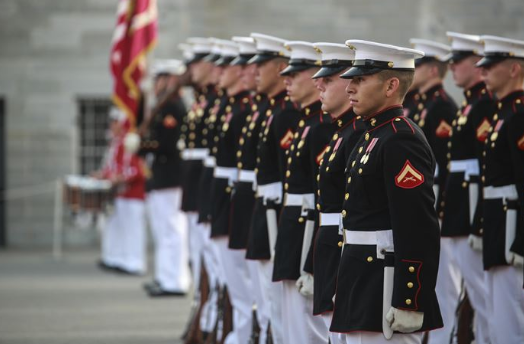
Many aspiring service members want to know the clear path to becoming a United States Marine in 2026.
The Marine Corps remains the smallest branch with a focus on expeditionary operations amphibious warfare and elite standards.
Joining involves meeting strict eligibility criteria passing tests and completing rigorous training whether enlisting or pursuing an officer commission.
Enlisted Marines serve in hands-on roles with contracts typically starting at four years while officers lead with a bachelor’s degree requirement.
Key steps include contacting a recruiter completing documentation taking the ASVAB undergoing MEPS processing and succeeding in boot camp or officer training.
Requirements cover age citizenship education physical fitness moral character and aptitude scores with possible waivers for certain conditions.
Benefits include education opportunities travel health care leadership development and lifelong camaraderie.
This updated guide covers the current process requirements and tips for success in 2026.
Related Article: 13 Pros And Cons Of Joining The Marines
Joining the Marines as Enlisted
Meeting with A Recruiter

A recruiter is responsible for ensuring an applicant is qualified and that they are aware of the long-term commitment they are about to make.
All questions should be directed toward a recruiter, as they will either have the answer or know the appropriate person who would know it, ranging from qualifications to benefits and pay.
Arrangements to meet with a recruiter can be made using an online locator to find an office nearest you or if the distance is an issue maybe a phone call may be more convenient.
Alternatively, most of the recruiting process can be completed online. During a typical meeting, a recruiter will guide you through the various career options available, education opportunities, and possibly even cash bonuses.
Think of recruiters as gatekeepers into the Marine Corps. The more prepared you are to complete the application, the faster the process will go.
Required Documentation
When preparing to meet with a recruiter to fill out an application, it is important to bring the necessary documents with you as this will help speed up the process.
Here is a list of paperwork you may need:
- Birth Certificate
- Social Security card
- Driver’s License
- Passport
- Marriage License or Divorce Papers (if applicable)
- High School diploma
- College transcripts (Official, not copies)
- Contact information for people known for up to 10 years ago
- Full name/Address/Phone number
- Green card (if applicable)
- Copies of Medical Records for any significant injuries/surgeries/illnesses
As the military does medical screenings, it is critical to file appropriate paperwork for any major surgeries or illnesses you have had as they may require medical waivers.
A list of disqualifying ailments can be inquired through your recruiter, see a brief list of them here.
Every individual applicant has a different background, so it will also be helpful to call ahead to see if other documentation not listed here should be brought in.
Related Article: 41 Questions To Ask A Military Recruiter
Academic / Physical Fitness Evaluations
During the recruiting process, you will become acquainted with the Military Entrance Processing Station (MEPS).

MEPS is where you go to take the Armed Forces Vocational Aptitude Battery, otherwise known as the ASVAB, undergo a physical examination, and list your preferred Military Occupational Specialty (MOS).
Going to MEPS is an entire process of steps, starting the night before after you take the ASVAB.
The ASVAB is a test required for the application process which evaluates a potential member’s aptitude.
It consists of ten short subtests covering the following topics: General Science, Arithmetic Reasoning, Word Knowledge, Mathematics Knowledge, Paragraph Comprehension, Electronics Information, Auto and Shop Information, Mechanical Comprehension, and Assembling Objects.
Practice tests can be found online to take in preparation for the real deal.
The maximum score is 99 and the minimum score to enlist into the Marine Corps is 32. Based on the overall score and line scores, the ASVAB determines what enlisted careers you are eligible for.
After completion of the ASVAB, you are shuttled to a hotel along with other recruits.
You will be given a meal ticket to have a small dinner, be given a security briefing, and rest before waking up early to be shuttled to MEPS to start the process.
The physical examination and job classification will take a majority of the day, so plan on being there a while.
And be sure to wear your khakis, button-up shirt, and dress shoes, as required, or you will be turned away to be processed another day.
Once the process is complete, you’ll be sworn in to make it official and then go back home to prepare for the next step—boot camp!
Related Article: 10 Best Marine Corps Jobs For Civilian Life
Marine Career Opportunities
The U.S. Marines has numerous options in career fields and specialties to choose from.
See a full list of Marine Corps MOS’ here.
Depending on your ASVAB score you can choose what job best suits you. Every MOS has different ASVAB requirements.
Availability upon recruitment may range however, as different MOSs may not be open until the next cycle.
Recruiters communicate with Detailers; whose goal is to place members in open billets.
Here are a few types of MOSs the Marine Corps has to offer:
- 01 Personnel & Administration
- 02 Intelligence
- 03 Infantry
- 05 Marine Air-Ground Task Force (MAGTF)
- 17 Cyberspace Operations
- 18 Tank and Assault Amphibious Vehicle (AAV)
- 26 Signals Intelligence/Ground Electronic Warfare
- 27 Linguist
- 28 Ground Electronics Maintenance
- 35 Motor Transport
- 43 Public Affairs
- 57 Chemical, Biological, Radiological, and Nuclear (CBRN) Defense
- 63/64 Avionics
A full list of enlisted career fields and specialties is available at the Recruiting Office.
And as of 2016, women are eligible to enlist in all Military Occupational Specialties.
Related Article: Marine Corps Ranks And Pay
Marine Corps Boot Camp
Marine Corps Recruit Depot (MCRD) is located at Parris Island, SC and San Diego, CA.

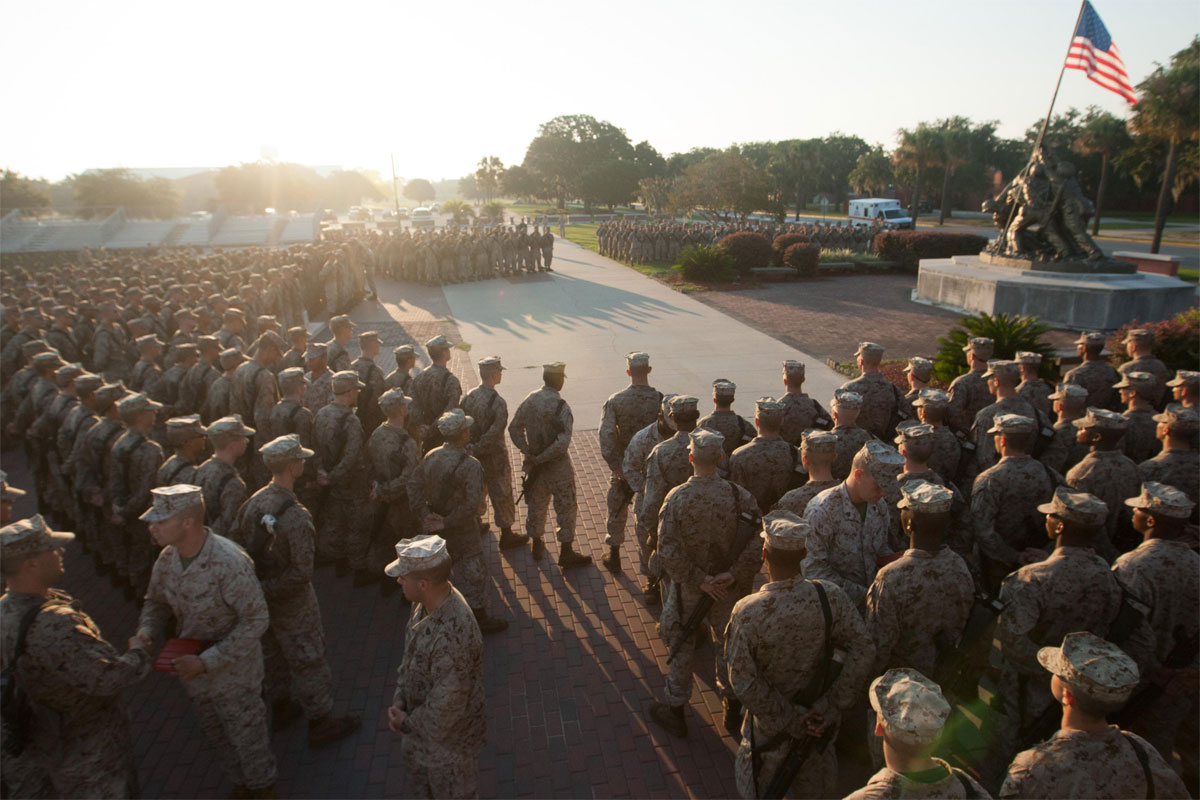
MCRD is where recruits complete their basic training. The program is 12 weeks long, divided into four phases, and is deemed physically, morally, and mentally demanding.
First Phase
In the first phase (Weeks 1-4), the first week is known as “Recruit Receiving” where they spend their first few days getting haircuts, gear issued, medical and dental screenings, as well as the Initial Strength Test (IST).
The IST is basically a shortened version of the USMC Physically Fitness Test (PFT). Men need to complete a minimum of 2 pull ups, 44 sit ups (within 2 minutes), and run a 1.5 mile in 13 and a half minutes or less.
Women must complete a flexed arm hang (maintaining elbow flexion) of at least 12 seconds, 44 sit ups (within 2 minutes) and run a mile under 10 and a half minutes.
Second Phase
Second phase (Weeks 5-7) recruits learn to handle a rifle and master their marksmanship skills. General Alfred M. Gray, 29th Commandant of the Marine Corps, is famous for his quote “Every Marine is, first and foremost, a rifleman. All other conditions are secondary.” Regardless of your chosen MOS, every Marine is known to be combat-ready.
Third Phase
The third phase (Weeks 8-10) recruits begin their basic warrior training to prepare for combat survival and land navigation.
In addition to combat training, recruits must go through the Crucible—a 54-hour event which includes sleep and food deprivation and a 45-mile march.
Upon successful completion, recruits receive their Eagle, Globe and Anchors.
Final Phase
Final phase (Weeks 11-12) new Marines complete their final tasks before graduation and earn 10 days of leave prior to reporting to Camp Lejeune in North Carolina for further combat training and appointed MOS specialty school.
Joining the Marines as an Officer
Difference Between Officer and Enlisted
Enlisted members account for a large part of the Corps and rank from Private to Sergeant Major, whereas Officers command groups of Marines and rank from Second Lieutenant to four-star General.
To put things plainly, junior enlisted members would be your cashiers, stockmen, and general maintenance of a grocery store; your supervisors would be your staff non-commissioned officers (NCOs) and your Officers would round out the general management roles.
Commissioned Officers oversee and direct operations and command units but rely on enlisted members’ technical abilities to ensure the job is completed.
Related Article – US Naval Academy Summer Seminar: A Day In The Life Of A Camper
How to Become an Officer
A commissioned officer is a member who holds high authority over enlisted members in the military.
To become a Marine Officer, you must meet with an Officer Selection Officer (OSO). An OSO answers questions, helps you determine and prepare for the officer program best suited for you.
For the Marine Corps, commissioning begins at the rank of Second Lieutenant.
There are many ways to receive commissioning into the Corps, through Platoon Leaders Course (PLC), Officer Candidate School (OCS), Naval Reserve Officers Training Corps (NROTC) Program, United States Naval Academy (USNA), The Citadel and various enlisted-to-officer programs.
Platoon Leaders Course is designed for freshmen, sophomores, or juniors attending college who want to participate in summer training sessions and upon completion become commissioned.
All expenses are paid for by the Marine Corps, you get paid during the sessions, and may be eligible for financial assistance.
Academic credit may also be granted by select colleges for PLC participation.
Officer Candidate School, located in Quantico, Virginia, is a training regimen that screens potential Marine Officers and provides candidates with the right resources to demonstrate characteristics of a USMC leader.
The NROTC program educates and trains qualified civilians to prepare for service as commissioned officers in the Marine Corps Reserve.
Students who attend the USNA can become Marine Corps Officers. With this option, students attend the academy, graduate with their degree and become commissioned—in that order.
The Citadel is the military college of South Carolina. It is where SC Corps Cadets and Active Duty Marine students go to complete their degrees for the Marine Corps Enlisted Commissioning Education Program.
Qualified enlisted members may apply for the following enlisted-to-officer programs: Enlisted Commissioning Program (ECP), Marine Corps Enlisted Commissioning Education Program (MECEP), Enlisted to Warrant Officer Program (WO), and the Limited Duty Officer Program (LDO).
The ECP allows both active duty and reserve Marines the opportunity to become an officer after earning a four-year degree either before joining or during active duty.
With successful completion of the program, the Marine is commissioned to second lieutenant.
MECEP is a program created to provide exceptional Marines an opportunity to become an officer by receiving a bachelor’s degree upon completion.
The LDO program is sought after by enlisted members with highly oriented technical skills in their MOS that perform greater than normally expected of a Warrant Officer.
Potential LDO applicants must possess strong managerial qualities.
And finally, the WO program is geared towards technical specialists who have extensive knowledge in their field.
This last route is usually followed by Marines without a college degree but want to become an officer.
Related Article – How to Join the US Military as a Non-Citizen
Warrant Officers and Non-Commissioned Officers
Warrant Officers (WOs) are previous active duty enlisted technical specialists in their MOS that rank above the highest enlisted rank and rank below a commissioned officer.
Non-Commissioned Officers (NCOs) are higher-ranking enlisted members who demonstrate outstanding leadership abilities. Pay grades E-4 (Corporal) and E-5 (Sergeant) are considered NCOs, while E-6 and above are referred to as Staff Non-Commissioned Officers.
What People Get Wrong About Joining the US Marine Corps
Many believe joining the Marines is similar to other branches with easier entry or less demanding training.
In truth the Corps maintains some of the highest standards including physical mental and moral requirements that emphasize elite readiness.
People often assume the minimum ASVAB score is low not realizing enlisted applicants need at least 31 overall with GED holders requiring 50 or higher.
Others think age limits are flexible overlooking the strict 17 to 28 range for enlistment with parental consent at 17 and rare waivers beyond that.
Families sometimes believe all recruits face mandatory combat roles ignoring diverse MOS options from infantry to cyber intelligence logistics and aviation support.
Another misconception is that boot camp lasts only a few weeks when it spans 12 intense weeks with phases building rifleman skills warrior training and the Crucible event.
Some view officer paths as easy alternatives not understanding they require a bachelor’s degree competitive selection through OCS PLC NROTC or USNA and leadership screening.
People frequently think enlistment guarantees a specific job overlooking that MOS assignments depend on ASVAB scores availability and needs of the Corps.
Others assume physical standards remain unchanged overlooking recent 2026 updates like sex-neutral scoring for combat arms PFT with a 210 minimum and waist-to-height ratio for body composition.
Many overlook the Delayed Entry Program which allows high school completion or other preparations before shipping to training.
Clearing these points helps candidates prepare realistically approach recruiters confidently and commit to the challenges of becoming a Marine in 2026.
Conclusion
The Marine Corps is the smallest branch of the U.S. military that conducts expeditionary and amphibious operations.
Once maritime ship guardians of the U.S. Navy, the Marine Corps has become the main and most recognized fighting force of the U.S. Armed Forces.
There are many perks of joining the Marines as either Enlisted or an Officer. Some advantages of joining the Marine Corps include but are not limited to free education, high level of financial support, travel, affordable health care, and the everlasting bond created with your fellow Marines.
Whether you decide to join as an Active Duty member or Reservist, the experiences and knowledge that you gain can provide you with a lifetime of pride and sense of accomplishment.
As the USMC motto goes, “Semper Fidelis,” meaning always faithful.
Related Article – Marine Corps Grooming Standards: Hair, Beard, And Nail Regulations
Resources:
