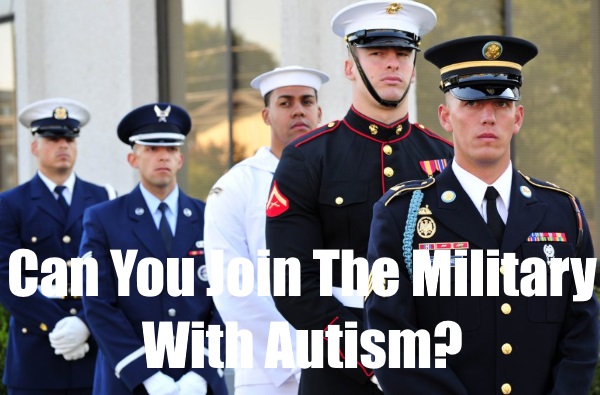
Joining the U.S. military today involves a structured and closely regulated screening process, with medical eligibility playing a central role.
Over time, enlistment standards have evolved, and conditions that once received little scrutiny are now evaluated carefully during recruitment.
This article focuses specifically on autism and how it may affect eligibility for military service, outlining how policies vary by diagnosis, symptom severity, and branch of service based on publicly available guidance.
Related Article – Top 15 Military Schools For Boys And Girls
Jump To A Section
What People Get Wrong About Joining the Military With Autism
A common misconception is that an autism diagnosis automatically disqualifies someone from military service, regardless of severity or individual functioning.
In reality, eligibility decisions are typically based on how the condition affects daily functioning, communication, and performance, rather than the diagnosis label alone.
Another misunderstanding is that policies are uniform across all branches, when each service evaluates autism-related cases independently and applies its own waiver standards.
It is also often assumed that waiver approvals are routine, when in practice they are discretionary, case-specific, and influenced by current personnel needs and medical evaluations.
What Is Autism?

First, you need to understand the type of autism that you have, as it will determine your eligibility to join the military.
Autism is a condition that impairs the ability to interact and communicate with others. The disorder is characterized by rigid and repetitive patterns or behaviors that affect social interaction and language or communication skills.
Typically, there are three types of autism, including autistic disorder, Asperger’s syndrome (high functioning), and pervasive developmental disorder. (Source)
The diagnosis of autistic and pervasive developmental disorders normally occurs during childhood, while that of Asperger’s syndrome occurs when one is in their teens or adulthood.
Out of these three autism spectrum disorders, people with Asperger syndrome or high-functioning autism are more likely to get enlistment.
Related Article: Can You Join The Military With That? 20 Potential Medical Disqualifiers
Increased chance of enlistment with high-functioning autism is due to the fact that those falling in that category do not have obvious symptoms and display a higher level of cognitive ability than other people with autism do.
Nevertheless, you will still need to disclose your condition to the recruiter or medical examiner and apply for an Asperger’s military waiver.
In addition, different branches of the military have specific requirements for applicants with autism. Here is a breakdown of what you need to know before submitting your application.
Can You Join the Army if you have Autism?

#/media/File:U.S._Army_Rangers,_assigned_to_2nd_Battalion,_75th_Ranger_Regiment,_prepare_for_extraction_on_Fort_Hunter_Liggett,_California,_Jan._30,_2014.jpg)
If you have autism, getting into the Army is much easier than enlisting with other branches of the military.
The Army is always under intense pressure to recruit to meet the demand for personnel in various bases around the world. For this reason, it is not surprising that you may join this branch of the military even if you have autism.
Apparently, the Army is somewhat lenient when it comes to handling applicants who have various medical conditions.
Moreover, autism is not necessarily a disqualifier for applicants joining the Army as compared to other disorders.
However, your chances of enlistment will depend on the spectrum of the disorder.
If you have PDD or autistic disorder, the chances of joining the armed forces are extremely limited, considering the fact that these particular spectrums might affect your work.
Nonetheless, things are a little bit different for people with Asperger’s Syndrome since the condition is mild with no significant symptoms.
In addition, Army recruiters are often looking for bright, industrious recruits, and applicants with Asperger’s often prove to fit the bill with a high IQ.
Even so, you might still need to apply for a military autism waiver.
The good news is that the probability of receiving a waiver is much higher in the army than any other branch of the military.
Can You Join the Navy if you have Autism?

The Navy is another branch of the military that has moderate policies as far as accepting those on the autistic spectrum is concerned.
In order to join the Navy with autism, you first need to visit a specialist to determine the scope of the condition. The medical examiner will be able to discern whether your condition can affect your productivity at work or not.
Consulting a specialist before going through the recruitment process is important in view of the fact that various autism spectrums are disqualifying factors in the Navy.
Much like the Army, people with Asperger’s syndrome have the upper hand when it comes to joining the Navy.
As is the norm with most recruitment processes, all potential recruits must undergo testing at the Military Entrance Processing Station (aka MEPS).
Here, you have to disclose to the recruiter your condition and submit relevant documents to prove that you meet high mental, moral, and medical standards despite your condition.
However, your diagnosis might first go through re-evaluation to determine your eligibility.
In addition, the re-evaluation report must indicate sufficient proof that your condition does not affect or interfere with your daily functioning.
You may also need to apply for a waiver, which might be determined on a case-by-case basis if the recruiter realizes that you have something to offer the nation.
Can You Join the Air Force if you have Autism?

Joining the Air Force might be a little bit tougher for applicants who have autism. The main reason behind this is that the Air Force requires higher entry test scores than most of the other branches.
In addition, you must have excellent social and communication skills to join the Air Force. The cold truth is that these skills are often rare in people with autism.
Nevertheless, the Air Force may allow you in if you can prove that you have outlived the condition over the years and that autism is not a hindrance in your daily life.
In addition, you must not be under any medications for at least one year before submitting your application.
However, that is not all… the Air Force may only enlist you if you have a special skill set that is urgently required.
It will also depend on whether they need more personnel or not. If the former is true, then you are likely to get a waiver if your condition does not display significant symptoms that may hamper operations.
Can You Join the Marines if you have Autism?


The United States Marine Corps is one of the most selective branches of the military as far as recruitment is concerned.
In addition, the fact that the Marines are the second smallest branch of the military branch after the Coast Guard further makes it harder for aspiring recruits to join.
Therefore, you might face an uphill task trying to join the Marines if you have autism or any other medical condition.
What is more discouraging is that waivers are hard to come by in the Marines.
This is because recruiters in the Marines normally regard applying for waivers as a professional risk, especially if it involves handling a case of autism or any other medical disorder.
For this reason, they might not process or approve your request unless there is a shortfall that the Corps is trying to overcome. In the unlikely event that you get a waiver, you may have to serve in a special reserve unit rather than active unit.
Can You Join the Coast Guard if you have Autism?
It’s not surprising that the recruitment process for Coast Guard officers is extremely competitive and selective, given it’s the smallest military branch.
You have to go through a rigorous assessment process before your application can even be considered in the first place.
The process gets even harder if you have a developmental disorder like autism.
However, like any other branch of the military, your eligibility to join the Coast Gguard depends on the severity of the condition.
Apparently, if your autism is mild, then you can successfully apply for a waiver.
Nonetheless, a medical clearance is required to gain a chance of obtaining a waiver request.
Final Thoughts
Autism is a life-long condition that does not have a cure.
However, this does not necessarily disqualify you from serving in the military. It all depends on the range of the disorder.
If you can cope well in neurotypical environments without displaying significant evidence of autistic symptoms, then you can easily join any military branch of your choice.
Historically, some individuals may have entered military service without a disclosed autism diagnosis, though current enlistment processes rely on thorough medical screening and disclosure requirements.
Applicants are required to disclose relevant medical information during enlistment, and failure to do so may result in administrative or disciplinary action if discovered later.
If a disqualifying medical condition is later discovered without an approved waiver, a service member may face separation for fraudulent enlistment under applicable military regulations.
In any case, autism is very hard to diagnose, meaning that the military medical examiners will also have a hard time testing for the condition.
Nevertheless, the biggest question you should ask yourself is whether you are ready to handle the rigors the military requires with your condition.
Military life is hectic, and it involves taking orders, being loud and responsive – traits that most autistics loathe.
In the same breath, various studies suggest that autistic people tend to be significant assets in combat thanks to their ability to focus on the task at hand.
For this reason, your application to join the military may be granted despite your condition.
If you are able to cope with military life comfortably, then there is no reason why you should not give it a shot.
More Health Guides: Explore our articles on Glow stack peptide benefits, KLOW peptide blend benefits and side effects, CJC-1295 ipamorelin benefits and safety, and BPC-157 peptide research. These guides cover peptide research and safety considerations separately from autism and military eligibility.