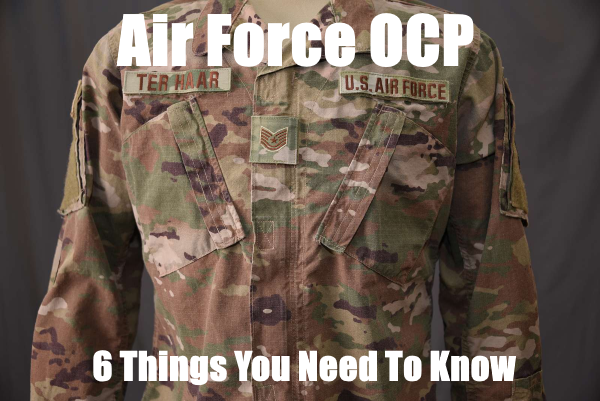
The Operational Camouflage Pattern (OCP) uniform is the standard daily and combat utility uniform for the U.S. Air Force, providing improved camouflage, durability, and functionality for a variety of environments.
Adopted in 2018 to align with joint-service standards, the OCP replaced the previous ABU and features a multi-terrain pattern, flame-resistant fabric, and practical design elements like reinforced knees and elbows, adjustable cuffs, and multiple pockets.
Air Force personnel wear the OCP in garrison, field training, deployments, and most duty situations, with specific rules governing patches, name tapes, rank insignia, and accessories to maintain a professional appearance.
The uniform emphasizes readiness, safety, and uniformity while allowing for authorized morale patches and skill badges in designated locations.
Proper wear and care are essential for longevity, compliance, and representing the Air Force effectively.
In this updated guide for 2026, we detail current OCP wear standards, authorized items, patch placement, grooming integration, recent changes, and tips for maintaining the uniform.
Related Article – Air Force Uniform Regulations
Table of Contents
1. Replacing The ABU


The OCP (Operational Camouflage Pattern) uniform has replaced the ABU (Airman Battle Uniform).
The ABU is what most airmen have worn since October 2011.
ABUs, in turn, replaced the former “woodland” camouflage Battle Dress Uniform (BDU) and Desert Camouflage Uniform.
Initially, the ABU was designed to match the Universal Camouflage Pattern developed by the U.S. Army.
In addition, the “tiger stripe” pattern of the ABU uniform was intended to pay tribute to the camouflage worn by service members during the Vietnam War.
However, the pattern was deemed ineffective in terms of concealment — especially for those deployed within Afghanistan’s diverse terrains.
Therefore, the Army and Air Force issued OCP uniforms to soldiers, airmen, and others who were deployed to Afghanistan.
This was so they could blend in with the environment more efficiently and effectively.
Ultimately, the OCP was determined to be a better uniform choice overall than the ABU.
2. Transition To The OCP
In October 2018, the Air Force approved the OCP, the Army’s service duty uniform, to be worn full-time.
The Army began its transition to the OCP three years earlier, in July of 2015.
The expectation was to retire the ABU after more than a decade of wear and use and transition to the OCP by April 2021.
This included all airmen as well as Space Force guardians.
As a result of some delays due to the global pandemic, the Air Force allowed approximately three years to phase in the OCP.
The Air Force has planned to donate the remaining uniforms and gear associated with the ABU to junior ROTC programs across the U.S.
Related Article – High School JROTC: 6 Things To Know Before Signing Up
3. Impact Of Coronavirus Pandemic On OCP Uniforms

The coronavirus pandemic impacted the Air Force’s transition from ABU to OCP uniforms as far as timing.
Though ABUs were supposed to be phased out in favor of the OCP uniform by April 2021, the Air Force had to make adjustments to this deadline due to COVID-19 restrictions.
In fact, extending the transition from ABUs to OCPs was done in an effort to alleviate and reduce stress on service members and professionals of the Air Force and Space Force.
As a result, the Air Force extended the time required for airmen to update certain elements of the Operational Camouflage Uniform by nearly six months, overall.
This extension applied to the modifications for the Two-Piece Flight Duty Uniform (2PFDU) as well.
4. Benefits Of The OCP
The OCP uniform offers many benefits to Air Force service members, especially when compared to the ABU.
Here are just some benefits of the OCP:
- Lower maintenance
- Worn with suede boots (no polishing needed)
- Greater comfort in wearing
- Lighter feel
- High functionality (less obstructive pockets than ABU)
In addition, most Air Force members report that the OCP is preferable in high-pressure mission environments.
This includes a much more effective camouflage design and efficient style for both at home and abroad.
5. Guidance For OCP Wear

The Air Force has published updated guidance for wearing the OCP uniform.
These regulations can be found in Air Force Instruction 36-2903, “Dress and Appearance of Air Force Personnel.”
Such updates include the following for OCP uniform changes:
- The only authorized T-shirt color is “coyote brown”
- Only green or coyote brown socks issued by the Defense Logistics Agency (DLA) are authorized
- Officer rank insignia is “spice brown” with the exceptions of first lieutenant and lieutenant colonel (black rank insignia)
- Mandatory cloth U.S. flag patch in authorized spice brown color, worn in garrison and while deployed (infrared U.S. flags not allowed)
- Airmen must wear coyote brown boots unless exempted due to established and approved medical conditions or for those in industrial areas (black combat boots worn instead)
The two-piece flight duty uniform now also includes the following:
- the cloth, spice brown U.S. flag
- DLA-issued green or coyote brown socks
- Coyote brown boots
- Thermal undergarments in coyote brown
Related Article – Military Dress Uniforms: All 6 Branches Explained
6. Feedback From Service Members Regarding OCP
Though some Air Force service members have reported that they will miss the history and look of ABUs, the overall feedback regarding OCP uniforms has been positive.
In addition to the benefits of the OCP uniform mentioned above, many airmen have expressed approval of the Air Force moving to a single combat uniform.
In fact, numerous airmen have actually worn the OCP uniform since 2012, well before the Air Force’s decision to transition from ABU to OCP.
These include Air Force service members who have deployed overseas to Afghanistan and other areas.
Members of the Air Force Special Operations Command in addition to some Security Forces units were among the first to wear the OCP uniform.
This took place during certain deployments and other conditions.
As the Air Force has transitioned to OCP uniforms, unit patches have also returned.
Unit patches had not been part of this branch’s uniform since 2011, when BDUs were phased out in favor of ABUs.
As a result, Airmen are authorized two patches per sleeve to wear in addition to a rank patch in the coat’s center.
This is a change from the long-standing practice of rank being worn on uniform sleeves.
For the first time, non-flying Air Force service members are allowed to wear the American flag on their right sleeve, like their aircrew counterparts.
Since OCP uniform patches and ranks do not have to be sewn on, as they were for ABUs, maintenance of the current uniform is easier.
This also makes the OCP less costly and allows for quick changes in patches and/or rank.
Overall, with the OCP uniform and return of unit patches, members of the Air Force are able to showcase the branch’s proud history and their unit pride.
What People Get Wrong About the Air Force OCP Uniform
Many assume the OCP is identical across all branches with the same rules for patches and wear.
While the pattern is joint (Army, Air Force, Space Force), the Air Force has unique guidelines on name tapes, rank insignia, morale patches, and authorized skill badges; for example, Air Force name tapes are spice brown with black lettering, and morale patches have stricter placement and approval rules than Army standards.
Another misconception is that any morale patch can be worn anywhere on the uniform.
Morale patches are limited to one per side (left or right shoulder pocket flap), must be squadron-approved or AFI-authorized, and cannot be offensive, extremist, or commercial; commanders can restrict or prohibit them based on mission or professionalism.
People often think the OCP is flame-resistant only in combat zones or optional.
The entire uniform is made from flame-resistant material as standard issue; it’s mandatory for most duty environments, including non-deployed settings, to provide inherent protection against flash fires or hazards.
Some believe the uniform has no restrictions on undershirts or tucking rules.
Undershirts must be tan, coyote brown, or black (no logos visible), and the blouse must be tucked in when worn with the patrol cap or in certain formations; untucked wear is authorized only in specific field or maintenance scenarios per AFI 36-2903.
Finally, a common view is that the policy never updates or remains static.
The Air Force periodically revises AFI 36-2903 (Dress and Appearance); as of 2026, updates include expanded morale patch allowances in some units, continued emphasis on proper wear during hybrid work environments, and alignment with joint grooming standards.
Understanding these details helps Airmen maintain compliance, avoid corrective actions, and wear the OCP with pride and professionalism.
Featured Image – GetArchive.net