
Aspiring Sailors often inquire about the Gunner’s Mate GM rating a hands-on role central to Navy ordnance and weapons systems.
GM Sailors maintain operate and repair guns guided missiles launchers small arms and ammunition ensuring fleet readiness.
This enlisted position requires mechanical skills attention to detail and the ability to work in high-stress environments like ships or shore facilities.
Requirements include a qualifying ASVAB score of AR plus MK plus EI plus GS equals 205 or AR plus GS plus 2MK equals 205 along with normal color perception and security clearance eligibility.
Training starts with boot camp followed by a 10-week A-school at Naval Station Great Lakes Illinois.
GM ratings offer opportunities for deployments special pays and advancement in weapons expertise.
Benefits include competitive pay education assistance travel and strong pathways to civilian armorer or security roles.
This guide covers the current 2026 duties qualifications training pay and more for the Navy Gunner’s Mate role.
Related Article – Navy Jobs List: A List Of All 71 Ratings In The US Navy
Jump To A Section
Who Can Be a Gunner’s Mate?


Serving as a Gunner’s Mate can be a fulfilling and enjoyable career for those who enjoy shooting and caring for guns.
To be a Gunner’s Mate in the Navy, there are five basic requirements you must meet:
- You must have a combined ASVAB line score of: AR+MK+EI+GS>=205 OR AR+GS+2MK>=205
- You must have normal color perception (meaning no partial or full colorblindness)
- You must have normal hearing in both ears
- You must be able to obtain and maintain a security clearance
- You must be a United States Citizen
- Meet the Navy PRT Test standards
I think it goes without saying here that before you consider applying to be a Gunner’s Mate, it is important to consider your comfort with handling and discharging firearms on a regular basis.
If you are scared of, or uncomfortable with, the idea of handling a firearm regularly, this job may not be the best fit for you.
Gunner’s Mate Training and Qualifications
The first step in a Gunner’s Mate’s training cycle is Recruit Training, more commonly referred to as boot camp.
Navy Recruit Training takes place at Recruit Training Command Great Lakes in Great Lakes, Illinois. Here Recruit Division Commanders (RDCs) will teach you the basic military skills and knowledge necessary to begin work in the United States Navy.
While at RTC Great Lakes, you will also learn basic Navy ship handling, small arms usage, firefighting, and Naval heritage. Barring any unforeseen circumstances, this training normally lasts 7 – 9 weeks.
Upon completion of your Recruit Training, you will travel “across the street” to Training Support Center Great Lakes.
Your training at TSC Great Lakes will last approximately 15 weeks.
This training will encompass your basic technical training at the Apprentice Technical Training Center, followed by your rating-specific training at the Gunner’s Mate Accession Training School, or A School.
It is at Gunner’s Mate A-School that you will learn the basics of maintaining firearms and weapons systems, electrical and electronic circuitry, and mechanical, hydraulic, and pneumatic systems.
Upon completion of Gunner’s Mate A School, you will officially receive your designation as a Navy Gunner’s Mate and be assigned orders to a Navy ship.
Life as a Gunner’s Mate
Once you have made it to the fleet, you will begin working on your basic shipboard qualifications.
Before you can do much more than manual labor as a Gunner’s Mate, you have to become a certified Maintenance Man, attain your basic shipboard firefighting qualification, and on many ships, you will have to train as an armed watch stander.
Once you are you have your basic qualifications, you are ready to get started with some Gunner’s Mate work!
As a Gunner’s Mate you will have quite a wide range of duties on a ship.
1. Cleaning / Maintaining Weapons
First, you will be cleaning and maintaining the mounted weapons around the ship.
The M240 and M2 .50 caliber machine guns, and the 25 mm autocannon are mostly what you will be working with when it comes to mounted weapons.


Ensuring these weapons are in tip-top shape is vital to the defense of the ship.
2. Working In The Ships Armory
Second, you will work in the Ship’s Armory. This is where all of the small arms weapons and ammunition are held.
In the armory, you will be cleaning and servicing the M9 and M17 service pistols, M14 and M16 service rifles, and the Mossberg 500 shotguns.
You will also be managing all of the ammunition, grenades, and non-lethal weapons such as Oleoresin Capsicum (OC) spray, retractable batons, and flexi-cuffs.
As the Duty Armorer, you will also be responsible for issuing these weapons to watchstanders before they assume the watch, receiving them after they are relieved, and monitoring all temperature and sprinkler system readings in ammunition lockers throughout the ship.
3. Conduct Security Around The Ship
Third, you will conduct security operations for the ship.
Patrolling the ship’s perimeter and ensuring all is safe about the decks. Inspecting watchstanders and checking watch bills are also part of your daily duties.
4. Anti-Terrorism
Fourth (as you can see, this list is getting rather long), you will be working on the Anti-terrorism Training Team to conduct training with the ship’s armed watchstanders on tactics and procedures to combat potential terrorist threats.
You will assist in the creation of anti-terrorism plans for the ship when it is pulling up pier side in foreign ports and you will conduct drills to test the ship’s capability to defend itself against an attack.
5. Training Sailors On The Use Of Firearms
Finally, there’s the fun part that makes everybody want to be a Gunner’s Mates. Shooting guns!
As a Gunner’s Mate, you are directly responsible for training Sailors on the proper use of the ship’s firearms.
You will arrange and lead gun shoots at firing ranges all over the country and out to sea.
You will qualify as a line coach, so that you can teach Sailors and Marines weapon safety while discharging live ammunition, and you will grade Sailors’ performance on the range to determine their weapons proficiency.
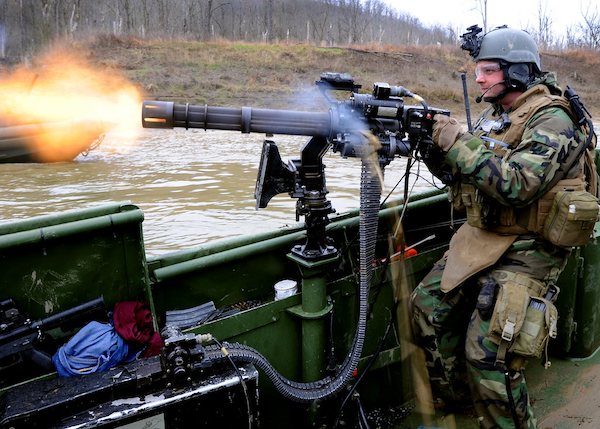
Out to sea, you will fire the larger mounted weapons as part of exercises and qualifying events.
You will train Sailors how to load, fire, and make quick adjustments to the mounted weapons as well.

Sea/Shore Rotation
In the Navy, you will swap between deployable “sea” duties and generally nondeployable “shore” duties.
There are situations where these rotations can change, but as a general rule, the Navy will do everything in its power to ensure all Sailors are able to meet their proper sea/shore rotations.
The sea-to-shore assignment rotation for Gunner’s Mate is as follows:
- First sea tour will be 49 months
- First shore tour will be 36 months
- Second sea tour will be 60 months
- Second shore tour will be 36 months
- Third sea tour will be 48 months
- Third shore tour will be 36 months
- Fourth sea tour will be 48 months
- Fourth shore tour will be 36 months
Pay and Compensation
Your pay is going to be based on a combination of your rank and time in service.
Related Article: Navy Enlisted And Officer Ranks And Pay
Gunner’s Mates will generally be somewhere around the pay grade of E-2 or E-3 with right at a year of service once they become rated.
This means your starting base yearly salary could be roughly $27,120 as an E-3 with fewer than two years and max out at $102,322 as an E-9 with 30 years of service.
This, of course, does not include Basic Allowance for Housing (BAH), or Basic Allowance for Subsistence (BAS).
You can actually calculate your BAH using the calculator below:
[omk-bah]
Gunner’s Mates will receive Sea Pay while they are attached to a ship.
This amount is based on your rank and the amount of time you have at sea.
The amount can range from $60 a month as an E-3 and below with less than a year at sea to $805 a month as an E-9 with eight or more years at sea.
Again, this does not factor in your BAH or BAS allowances.
BAH alone can range from $8,244 to $66,132 a year depending on your rank, marital status, and where you live.
Although it fluctuates semi-annually, Gunner’s Mates’ advancement opportunity is commonly higher than the Navy average.
This means you have a much higher chance of being advanced sooner in the Gunner’s Mate rating, than you would in other Navy ratings.
Of course, advancing sooner means your base pay is going to increase faster, giving you greater earning potential than you might see in other Navy ratings.
Civilian Opportunities
Gunner’s Mates have a few paths they can pursue once they complete their Naval service. Gunner’s Mates receive training as technicians capable of working on complex machines.
This can lead to work in a technical field; while their experience with security will be beneficial for law enforcement.
Below I have broken up some potential post-military occupations by their career fields:
Technical:
- Machine repair
- Industrial maintenance
- Mechatronics
- Electrical repair
- Hydraulic systems technician
Weapons proficiency:
- Gun range owner/operator
- Gun safety instructor
- Shooting coach
- Law enforcement officer
- Government contractor
Anti-terrorism
- Customs and Border Protection (CBP)
- Federal Bureau of Investigation (FBI)
- Department of Homeland Security
- Antiterrorism consultant
- Emergency operations professional
Related Article: 15 Best States For Military Retirees And Veterans
Through the Navy Credentialing Opportunities On-Line (COOL) program, Gunner’s Mates have the ability to earn credentials they can use in the civilian world. For free, they may earn the following certifications:
- Associate Safety Professional (ASP)
- Basic Electricity and Electronics – Direct Current (BEE-DC)
- Certified Manager of Quality/Organizational Excellence (CMQ/OE)
- Certified Safety Professional (CSP)
Additionally, Gunner’s Mates can earn apprenticeship designations from the Department of Labor through the United States Military Apprenticeship Program (USMAP) as a certified apprentice in the following fields:
- Armorer
- Small Arms Technician
- Hydraulics System Maintainer
- Electrical and Electronic Engineering Technologists and Technicians
On top of all of that, there is Active Duty Tuition Assistance and the GI Bill. Tuition Assistance will pay up to $250 a credit, for 12 credits a year, and a total of 120 credits over a lifetime. The Post 9/11 GI Bill provides 36 months of tuition, an annual book stipend, and Basic Allowance for Housing.
Because of their professional training, Gunner’s Mates are awarded approximately 18 credit hours in the areas of:
- Principles of technology
- Hydraulics and pneumatics
- Industrial safety
- AC/DC circuits
- Solid state electronics

.jpg)
What People Get Wrong About Navy Gunner’s Mate (GM)
Many believe GM Sailors spend most time firing weapons like in movies overlooking the primary focus on maintenance calibration and repair of complex systems.
In reality the job involves detailed inspections troubleshooting electronics and ensuring safety compliance more than active shooting.
People often think no technical background is needed ignoring the high ASVAB requirement emphasizing arithmetic mechanical and general science knowledge.
Another misconception is that A-school is brief when it spans 10 weeks covering advanced topics like missile systems small arms and ordnance handling.
Families sometimes view the rating as extremely dangerous daily not realizing while hazardous duty pay applies risks are managed through rigorous training and protocols.
Others assume promotion stalls in technical roles overlooking competitive advancement to E-9 with leadership in weapons departments and training teams.
Some overlook the color vision requirement thinking it’s optional when normal perception is crucial for identifying wiring markings and safety indicators.
People frequently assume civilian transitions limit to military-related jobs ignoring skills transfer to law enforcement firearms instruction or defense contracting with solid salaries.
Another common error confuses GM with other ratings like FC Fire Controlman not understanding GM handles mechanical ordnance while FC focuses on radar and fire control.
Clearing these points helps candidates prepare adequately meet standards and pursue a vital career in Navy weapons systems for 2026.
What is it Like to be a Gunner’s Mate?
Gunner’s Mates spend their days around guns of all shapes and sizes.
They can work on handguns, rifles, shotguns, machine guns, cannons, missile launchers, mines, and torpedoes.
Gunner’s Mates have a very diverse skill set that affords them the chance to experience many different types of opportunities in the Navy.
Gunner’s Mates will find themselves working in almost every type of Navy assignment.
They can be assigned to ship or shore, in the United States or overseas. Their work has them in both indoor and outdoor situations, doing clean or dirty work, and in any kind of climate or temperature.
They work alone often but will regularly find themselves working in a group as well.
GMs can often find work both mentally and physically challenging but generally enjoy what they do.
Many Gunner’s Mates volunteer for Individual Augmentee (IA) orders.
IA orders place a Sailor in a hazardous duty zone in support of direct combat operations. As weapons specialists, Gunner’s Mates bring an important skill to a deployed unit.
They will help maintain the Humvee M2 .50 caliber and M240 machine gun mounts and work with the different small arms on station.
Ensuring Soldiers, Sailors, and Marines all have operating, effective weapons at all times.
Some Gunner’s Mates choose to volunteer for Brig Duty.
These orders will assign them to a brig, where they will guard military prisoners. This type of duty affords Gunner’s Mates the opportunity to become certified prison guards and detainee handling specialists.
Gunner’s Mates have broad responsibilities, and they generally find satisfaction in their career.
Most really enjoy working with guns and get a lot of satisfaction out of the work they do every day.
Many enjoy the opportunity to work with the anti-terrorism side of the house, helping to protect Americans from terrorist threats.
If you enjoy handling firearms and teaching others how to do the same, then Gunner’s Mate just might be the Navy rating for you!
References / Resources
Official Gunners Mate Navy Webpage
