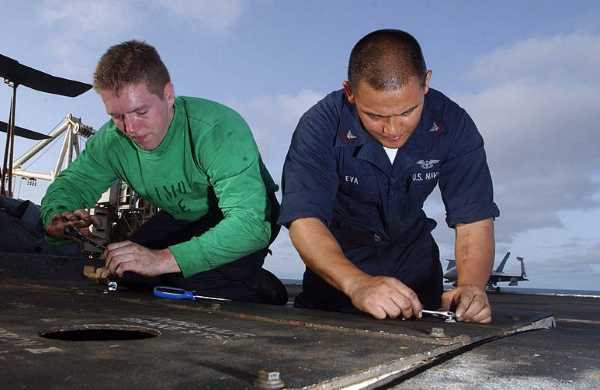
Navy Aviation Support Equipment Technicians are responsible for maintaining and repairing aircraft support equipment.
Their work supports aircraft operations at naval air stations and aboard ships.
These technicians service a wide range of mechanical, electrical, and hydraulic systems.
This article explains the role, requirements, training, and career considerations for Navy Aviation Support Equipment Technicians.
Related Article – Navy Airman (AN): Career Details
Navy Aviation Support Equipment Technician Requirements and Qualifications
Here is what it takes to qualify to start training to become an enlisted US Navy Aviation Support Equipment Technician:
Educational Requirements
- High School Diploma
- GED
ASVAB Requirements
- Minimum combined ASVAB Score of 210 on Verbal Expression, Mechanical Comprehension, Arithmetic Reasoning and Math Knowledge.
-OR-
- Minimum combined ASVAB Score of 210 on Arithmetic Reasoning, Verbal Expression, Auto and Shop Information, and Math Knowledge
Additional Qualifications
- Be between the ages of 17 and 34 unless in possession of a waiver
- Be a United States Citizen
- Must be able to speak clearly
- Must have normal color perception
- Must have at least average physical strength and possess good manual dexterity
- Successful completion of 8 weeks of Navy Basic Recruit Training held at Great Lakes Naval Training Center which is located on the western shore of Lake Michigan, close to Chicago. (Not required of those with prior military experience or training)
Training and Career Path to Become a Navy Aviation Support Equipment Technician
Here is the normal training progression it takes to eventually fulfill the duties required by a Navy Aviation Support Equipment Technician.
Navy Technical Training Information
The Navy A school for the technical training required to become a full fledged Navy Aviation Structural Mechanic takes place at the Navy Technical Training Center (NATTC) located in Pensacola, Florida.
This training is approximately 20 weeks in duration.
This is a foundation course that helps a recruit to better understand the principles of electrical, mechanical, and hydraulic maintenance.
After “A” school technical training is complete, many AS recruits will then attend a short equipment specific Class “C” technical training course at the same facility prior to going to their first permanent duty assignment.
Related Article – Navy Aircrew Survival Equipmentman (PR): Career Details
On the Job Training

Since this is a Navy career that is learned best by hands-on training, there will be several weeks of on the job training required at a recruit’s first permanent duty station.
Once this training is complete, the enlisted member will then be ready to work full-time as a certified Navy Aviation Support Equipment Technician.
How Much Are Navy Aviation Support Equipment Technicians Paid?
US Navy Aviation Support Equipment Technician’s pay is based on two characteristics.
These are an enlisted member’s current rank and the amount of time they have spent in the military.
Most new US Navy Aviation Support Equipment Technician’s will start out at a pay grade that is equal to that of a Seaman Recruit (E-1) through Seaman (E-3).
Here is the current pay table for Navy enlisted based on rank and time in service:
| Insignia | Pay Grade | Rank | Abbreviation | 2026 Minimum Monthly Pay (<2 Years) |
|---|---|---|---|---|
| N/A | E-1 | Seaman Recruit | SR | $2,407.20 (after 4 months; $2,225.70 for first 4 months) |
 | E-2 | Seaman Apprentice | SA | $2,697.90 |
 | E-3 | Seaman | SN | $2,836.80 |
 | E-4 | Petty Officer Third Class | PO3 | $3,142.20 |
 | E-5 | Petty Officer Second Class | PO2 | $3,342.90 |
 | E-6 | Petty Officer First Class | PO1 | $3,401.10 |
 | E-7 | Chief Petty Officer | CPO | $3,932.10 |
 | E-8 | Senior Chief Petty Officer | SCPO | $5,656.50 (starts at over 8 years) |
 | E-9 | Master Chief Petty Officer | MCPO | $6,910.20 (starts at over 10 years) |
 | E-9 | Fleet/Command Master Chief Petty Officer | FMCPO/CMCP | $6,910.20 (starts at over 10 years) |
 | E-9 | Master Chief Petty Officer of the Navy | MCPON | $6,910.20 (starts at over 10 years) |
Advancement through the Seamen ranks (E-1 to E-3) is done simply by time in grade, whereas advancement through higher enlisted ranks (E-4 and above) is done by a combination of time in grade, testing, and specific job knowledge
Miscellaneous Pay, Allowances, and Incentives
Other pay additions may include such things as:
- Housing allowance for those that live off base (BAH)
- Subsistence allowance (Food – BAS)
- Temporary duty pay
- Hazardous duty pay
- Sea duty pay (Separation pay)
- 100% paid healthcare
- Tuition reimbursement
What’s Life Like as a Navy Aviation Support Equipment Technician?
If you want to travel the world and participate in an important Navy role that takes a team effort to do, then you may be a perfect fit as a Navy Aviation Support Equipment Technician.
At any time a Navy Aviation Support Equipment Technician can be assigned to shipboard duty or spend a few months at a temporary duty station.
The specific job roles that Navy Aviation Support Equipment Technicians fulfill include:
- Maintain, repair, and test ground equipment electrical systems
- Maintain, repair, and test gas turbine compressor units
- Servicing and repairing tow tractors and other aircraft ground support equipment
- Keep ground air-conditioning units in good working condition
- Maintain and repair ground equipment gasoline and diesel engines
- Troubleshoot and repair ground support equipment hydraulic and mechanical systems
Check out the Youtube video below to see Navy AS personnel in action:
[youtube https://www.youtube.com/watch?v=FxucJK-cnfw]
Job Reviews
These are the reviews posted by two Ex-Navy Aviation Support Equipment Technicians on the website Indeed.com:


The general consensus is that working as a Navy Aviation Support Equipment Technician is a demanding but fun job that sometimes includes long working hours.
It may also cause you to spend extended periods of time away from family.
What People Get Wrong About Navy Aviation Support Equipment Technicians
Many people believe Aviation Support Equipment Technicians work directly on aircraft, when their role focuses on ground support equipment.
It is often assumed the job is limited to one type of machinery, despite responsibility for multiple systems and vehicles.
Some think the role is only shore-based, even though shipboard assignments are common.
There is a misconception that this rating involves minimal technical skill, despite extensive mechanical and electrical training.
Many assume advancement is automatic, without understanding testing and performance requirements.
It is often misunderstood that all training ends after A School, when additional on-the-job and specialty training is common.
Some believe civilian employment options are limited, despite transferable technical skills.
Another common misunderstanding is that this role operates independently, when coordination with flight and maintenance crews is constant.
Navy Aviation Support Equipment Technician Civilian Career Opportunities
Anyone that has hands-on experience maintaining and repairing electrical, mechanical, diesel, gas and hydraulic equipment should have no problems finding above average hourly employment in the civilian world.
Related Article – Navy Electronics Technician (AT): Career Details
Such is the case with Ex-Navy Aviation Support Equipment Technicians.
They are in demand to fill such positions as:
- Civilian passenger and cargo aircraft equipment support specialists
- Diesel and gas engine mechanics
- Jobs that require knowledge in electrical and mechanical troubleshooting
- Hydraulic maintenance and repair technicians
Examples of employers that are known to hire Ex-
- Signature Flight Support – San Diego, CA
- Dallas Airmotive – Dallas-Fort Worth, TX
- Citadel Completions LLC – Lake Charles, LA
- Signature Flight Support – White Plains, NY
References:
Aviation Support Equipment Tech Full Navy Profile

I am an ex- AS. I HONORABLY DISCHARGED IN NOV OF 98. MY RATE AND RANK WAS: AS1(AW). I am now 53 yrs old and used my 12 years of experience to become an ASE Certified Technician and on later to operate my own automotive repair shop. If your interested in more of my experiences then you may search records and or E-mail me. My name is Mark Martin.