
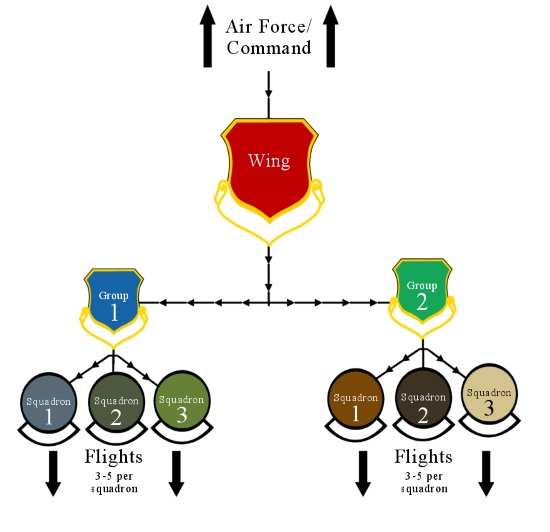
Every branch of the military has a chain of command, and if you are in the United States Air Force, you follow the Air Force Chain of command.
The chain of command exists so that the orders issued from higher up the chain flow downwards.
Also, the chain of command works to clarify issues and answer questions from down the chain of command.
Related Article – Air Force Bases in the US
Air Force Chain of Command
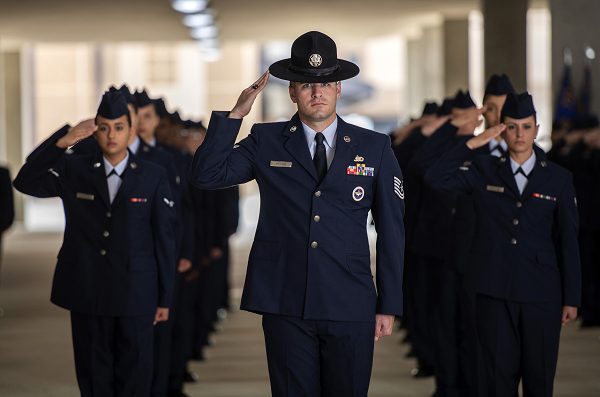
The Air Force chain of command, from top to bottom, goes as follows:
- President of the United States
- Secretary of Defense
- Secretary of the Air Force
- Air Force Chief of Staff
- Vice Chief of Staff
- Chief Master Sergeant of the Air Force
- Major Commands
- Air Combat Command
- Air Education and Training Command
- Air Force Global Strike Command
- Air Force Materiel Command
- Air Force Reserve Command
- Air Force Special Operations Command
- Air Mobility Command
- Pacific Air Forces
- U.S. Air Forces Europe
- Numbered Air Forces
- Wings
- Groups
- Squadron
- Flight
President of the United States
The President of the United States (POTUS) is at the top of the command chain in all military branches with the title Commander-in-Chief.
Secretary of Defense
The power of the Secretary of Defense authority in the chain of command is second only to the POTUS.
The Secretary of Defense has command and control both operationally and administratively of all military forces.
Currently, the acting Secretary of Defense is Lloyd Austin.
Secretary of the Air Force
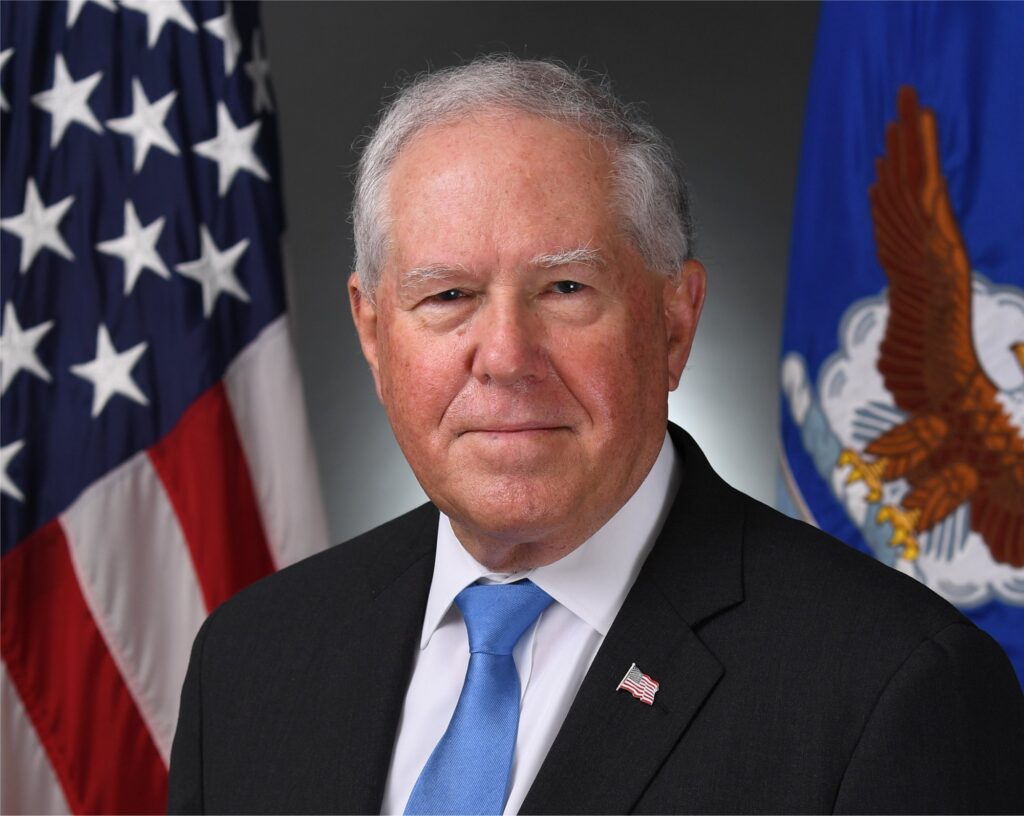
The Secretary of the Air Force receives their appointment by the President of the United States.
Also, the Secretary of the Air Force is a civilian, and the appointment receives approval from the Senate.
As the Secretary of the Air Force, they report to the Secretary of Defense and have the privilege to conduct all the necessary affairs set forth by the Department of the Air Force.
Currently, Frank Kendell is the Secretary of the Air Force.
Air Force Chief of Staff
The Air Force Chief of Staff is responsible for the USAF Active-Duty, Reserves, and Guard units in the United States and overseas.
Currently, General Charles Q. Brown, Jr. services in this position, and he works with the Secretary of Defense, the POTUS, and the National Security Council.
Vice Chief of Staff
The Vice Chief of Staff of the Air Force presides over the Air Staff and chief of staff, handling the organization of all the USAF Active-Duty, Reserves, and Guard units.
General David W. Allvin is the current Vice Chief of Staff of the Air Force.
Chief Master Sergeant of the Air Force
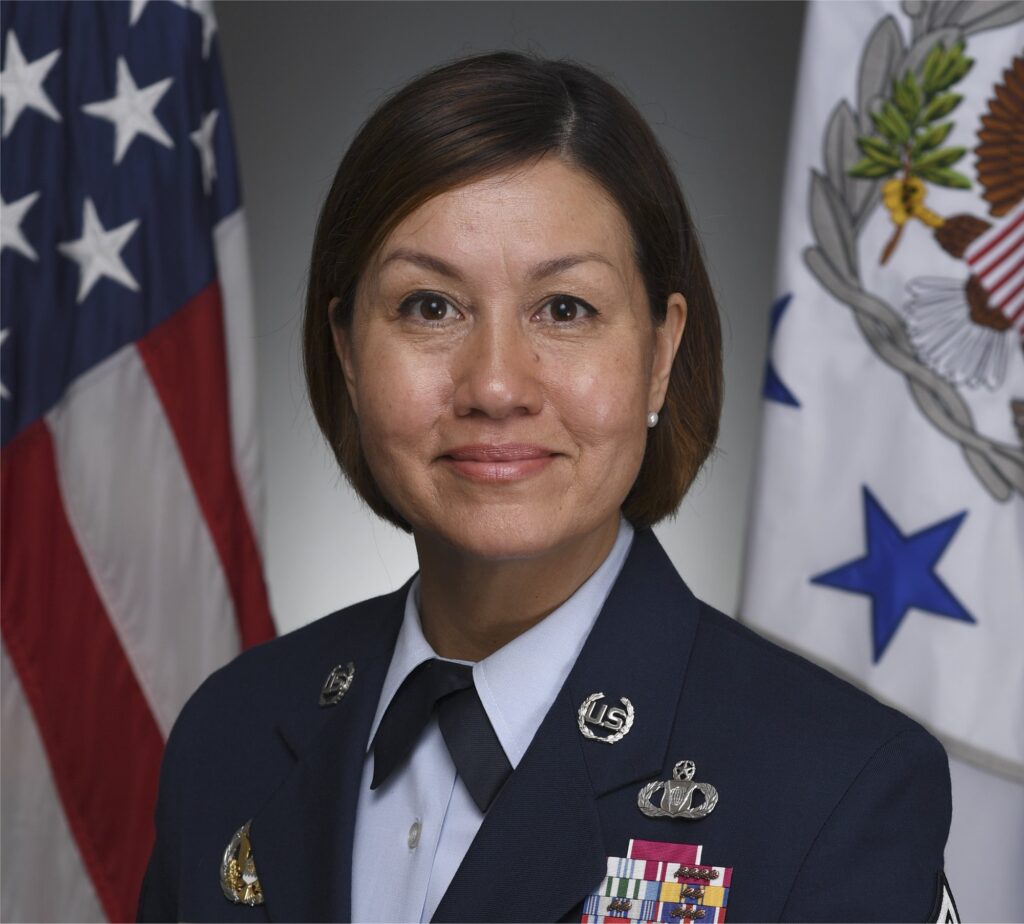
A Chief Master Sergeant manages enlisted members of the Air Force. Also, this position requires mentoring of non-commissioned officers and advising unit commanders and all senior officers.
The Chief Master Sargeant of the Air Force, however, represents the enlisted force and their interests when it comes to the public and all levels of government.
The Chief Master Sergeant of the Air Force serves as a personal advisor to the Secretary of the Air Force when it comes to issues involving the enlisted force.
The current Chief Master of the Air Force is CMoSgt JoAnne S. Bass.
Air Force Chain of Command: Major Commands
In the Air Force, Major Commands have their own organizations that answer to the Major Command. All numbered air forces, squadrons, and flights fall under their major commands.
Air Combat Command
General Mark D. Kelly is the Commander of the Air Combat Command, and he is responsible for ensuring all forces are ready for combat. Also, if we are at peace, his job does not end.
The Air Combat Command has five numbered regular air forces and one Reserve numbered air force as subordinates:
Air Education and Training Command
The Air Education and Training Command works to train and educate members of the Air Force.
Lieutenant General Brian S. Robinson commands this major command, which is located in Texas.
Air Force Global Strike Command
The Air Force Global Strike Command, located at Barksdale AFB, Louisiana, is commanded by General Thomas A. Bussiere.
This major command handles combat support, combat missiles, all of the Air Force’s bombers, and the Long Ranger Strike Program.
Air Force Materiel Command
Located at Wright-Patterson AFB, Ohio, and commanded by General Duke Z. Richardson, the Air Force Material Command develops technology and handles the testing and evaluation of weapon systems.
Air Force Reserve Command
The Air Force Reserve Command handles the operational force of the Air Force Reserves.
The Air Force reserves perform every Air Force function and offer operation force in any changing global landscape.
The Commander of the Air Force Reserve Command is Lieutenant General John P. Healy.
Air Force Special Operations Command
Located at Hurlburt Field, Florida, the Air Force Special Operations Command is the special operations part of the Air Force.
Lieutenant General Tony D. Bauernfeind commands this major command.
Air Mobility Command
General Mike Minihan commands the Air Mobility Command out of Scott Air Force Base in Illinois.
The Air Mobility Command works to stay ahead of technology to ensure our warfighting concepts and systems are the best.
Pacific Air Forces
Pacific Air Forces strives to support the objectives set forth by the United States Indo-Pacific Command and Pacific Air Forces.
This major command, commanded by General Kenneth S. Wilsbach, works with allies and others to ensure stability.
U.S. Air Forces Europe & Africa
U.S. Air Forces Europe provides forward-based airpower to defend U.S. interests and deter aggression as well as deepen relationships with allies in Europe and Africa.
This major command is headed by James B. Hecker.
Air Force Chain of Command: Numbered Air Forces
Under the Major Commands are the Numbered Air Forces.
Each numbered Air Force has its own commanders who provide leadership. Usually, a Major General or Lieutenant General commands a Numbered Air Force.
However, the NAF chain of command goes upwards to the Major Commands.
Within the structure of a NAF, there are wings, groups, squadrons, and flights, all with their own chain of command that leads to the NAF commander.
Often, the Numbered Air Forces are assigned according to a geographical assignment.
Air Force Chain of Command: Wings
Wings have a narrow focus on a specific mission, and it is the organization that falls under the Numbered Air Forces.
A Wing is comprised of two or more groups and several squadrons with one person in command.
The role of the wing is usually operational, specialized, or an air base wing.
Also, a wing may have an operations, support, medical, and maintenance group.
Your chain of command does not start with the wing commander, however, because the wing is made up of more than one group. Your chain of command begins within your flight or section.
Air Force Chain of Command: Groups
A group in the Air Force has at least two squadrons, but only one commander in each group.
Typically, a Colonel heads an Air Force Group. However, it is essential to remember that while there are group commanders, the groups fall under the Wing Commander’s command.
Air Force Chain of Command: Squadron
A squadron is a basic unit in the Air Force, and it includes two flights and several aircraft.
Each squadron has its commander, who answers to the group commander. You would expect the squadron commander to be a Major or Lieutenant Colonel.
A squadron is considered a lower level of command.
Since each squadron has two flights, you should evaluate the command and structure chain within a flight.
Air Force Chain of Command: Flights
The flight is usually the smallest grouping within the Air Force. There might be over a hundred people in a flight, but it is not unusual for a dozen people to make up a flight.
Also, a flight may have four aircraft.
Typically, a flight commander is a Captain or a flight chief.
Your first step up your chain of command includes your flight commander because they handle day-to-day operations regarding people and equipment.
Born and raised in Woodbridge, NJ, he graduated from the New Jersey Institute Of Technology with an MBA in eCommerce.His hobbies include beach volleyball, target shooting, and lifting.
Rob is also a Commercially rated pilot and Certified Flight Instructor (CFI), with over 1,500 hours of flight time.
- Ikon Pass Military Discount: Learn How To Save Big - January 31, 2025
- RTIC Military Discount: Find Out How To Save Big on Gear - January 30, 2025
- Traeger Military Discount: Learn How To Save Big on Smokers - January 28, 2025
