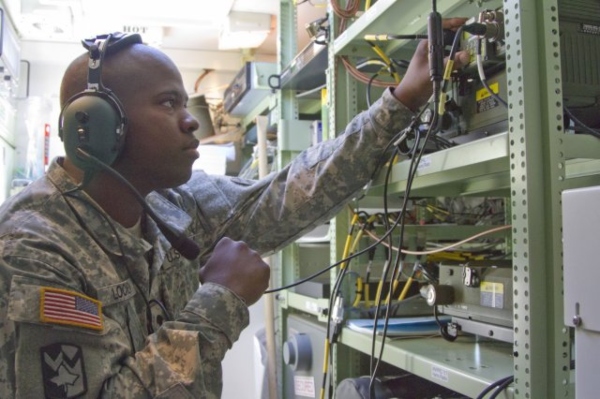
Army Signal Support System Specialists (MOS 25U) are responsible for maintaining and operating communication systems used by the U.S. Army.
These systems support the transmission of information across units and help ensure reliable communication during operations.
The role requires technical training and ongoing maintenance of signal equipment in a variety of environments.
The sections below explain the education requirements, training pipeline, job duties, and career considerations for MOS 25U.
Related Article – Army Careers List: 159 Jobs in the US Army
Education, Qualifications, Training, and Duty Stations

Support Operations Specialists (MOS 25U) serve an important function in the communications of the U.S. Army.
The Army relies on signal support systems and terminal devices to direct the movement of troops during combat.
The technical position of MOS 25U requires some education and training.
Related Article – Army Information Technology Specialist (MOS 25B): Career Details
Education
Are you interested in becoming an Army Support Operations Specialist (MOS 25U)?
First, you will need to finish high school with a diploma or GED.
Secondly, you will want to speak to a local Army recruiter and notify the individual of your intention to become MOS 25U.
The recruiter will give you more information about the Armed Services Vocational Aptitude Battery (ASVAB).
The series of tests are used by the Army to understand your strengths.
It helps you identify which Army Military Occupational Specialties (MOS) are best suited to your strengths.
In order to become an Army Support Operations Specialist (MOS 25U) you must score on the ASVAB:
- Surveillance & Communications (SC): 95
- Electronics (EL): 95
Qualifications
There are not a ton of special qualifications required to become an Army Support Operations Specialist.
The Army does require you to have normal color vision (no color blindness).
You also must be a citizen of the United States and qualify for a Secret security clearance.
Related Article – How to Join the US Military as a Non-Citizen
The Army also points out that those that succeed in MOS 25U demonstrate great problem-solving skills as well as an interest in electronics equipment.
Training
The first phase of your training begins at boot camp.
Boot camp, or Basic Combat Training (BCT) involves 10 weeks of physical and mental preparation to see if you can cut it in the U.S. Army.
After completing boot camp, soldiers progress to Advanced Individual Training (AIT) which is specific to your MOS.
Advanced Individual Training for MOS 25U includes job-specific instruction conducted over several months.
The time in AIT is a combination of classroom learning and work in the field.
The training for MOS 25U takes place at Fort Gordon in Georgia.
You will learn more about becoming an Army Signal Support System Specialist including:
- Mechanical and electrical principles
- Preventive maintenance principles
- Communication security policies and procedures
- Line installation and wiring techniques
Duty Stations
Those serving in the Army in MOS 25U can expect to be potentially based at one of the following duty stations:
Inside the Continental US (CONUS)
- Aberdeen Proving Ground, MD
- Fort Belvoir, VA
- Fort Bliss, TX
- Fort Campbell, KY
- Fort Carson, CO
- Fort Cavazos, TX
- Fort Detrick, MD
- Fort Drum, NY
- Fort Eustis, VA
- Fort Gordon, GA
- Fort Gregg-Adams, VA
- Fort Huachuca, AZ
- Fort Hunter Liggett, CA
- Fort Irwin, CA
- Fort Johnson, LA
- Fort Knox, KY
- Fort Leavenworth, KS
- Fort Leonard Wood, MO
- Fort Lesley J. McNair, Washington D.C.
- Fort Liberty, NC
- Fort Meade, MD
- Fort Moore, GA
- Fort Novosel, AL
- Fort Riley, KS
- Fort Sill, OK
- Fort Stewart, GA
- Joint Base Lewis-McChord, WA
- Joint Base Myer–Henderson Hall, VA
- Joint Base San Antonio, TX
- Joint Expeditionary Base Little Creek-Fort Story, VA
- Pentagon, Washington D.C.
Outside the Continental US (OCONUS)
- Fort Greely, AK
- Fort Wainwright, AK
- JFC Naples, Italy
- Joint Base Elmendorf-Richardson, AK
- Joint Base Pearl Harbor–Hickam, HI
- Landstuhl Regional Medical Center, Germany
- Osan AB, South Korea
- Ramstein AB, Germany
- Sembach Kaserne, Germany
- USAG Ansbach, Germany
- USAG Bavaria, Germany
- USAG Daegu, South Korea
- USAG Hawaii
- USAG Humphreys, South Korea
- USAG Italy
- USAG Japan
- USAG Okinawa
- USAG Rheinland-Pfalz, Germany
- USAG Stuttgart, Germany
- USAG Wiesbaden
- USAG Yongsan-Casey, South Korea
What does an Army Support Operations Specialist Do?

Army Support Operations Specialists are important to battlefield operations.
They handle signal support systems and terminal devices out in the field.
Support Operations Specialists (MOS 25U) work as part of the Army Signal Corps (USASC).
The Army Signal Corps (USASC) is responsible for managing communications and information systems support.
Related Article – Army Information Technology Specialist (MOS 25B): Career Details
Job Duties of 25U MOS
There are numerous job duties related to the role of an Army Support Operations Specialist (MOS 25U).
Though we cannot begin to cover every single duty in this article, here is a general breakdown:
- Maintain radio and data distribution systems.
- Perform signal support functions and technical assistance.
- Maintain equipment, terminal devices, assigned vehicles, and power generators.
- Provide technical assistance and training for local area networks.
Soldiers that work in 25U MOS like the variety of equipment that they manage and maintain.
Equipment ranges from communications to vehicles, radio and wire systems, as well as power generators.
An Army Support Operations Specialist spends time with offensive and defensive communications strategies.
They are on the offensive, detecting enemy signals and jamming enemy radio transmissions.
They also work defensively to make sure everyone in the Army is remaining in contact while troops are mobilized.
About the USASC
Army Support Operations Specialists (MOS 25U) work as part of the Army Signal Corps (USASC).
The USASC was created in 1860 and has played a role in every major U.S. military campaign since the Civil War.
The Signal Corps is responsible for some of the biggest advances in radio signal technology.
The Army Signal Corps has historically contributed to the development of military communications technologies.
What does an Army Support Operations Specialist make?

Army Support Operations Specialists are not paid based on their Military Occupational Specialty (MOS).
The Army determines pay based on military rank and years of service.
| Insignia | Pay Grade | Rank | Abbreviation | Minimum Monthly Pay |
|---|---|---|---|---|
| E-1 (less than 4 months) | Private | PVT | $2,226 | |
| E-1 (after 4 months) | Private | PVT | $2,407 | |
 | E-2 | Private Second Class | PV2 | $2,698 |
 | E-3 | Private First Class | PFC | $2,837 |
 | E-4 | Specialist or Corporal | SPC | $3,142 |
 | E-5 | Sergeant | SGT | $3,342 |
 | E-6 | Staff Sergeant | SSG | $3,401 |
 | E-7 | Sergeant First Class | SFC | $3,932 |
 | E-8 | Master Sergeant | MSG | $5,657 |
 | E-8 | First Sergeant | 1SG | $5,657 |
 | E-9 | Sergeant Major | SGM | $6,910 |
 | E-9 | Command Sergeant Major | CSM | $6,910 |
 | E-9 | Sergeant Major of the Army | SMA | $6,910 |
Benefits
The U.S. Army has a terrific benefits package included with your monthly salary:
- Vacation Time
- Special Pay
- Medical Insurance
- Retirement
- Education: Army members can earn full tuition, merit-based scholarships, allowances for books and fees, plus an annual stipend for living expenses.
- Housing: Allowances for living expenses, utilities, and maintenance.
- Food: Allowance for the on-base dining hall and access to tax-free department and grocery stores.
Job Reviews
Indeed.com has job reviews related to an Army Signal Support System Specialist (MOS 25U).

Some former service members describe their experience as having a significant personal impact.
Common pros cited by former military include the responsibility and integrity you earn through your time in service:

Though you will work long and hard hours in the U.S. Army some find the chosen career path more than rewarding.

Related Article – Army Radio Operator (MOS 25C): Career Details
Civilian Job Opportunities
Serving in the U.S. Army as a Support Operations Specialist (MOS 25U) will train you as well as provide real-world experience for a number of civilian job occupations.
Those that leave the military in 25U MOS eventually find careers as radio mechanics, operators, installers, and repairers.
The job of an Electronics Technician is a growing trade in the U.S., and those with skills in 25U MOS can make the transition easily.
While in the Army, you can earn an Associate Certified Electronics Technician degree through additional study and two years of electronics experience.
What People Get Wrong About MOS 25U
One common misconception is that MOS 25U is strictly a combat role.
While Signal Support System Specialists may operate in field environments, much of their responsibility involves maintaining, troubleshooting, and supporting communication systems rather than engaging in direct combat.
Another misunderstanding is that the job only involves radios.
In reality, MOS 25U personnel work with a wide range of equipment, including data systems, terminal devices, power sources, and network components.
Some people assume that MOS 25U requires advanced technical education before enlistment.
While technical aptitude is important, required skills are taught through Army training programs rather than expected prior experience.
There is also confusion between MOS 25U and other signal-related specialties.
Although roles may overlap, MOS 25U has distinct responsibilities within the Army Signal Corps compared to other communications MOS fields.
Finally, the job is sometimes viewed as static or repetitive.
In practice, assignments, equipment, and responsibilities can vary significantly depending on unit, location, and operational needs.
Summary
An Army Support Operations Specialist (MOS 25U) performs signal support functions and technical assistance for computer systems.
Technical assistance includes help with local area networks, and maintaining communications equipment, terminal devices, power generators, and vehicles.
Resources:
- https://www.goarmy.com/careers-and-jobs/browse-career-and-job-categories/computers-and-technology/signal-support-systems-specialist.html
- https://www.indeed.com/cmp/U.S.-Army/reviews?fjobtitle=Signal+Support+Systems+Specialist
