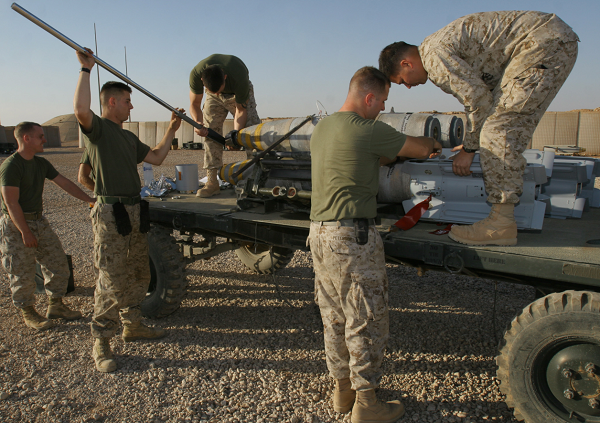
Marine Corps Aviation Ordnance Systems Technician (MOS 6541) is a critical aviation maintenance role responsible for the safe storage, handling, assembly, and delivery of all air delivered munitions.
These Marines ensure that every bomb, missile, and rocket is ready when aircrews need them.
It is a highly technical, safety focused job that combines heavy physical work with strict attention to detail and explosive ordnance procedures.
This 2026 guide explains exactly what the 6541 MOS involves, the full training pipeline, daily responsibilities, deployments, and the real pros and cons so you can decide if it is the right fit.
Qualifications and Training
Initial entry into this Marine Corps MOS will require a minimum score of 105 on the General Technical (GT) portion of the ASVAB.
This position requires secret security clearance eligibility, which also means that you must be a U.S. Citizen.
To enter into MOS 6541 you have to be 17-28 years old, have a high school diploma, normal color vision and have a driver’s license.
Aviation Ordnance Systems Technicians will handle a variety of ordnance types, and because of this duty, they are required to meet the same medical requirements that Explosives Handlers and Explosive Vehicle Operators do.
The medical evaluation will identify any conditions that reasonably impairs the ability to safely perform the job functions of safe explosives handling such as hearing impairment, vision impairment, cardiac disease, drug use and more.
After passing all medical and physical testing, recruits will attend Recruit Training at either Parris Island or San Diego.
Course work includes completing AO A1 Aviation Ordnance Course and CNATT AO (C) Course at CNATT MARU, Cherry Point, NC.
Related Article –Marines Ammunition Technician (MOS 2311): Career Details
What are the job duties of an Aviation Ordnance Systems Technician?

The main job duties of an Aviation Ordnance Systems Technician includes accounting, stowage, breakout, testing, maintenance, assembly and transportation of airborne armament equipment and armament-handling equipment.
Once Marines are given their assignment, they will obtain the specific support equipment and/or material handling license.
They operate tactical vehicles and will hold a Incidental Motor Vehicle Operator license for vehicles up to 7-ton.
Aviation Ordnance Systems Technicians are required to be familiar with all munition types, nomenclature, explosive hazard and how to appropriately respond to emergencies involving each type of munition.
Duties can vary based on rank.
Staff Sergeant to Private
These duties include performing IMA (Individual Mobilization Augmentee) duties.
IMA duties are to inspect, test, check adjustments, repair and complete preventative maintenance.
They will perform the above functions on support equipment, multiple ejection/bomb racks, aircraft guns, missile launching equipment, aerial targets, turrets and weapon systems.
At this level, Technicians will perform maintenance on air-launched missiles, conventional munitions, armament equipment and aircraft guns.
They prepare, package and certify hazardous material shipments, transport the explosives using transportation equipment and certify the vehicle for transport.
Administrative functions include using the Ordnance Information System (OIS) Ammunition Accounting and Management System, conducting inventories, maintaining stock records and record keeping practices.
Staff Sergeant to Corporal
This role provides more administrative and supervisory tasks.
At this level, Technicians will use technical and supply publications to ensure supply data is accurate and complete.
They will perform inspections on explosives maintenance, shipments and storage.
Technicians maintain files, prepares naval messages, prepares/edits ammunition requisitions and prepares invoices and custody records.
They work will the OIS system as a system administrator.
Staff Sergeant to Sergeant
Personnel at this level complete training and establish operational procedures.
They are required to establish a training program for Aviation Ordnance Technicians.
Their time may be spent preparing various reports, based on needs, such as Product Quality Deficiency Reports, Technical Publication Deficiency Reports and others.
They supervise operations in the ammunition assembly area and determine the serviceability of ammunition.
Part of their job is to establish and supervise a Forward Arming and Refueling Point.
Staff Sergeant
Managing the Ammunition Stock Recording System, preparing naval messages, orders, instructions, SOPs and safety precautions, are all duties at this level.
They are also required to use aviation ordnance administrative procedures to establish and operate an IMA including conducting inspections of IMA activities.
Related Article – Army EOD (MOS 89D): Career Details
What does an Aviation Ordnance Systems Technician get paid?
Each rank has different tasks and requirements, and Technicians will be paid based on their appropriate rank.
Those entering into this MOS as a Private, can expect to make around $1800 a month initially.
According to employee feedback on Glassdoor, the average Aviation Ordnance Systems Technician makes around $26,600 a year.
Marine Corps rank and pay can be found below.
| Insignia | Pay Grade | Rank | Abbreviation | 2026 Minimum Monthly Pay |
|---|---|---|---|---|
| E-1 +4 months | Private | PVT | $2,226 | |
| E-1 (after 4 months) | Private | PVT | $2,407 | |
 | E-2 | Private First Class | PFC | $2,698 |
 | E-3 | Lance Corporal | LCpl | $2,837 |
 | E-4 | Corporal | Cpl | $3,142 |
 | E-5 | Sergeant | Sgt | $3,343 |
 | E-6 | Staff Sergeant | SSgt | $3,401 |
 | E-7 | Gunnery Sergeant | GySgt | $3,932 |
 | E-8 | Master Sergeant | MSgt | $5,657 |
 | E-8 | First Sergeant | 1stSgt | $5,657 |
 | E-9 | Master Gunnery Sergeant | MGySgt | $6,910 |
 | E-9 | Sergeant Major | SgtMaj | $6,910 |
 | E-9 | Sergeant Major Of The Marine Corps | SgtMaj | $6,910 |
Benefits
Men and women in the Marine Corps are provided with benefits that are generous in comparison to most civilian benefit programs.
Personnel are provided with housing, with utilities and basic maintenance included.
They also have access to continue their education with tuition assistance programs.
Marines receive insurance, paid sick time, vacation, retirements and affordable life insurance.
Job Reviews
Reviews of this position are mixed.
The experience seems to depend on the assignment and leadership.
Common themes among reviews are great benefits, rewarding experience and high stress.
Positive aspects include being able to travel and gaining experience working with different systems.
Negative reviews discuss long hours depending on the needs at the time and poor leadership.
The review below shows the enjoyable and difficult parts of the position.

This review rates the position 5 stars, but discusses negative aspects.

Related Article –Marine M1A1 Tank Crewman (MOS 1812): Career Details
Civilian Career Opportunities
Working in this MOS provides experience that relates to a variety of civilian fields from bookkeeping to aviation and ordnance.
Position related to the duties of this MOS are:
- Auditing Clerks
- Ordnance Handling Experts
- Maintenance/Repair Worker (Aircraft and non)
- Industrial Truck Operator
- Inspector
- Aircraft System Assembler
Marines have opportunities to apply for Department of Labor registered apprenticeships, and receive additional credentials through the USMC COOL program.
These opportunities can give Marines additional training credentials and certifications that relate to additional civilian career opportunities and increased pay.
What People Get Wrong About Marine Corps Aviation Ordnance (MOS 6541)
Many recruits assume 6541 is basically a warehouse job where you just move boxes and load bombs onto aircraft.
In reality it is a demanding technical MOS that requires deep knowledge of explosive safety, precise assembly procedures, and the ability to work quickly under tight timelines during high tempo flight operations.
Another common myth is that the job is low risk because you are not infantry.
Aviation ordnance technicians work daily with live explosives, high pressure systems, and heavy munitions.
One mistake can have catastrophic consequences, which is why the training and safety standards are extremely rigorous.
Some Marines believe that once you finish the MOS school you will spend most of your time in an air conditioned shop.
Junior 6541s often work long hours on the flight line in extreme heat or cold, loading and unloading aircraft, conducting inventory in magazines, and supporting around the clock flight operations.
Many assume the MOS has limited promotion potential or civilian value.
In reality experienced 6541s promote well and transition very successfully into civilian careers in aviation maintenance, explosive ordnance disposal, logistics, and defense contracting with their security clearance and specialized skills.
A frequent error is underestimating the physical demands.
The job involves lifting heavy ordnance, working in confined spaces inside aircraft, and moving quickly during aircraft turnaround times.
Physical fitness is essential to avoid injury.
Finally some believe that if you are not mechanically inclined you cannot succeed.
While mechanical aptitude helps, the Marine Corps trains you from the ground up.
Attention to detail, the ability to follow strict technical manuals, and a strong sense of responsibility matter more than previous experience.
Understanding these realities helps Marines enter the 6541 MOS with accurate expectations and prepares them for one of the most important and respected aviation maintenance roles in the Marine Corps in 2026.
Summary

Marine Corps MOS 6541, Aviation Ordnance Systems Technician work with ordnance equipment, weapon systems and ordnance to provide maintenance, testing, transport, assembly and accounting duties.
The duties vary based on rank and can include a mixture of hands-on and administrative functions.
Entering into this MOS requires advanced training in ordnance handling and meeting security clearances.
Marines in this MOS will receive housing and benefits and their pay is based on rank.
Reviews of this position are mixed, with the majority of the roles noting your assignment and leadership have a large impact on your experience.
Civilian career opportunities related to this position are available in ordnance, bookkeeping and maintenance roles.
Related Article –Navy Information Systems Technician (IT): Career Details
References
