
Meeting Air Force requirements is the first step toward enlisting or commissioning, ensuring candidates are physically, mentally, and legally prepared for service in a highly technical and mission-focused branch.
Standards cover age, citizenship, education, ASVAB scores, medical and physical fitness evaluations, moral character, and background checks, with specific thresholds for enlisted and officer paths.
The Air Force prioritizes quality over quantity, seeking individuals who demonstrate strong academics, fitness, and integrity while offering waivers for certain conditions when risks are low.
Understanding current criteria helps applicants prepare documentation, address potential issues early with recruiters, and increase chances of approval during the MEPS process.
Requirements remain consistent across active duty, Air National Guard, and Air Force Reserve, though officer paths add education and commissioning options like the Academy, ROTC, or OTS.
In this updated guide for 2026, we detail enlisted and officer eligibility, key disqualifiers, waiver possibilities, testing and medical steps, and tips for a smooth application.
Table of Contents
Height & Weight Requirements
The Air Force requirements for height and weight for both males and females are as follows:
| Height (Inches) | Max Weight (lbs) | Min. Weight (lbs.) |
|---|---|---|
| 58 | 131 | 91 |
| 59 | 136 | 94 |
| 60 | 141 | 97 |
| 61 | 145 | 100 |
| 62 | 150 | 104 |
| 63 | 155 | 107 |
| 64 | 160 | 110 |
| 65 | 165 | 114 |
| 66 | 170 | 117 |
| 67 | 175 | 121 |
| 68 | 180 | 125 |
| 69 | 186 | 128 |
| 70 | 191 | 132 |
| 71 | 197 | 136 |
| 72 | 202 | 140 |
| 73 | 208 | 144 |
| 74 | 214 | 148 |
| 75 | 220 | 152 |
| 76 | 225 | 156 |
| 77 | 231 | 160 |
| 78 | 237 | 164 |
| 79 | 244 | 168 |
| 80 | 250 | 173 |
It is also helpful to look at the BMI chart to evaluate your weight as it relates to your height.
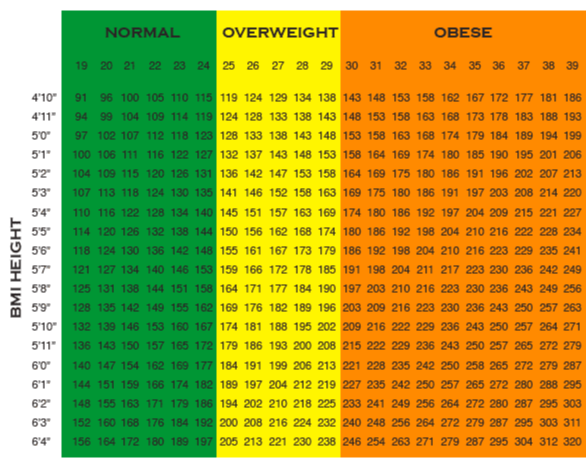
It is important to note the Air Force wants you five pounds under your maximum weight.
Related Article – Air Force Pilot Requirements
Vision Requirements
Before you officially join the Air Force, you will have a vision screening.
Not everyone has perfect eyesight, and you can join the Air Force as long as your eye refraction level is now worse than +/- 8.0.
However, there are careers where the vision requirements are more demanding.
For instance, a pilot needs their distance vision 20/70 or better with the ability to correct to 20/20.
Other Air Force jobs have similar requirements for vision, such as Combat Controllers (CCT) and Combat systems Officers.
However, you can have an uncorrected vision of 20/200 to be a Tactical Air Control Party as long as your eyes correct to 20/20.
Age Requirements
If you are a brand-new recruit, you must be at least 17 years old.
However, if you are under the age of 18, you must have parental consent.
Furthermore, you cannot be more than 39 years old.
If you wish to be an Air Force officer, you must be at least 18 years old, but not older than 40 years by the time you finish officer training school.
If you have a GED instead of a high school diploma, you must be 18 years old.
Lastly, if you have a professional degree in specific industries such as medicine or the ministry, you can be between the ages of 18 to 48.
Although, you should contact a recruiter to verify since this may change according to the Air Force’s needs.
Related Article – Military Age Limits For Each Branch
ASVAB Score Requirements
If you are a brand-new recruit, you need a minimum score of 36 on the ASVAB test as a high school graduate or senior.
However, if you have your GED instead of a high school diploma, you need a score of 50.
Each job in the Air Force has a different requirement, so if you are interested in specific careers, please talk to your recruiter for MOS-specific requirements.
GPA Requirements

The Air Force does not have requirements for a GPA.
However, the possession of a diploma or GED and the minimum score on the ASVAB test is vital.
It is also essential to know that the Air Force has a limited amount of GED applicant slots, so talk to your recruiter if you have a GED.
Citizenship Requirements
To enlist in the Air Force, you must either be a citizen or a legal permanent resident.
If you are a legal permanent resident, you must have a Permanent Resident Card, also known as a Green Card.
If you are not a permanent resident, obtain your residency before officially applying as a recruit in the Air Force.
Other Requirements
You can join the Air Force if you are married.
However, expect a separation during initial training.
Also, if you are legally married, you can have up to two minor children.
Although, if you have three dependents, you need a waiver to enlist.
Also, if you have body modifications such as piercing and tattoos, please talk to your recruiter about their location.
You are not necessarily disqualified for having body modifications, but there are limits and expectations.
What People Get Wrong About US Air Force Requirements
Many believe the Air Force has the easiest entry standards among branches due to its technical focus.
In fact, the Air Force maintains some of the most selective criteria, including higher ASVAB minimums for many jobs, strict medical and vision standards, and limited waivers for certain conditions compared to ground combat branches.
Another assumption is that any high school diploma or GED works equally well.
The Air Force strongly prefers high school graduates and limits GED acceptances with additional requirements like higher ASVAB scores; Tier 1 diplomas (standard high school) are preferred over Tier 2 (GED or alternative credentials).
People often think physical fitness requirements are minimal before joining.
While Basic Military Training builds fitness, applicants must pass the MEPS physical and meet weight/body fat standards; failing the initial fitness assessment or having unresolved medical issues can delay or disqualify entry.
Some assume citizenship rules are flexible or that permanent residents have equal opportunities.
Enlistment requires U.S. citizenship or lawful permanent residency (green card), but non-citizens face restrictions on certain jobs and security clearances; full citizenship is required for officer commissioning and many sensitive AFSCs.
Finally, a common view is that waivers are rare or never granted for medical or moral issues.
Waivers are frequently approved for minor or resolved conditions (e.g., childhood asthma, tattoos, minor criminal history) when documentation shows low risk; recruiters and MEPS work with applicants to pursue waivers, and thousands are granted annually for qualified candidates.
Knowing these details helps applicants approach the process with accurate expectations and prepare effectively for success.
See Also
Vision Requirements for each Military Branch
Military Pilot Vision Requirements
Army Height and Weight Standards
Coast Guard Height and Weight Requirements

I have a young patient who wants to go flight school. He is a sickle cell carrier (trait) but does not have sickle cell anemia. In fact he is not anemic. Does this disqualify him from entering the Airforce?
Hi Dr. Seidler,
His best bet would be to talk to a recruiter. They will send him to MEPS, and assuming there are no issues, should qualify him as a pilot candidate. Even if it is an issue, they might be able to issue him a waiver. It’s all on a case-by-case basis, so that’s the only way to know for sure.
Best of luck!
Rob V.
Founder
OperationMilitaryKids.org