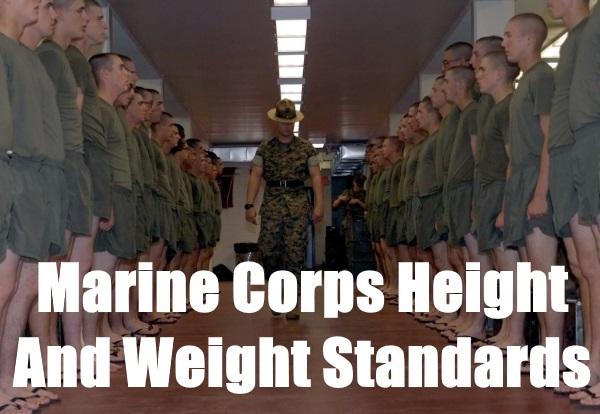
To join the U.S. Marine Corps, applicants must meet established height, weight, and body composition standards.
These standards apply to both enlisted personnel and officers and are enforced throughout a Marine’s career.
The Marine Corps uses a combination of weight, body fat measurements, and fitness test performance to assess compliance.
This article explains Marine Corps height, weight, and body fat standards and how they are measured and enforced.
Enlisted and officer Marines in active duty are weighed semi-annually while Reserves are weighed annually. These weights are compared to the set Marine standards in the below chart.
Here are charts for height and weight standards for the Marines, both for females and males:
Marine Corps Height and Weight Standards Charts
Male
Marine Corps Weight Standards for Men
| Height (inches) | Minimum Weight (in lbs.) | Maximum Weight (in lbs.) |
|---|---|---|
| 56 | 85 | 122 |
| 57 | 88 | 127 |
| 58 | 91 | 131 |
| 59 | 94 | 136 |
| 60 | 97 | 141 |
| 61 | 100 | 145 |
| 62 | 104 | 150 |
| 63 | 107 | 155 |
| 64 | 110 | 160 |
| 65 | 114 | 165 |
| 66 | 117 | 170 |
| 67 | 121 | 175 |
| 68 | 125 | 180 |
| 69 | 128 | 186 |
| 70 | 132 | 191 |
| 71 | 136 | 197 |
| 72 | 140 | 202 |
| 73 | 144 | 208 |
| 74 | 148 | 214 |
| 75 | 152 | 220 |
| 76 | 156 | 225 |
| 77 | 160 | 231 |
| 78 | 164 | 237 |
| 79 | 168 | 244 |
| 80 | 173 | 250 |
Source: Marines.mil
Female
Marine Corps Height And Weight Standards for Women
| Height (in inches) | Minimum Weight (in lbs.) | Maximum Weight (in lbs.) |
|---|---|---|
| 56 | 85 | 115 |
| 57 | 88 | 120 |
| 58 | 91 | 124 |
| 59 | 94 | 129 |
| 60 | 97 | 133 |
| 61 | 100 | 137 |
| 62 | 104 | 142 |
| 63 | 107 | 146 |
| 64 | 110 | 151 |
| 65 | 114 | 156 |
| 66 | 117 | 161 |
| 67 | 121 | 166 |
| 68 | 125 | 171 |
| 69 | 128 | 176 |
| 70 | 132 | 181 |
| 71 | 136 | 186 |
| 72 | 140 | 191 |
| 73 | 144 | 197 |
| 74 | 148 | 202 |
| 75 | 152 | 208 |
| 76 | 156 | 213 |
| 77 | 160 | 219 |
| 78 | 164 | 225 |
| 79 | 168 | 230 |
| 80 | 173 | 236 |
Source: Marines.mil
Body Fat Standards for Marines
As per the recent updates, effective for 2023:
Maximum body fat percentages for Marines vary by age and gender according to current Marine Corps policy. These standards apply to first-time recruits and extend throughout their career as a Marine.
Marines may avoid body fat screening tests if they meet the set scores for both the physical fitness test and the combat fitness test. Exemptions from body fat screening are based on meeting qualifying scores on Marine Corps fitness tests, as defined by current policy. Body fat allowances tied to fitness test performance are determined by official Marine Corps guidelines.
Here are the maximum body fat percentages for Marines in each age group:
| Age Group | Body Fat % - Men | Body Fat % - Women |
|---|---|---|
| 17 - 20 | 18% | 27% |
| 21 - 25 | 18% | 27% |
| 26 - 30 | 19% | 28% |
| 31 - 35 | 19% | 28% |
| 36 - 40 | 20% | 29% |
| 41 - 45 | 20% | 29% |
| 46 - 50 | 21% | 30% |
| 51+ | 21% | 30% |
Related Article – USMC PFT/CFT Calculator
How Are Height and Weight Measured For the Marine Corps?
To measure height, a Marine must stand with his/her back against a wall with their heels flat on the floor and their head facing forward. Arms should hang relaxed at the sides and shoulders should lean backward. Height is rounded to the nearest full inch.
Weight is taken on a calibrated scale, either a balanced bean or digital scale. For Marines already in the service, their weight is taken while in their PT uniforms with no shoes. This means that a pound is deducted from the measured weight to account for the uniform. Again, the weight is rounded off to the nearest full pound.
What Happens When You Exceed Marines Weight Standard?
If a Marine has exceeded the maximum limit for weight requirement, he/she will undergo body fat tests using a tape measure with a self-tensioning measuring tape. Those results are recorded on the BCP Evaluation form (NAVMC 11621 (Rev. 11-16)) and used to estimate body fat percentage.
If the body fat percentage for the Marine is higher than the allowable number according to the chart above, a Dual -Energy X-Ray Absorptiometry (DEXA) or Bioelectrical Impedance Analysis (BIA) is used to validate the tape test.
The Marines discovered that the tape test wasn’t as accurate as required, so they changed the policy as of 2023.
If the body fat percentage is still above the maximum allowed, the Marine is enrolled in the Body Composition Program.
Before being placed on the program, active-duty Marines are given a medical work-up to rule out any underlying medical cause.
If even after joining the Body Composition Program, a Marine fails to meet the maximum weight limit, he/she may be involuntarily discharged.
Please note that Marines who exceed the weight standards but meet the body fat requirements are considered fit for the service; they would not be enrolled in the Body Composition Program.
Policy updates were implemented to better align body composition standards with overall fitness and readiness.
Also, it is important to point out that Marines who are below the standard weight and body standards are considered fit for the Marines. However, Commanders may refer them for a thorough medical evaluation to rule out any health or psychological factor that might be resulting in them being underweight.
It’s also important to note that the Corps waives weight requirements for existing female Marines up to 9 months after delivery for pregnancy.
Waivers for Body Fat Requirements
Waivers, under rare circumstances, are passed to the first Commanding General Officer in the Marine’s chain of command.
Body composition waivers are evaluated on a case-by-case basis through the chain of command.
What People Get Wrong About Marine Corps Height and Weight Standards
A common misconception is that the Marine Corps evaluates fitness based solely on weight. In reality, body fat percentage and physical fitness test performance are central components of the assessment process.
Some people assume that exceeding the weight chart automatically disqualifies a Marine. Marines who exceed weight limits but remain within body fat standards are generally considered compliant.
Another misunderstanding is that standards are based on appearance rather than performance. Marine Corps policies emphasize health, readiness, and operational capability rather than visual criteria.
There is also confusion about exemptions, with the belief that standards apply only at enlistment. Height, weight, and body composition requirements apply throughout a Marine’s career, with limited temporary exceptions such as pregnancy-related waivers.
Bottom Line
All Marines are expected to maintain the set height and weight standards throughout their stay in the service. This is to ensure they are physically ready for any operation they get called upon.
Marines who exceed the maximum weight limit or body fat composition may be enrolled in the Marine Corps’ Body Composition Program to help them trim down their weight.
Additional References
Related Articles:
Pros And Cons Of Joining The Marine Corps