
Understanding Navy SEAL ranks helps aspiring candidates map out their potential career path in special operations.
These ranks follow the standard United States Navy hierarchy with no separate system for SEAL personnel.
Enlisted members advance from entry level paygrades up to senior leadership positions.
Commissioned officers provide command and strategic oversight at higher levels.
This updated 2026 resource covers insignia descriptions current pay information and progression tips.
Families and service members alike can use these details to make informed decisions about pursuing this elite career.
Related Article: Navy Ranks and Pay
Jump To A Section
Navy SEAL Enlisted Rankings Structure
The following list contains Navy SEAL ranks and pay based on non commissioned and senior non commissioned officers.
This breakdown includes ranking insignia, abbreviation of ranking, and overview of the role.
To start, here’s a chart that shows the pay for all enlisted ranks:
| Insignia | Pay Grade | Rank | Abbreviation | 2026 Minimum Monthly Pay (<2 Years) |
|---|---|---|---|---|
| N/A | E-1 | Seaman Recruit | SR | $2,407.20 (after 4 months; $2,225.70 for first 4 months) |
 | E-2 | Seaman Apprentice | SA | $2,697.90 |
 | E-3 | Seaman | SN | $2,836.80 |
 | E-4 | Petty Officer Third Class | PO3 | $3,142.20 |
 | E-5 | Petty Officer Second Class | PO2 | $3,342.90 |
 | E-6 | Petty Officer First Class | PO1 | $3,401.10 |
 | E-7 | Chief Petty Officer | CPO | $3,932.10 |
 | E-8 | Senior Chief Petty Officer | SCPO | $5,656.50 (starts at over 8 years) |
 | E-9 | Master Chief Petty Officer | MCPO | $6,910.20 (starts at over 10 years) |
 | E-9 | Fleet/Command Master Chief Petty Officer | FMCPO/CMCP | $6,910.20 (starts at over 10 years) |
 | E-9 | Master Chief Petty Officer of the Navy | MCPON | $6,910.20 (starts at over 10 years) |
Related Article: Most Popular SEAL Cadences
Seaman (E-3)
Abbreviation: SN
How they are identified:


Rank overview: Seaman is considered the entry level of the U.S. Navy SEALs and the third lowest ranking among enlisted in the USN.
Navy Seaman (E-3 / SN) are entry-level sailors who may still be completing initial training or qualifications. Most of them are already part of Fleet at the time of training.
Fleet E-3s have already earned basic qualifications and understand how to navigate a ship. The experience and knowledge is helpful in this entry-level role, as well as future placement in higher rankings.
Fleet Seamen will have a number of different responsibilities within their Division. As they provide basic maintenance and watch, Navy Seamen also prepare for the role of Petty Officers.
Petty Officer Third Class (E-4)
Abbreviation: PO3
How they are identified:

.svg)
Rank overview: By the time most members reach E-4 they have made it to Fleet. There are a few rare exceptions, but by now most are fully trained and prepared for general duties.
E-4s are the most junior of all Petty Officer ranks. Leadership and becoming self-sufficient are major priorities of this ranking.
Members are qualified to hold watch and may also conduct maintenance and repairs on certain equipment.
Petty Officers help mentor junior Seamen to help improve their leadership skills. E-4s will also begin to attend advanced schools to build upon other skills.
Petty Officer Second Class (E-5)
Abbreviation: PO2
How they are identified:


Rank overview: The mid-grade E-5 operates between Petty Officers and First Class Petty Officers.
Skills continue to be enhanced in watch stations and maintenance. Mentoring is another big component of the role of junior Seamen and Petty Officers.
Leadership roles will continue to be expanded along with several important additional duties. E-5s are attending advanced schools and starting work on supervisory qualifications.
Petty Officer First Class (E-6)
Abbreviation: PO1
How they are identified:

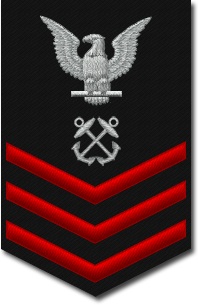
Rank overview: E-6s represent the highest grade of Petty Officers. They serve as Divisional leadership and delegate assignments.
First Class Petty Officers primarily oversee work and only execute the most difficult and complex tasks themselves.
Mentoring is a major part of their duty as they remain in charge of day-to-day operations.
Chief Petty Officer (E-7)
Abbreviation: CPO
How they are identified:

Rank overview: Chief Petty Officers (E-7) are considered the heart of the “deckplate”, or ground-level leadership. The uniform resembles that of an officer, and thus are treated accordingly.
E-7s are very seasoned and knowledgeable. Their supervision includes the supervision of all Petty Officers.
The training and mentoring of Junior Officers are the primary duty of E-7 Officers. The Officer and Chief work in close coordination during this training.
Each Chief represents his or her own Division or Department.
Senior Chief Petty Officer (E-8)
Abbreviation: SCPO
How they are identified:


Rank overview: E-8s, or Senior Chief Officers, are extremely seasoned and outstanding service members.
E-8s closely communicate with Department Heads as well as Chiefs.
Their primary responsibility is to train new Chiefs. E-8s are not nearly as present on the deckplate as E-7s.
Master Chief Petty Officer (E-9)
Abbreviation: MCPO
How they are identified:
U.S. Navy SEAL Master Chief Petty Officer.


Rank overview: Master Chiefs are the most seasoned members of the Chiefs Mess, or rankings E-7, E-8 and E-9.
Their voice is heavily considered in every discussion as they represent the largest department on the ship.
Master Chiefs ensure communication, unity, and cooperation.
Command Master Chief Petty Officer (E-9)
Abbreviation: CMDCM
How they are identified:


Rank overview: Command Master Chiefs are the leading Chief on ships or shore-based units.
They are a walking and talking example for how the rest of the ship should conduct themselves. The example they establish is crucial.
Their role is part of a “Command Team” that also includes a CO and XO.
Master Chief Petty Officer of the Navy (E-9)
Abbreviation: MCPON
How they are identified:


Rank overview: The Master Chief Petty Officer (MCPON) represents the senior enlisted person in the Navy.
The position is the principal enlisted advisor to the Chief of Naval Operations.
The primary duties include addressing the concerns and complaints of enlisted sailors throughout the Navy.
Related Article: How to Join the U.S. Navy
Navy SEAL Officer Rankings Structure
The following list contains Navy SEAL officer ranks and pay based on junior, senior, and flag officers.
This breakdown includes the officer ranking insignia, abbreviation of ranking, and overview of the role.
Here’s a chart of Navy SEAL officer ranks and minimum monthly pay:
| Insignia | Pay Grade | Rank | Abbreviation | 2026 Minimum Monthly Pay (<2 Years) |
|---|---|---|---|---|
 | O-1 | Ensign | ENS | $4,150.20 |
 | O-2 | Lieutenant Junior Grade | LTJG | $4,782.00 |
 | O-3 | Lieutenant | LT | $5,534.10 |
 | O-4 | Lieutenant Commander | LCDR | $6,294.60 |
 | O-5 | Commander | CDR | $7,295.40 |
 | O-6 | Captain | CAPT | $8,751.30 |
 | O-7 | Rear Admiral Lower Half | RDML | $11,540.10 |
 | O-8 | Rear Admiral Upper Half | RADM | $13,888.50 |
 | O-9 | Vice Admiral | VADM | $19,629.30 (starts at over 20 years) |
 | O-10 | Admiral | ADM | $20,058.30 (starts at over 20 years) |
Ensign (O-1)
Abbreviation:
How they are identified:


Rank overview: An Ensign (O-1 / ENS) is the lowest commissioned officer rank in the U.S. Navy. It is typically held for about two years before promotion to O-2.
Ensigns have a variety of different roles. They spend time earning the respect of their crew during this two-year phase.
Fleet Ensigns are often assigned to lead a division or small team, managing 5–50 personnel depending on the unit.
Lieutenant Junior Grade (O-2)
Abbreviation: LTJG
How they are identified:


Rank overview: Lieutenant Junior Grade holds this position for two years after progressing from Ensign.
O-2s may have already spent several months in the Fleet, or may start shortly after being promoted.
The responsibilities of an O-2 increase with the promotion. They are usually in charge of more soldiers and duties are more complex.
Lieutenant (O-3)
Abbreviation: LT
How they are identified:


Rank overview: Lieutenants in the U.S. Navy SEALs is different than the role in the Army, Marines, and Air Force, where they represent O-1 or O-2.
The expectations for an O-3 are high and they are expected to be fully warfare qualified by this point in time.
Lieutenants are the principal mentors of Junior Officers and provide much of the training as well as direction.
Lieutenant Commander (O-4)
Abbreviation: LCDR
How they are identified:


Rank overview: O-4s are usually referred to as Lieutenant Commanders. An LCDR handles what is called “billets,” or jobs that vary based on the community.
O-4s are professionals that are assigned based on equivalent years of experience, offering quicker advancement.
Commander (O-5)
Abbreviation: CDR
How they are identified:


Rank overview: While an 0-5 in the Navy would generally command anything from a destroyer to a submarine, O-5s in the SEAL teams will command a SEAL team.
Commanding Officers are usually referred to as “Skipper” or “Captain.” The latter of which is only used for sea-going Commanders.
O-5s are specialized professionals with equivalent years of experience, much like 0-4s.
Captain (O-6)
Abbreviation: CAPT
How they are identified:


Rank overview: Captains (O-6) serve as the Commanding Officers of Major Commands. Certain ships, like aircraft carriers, feature multiple O-6s.
Captains are assigned sea-going as well as shore-based roles. They are placed in varying political empowerment depending on their inherent “track” toward a flag position.
Rear Admiral Lower Half (O-7)
Abbreviation: RDML
How they are identified:


Rank overview: Rear Admiral Lower Half (O-7) oversees operations on ships. They work closely with Commanding Officers.
Overall planning and movement are a priority. They also oversee major shore-based commands too.
Rear Admiral (O-8)
Abbreviation: RADM
How they are identified:


Rank overview: Rear Admirals (0-8) handle many of the same responsibilities as O-7s though with a greater emphasis.
They are usually stationed on a ship and are able to speak with Commanding Officers directly.
Vice Admiral (O-9)
Abbreviation: VADM
How they are identified:


Rank overview: Vice Admirals are generally in charge of the highest Navy Commands. They also serve as deputies of Combatant or Geographic Commands.
Flag rank officers from any service may get selected for Joint Commands. An example of this would be AFRICOM.
Admiral (O-10)
Abbreviation: ADM
How they are identified:


Rank overview: Admirals (ADM) hold the highest position within Navy Commands, or Combatant or Geographic Commands.
Like O-9s, Admirals may be selected from any service for Joint Commands, such as the Chairman of the Joint Chiefs of Staff (CJCS).
As before, we mentioned that the pay listed for each rank is the absolute minimum. The big factor to influence it would be time served in the Navy. An 03 that’s been in 6 years would make $9,012.60 in basic pay.
Other factors to consider for an increase in pay would be SkIP, or Skill Incentive Pay for those that have been certified in parachute, dive, and/or demolition. This pay can range from $515 to $715 monthly whether one is deployed or not.
Related Article: How to Make Sure Someone is a Navy SEAL
Non-Commissioned Officer Vs. Commissioned
Non-commissioned officers of the Navy SEAL ranks structure hold lower positions than commissioned officers. Their roles and responsibilities are more limited.
They also receive less pay per month than most commissioned ranks. Commissioned officers have more training than non-commissioned officers, though non-commissioned members can eventually move up in ranking.
Junior Officer Vs Senior Officer
Senior Officers have more priority and higher ranking than Junior Officers, yet both still serve under the leadership of commissioned officers.
Junior Officers fill the lower ranks of units, usually answering to senior officers, who help provide guidance and mentoring. The goal of Junior Officers is to progress to Senior Officers.
Senior Officer Vs. Flag Officer
Based on the Navy SEAL ranks and pay, Flag Officers receive better benefits than Senior Officers. They are both high-ranking positions, though Flag Officers are considered the most elite.
They receive the most pay of any Navy SEAL member and have incredibly diverse and important responsibilities. Senior Officers are important in their own right, serving as Division Heads and other important roles.
Related Article: Basic Underwater Demolition/SEAL (BUD/S) Training Explained
What People Get Wrong About Navy SEAL Ranks
Many people incorrectly assume that Navy SEALs maintain a completely independent rank structure outside the standard Navy framework.
In truth SEAL operators hold the same paygrades and titles as their conventional Navy counterparts.
This alignment ensures consistent pay promotion timelines and authority levels across the service.
A frequent misunderstanding is that SEAL teams consist primarily of commissioned officers.
The reality is that enlisted sailors form the backbone of every SEAL platoon and carry out the majority of direct action missions.
Rank progression remains crucial even in the high tempo environment of special warfare.
Higher ranks unlock greater leadership responsibilities and influence over mission planning and execution.
Another myth suggests the Trident pin serves as the sole identifier of rank for SEALs.
Operators actually display standard Navy rating badges and stripes in addition to the qualification insignia.
Some individuals believe flag rank positions are easily attainable for those who complete BUD S training.
Only a handful of SEALs ever reach admiral level after decades of distinguished service and leadership.
Senior enlisted SEALs often get overlooked in discussions of command structure within teams.
These master chiefs and command master chiefs provide essential mentorship and operational expertise to junior team members.
Special pays such as dive pay and hazardous duty incentives supplement base salary but do not replace rank based compensation.
Understanding these nuances helps candidates set realistic expectations for long term advancement in the SEAL community.
Effective teamwork between officers and enlisted ranks drives the success of complex special operations worldwide in 2026.
Pay charts for 2026 reflect annual adjustments designed to support retention among highly skilled personnel.
Candidates should focus on continuous skill development alongside traditional rank advancement for optimal career growth and impact.
Summary
As you can see, the rank structure for Navy SEALs is identical to the rest of the U.S. Navy, with no unique ranks or paygrades specific to SEALs.
This also applies to the Navy’s elite SEAL team as well, often referred to as DEVGRU, or by its moniker SEAL Team 6.
If you have any questions on any of this, feel free to leave a comment below!

Hello,
thank you for the information. I watched the movie ‘Tears of the Sun’ (sorry for referencing a movie which must be a very tiresome source of misinformation); and assumed that Lieutenant was a senior rank. I think mostly of old British navy ranks where (ships) Captain is a field officer; army equivalent Colonel or General (obviously somtimes an Admiral). Just under the Captain is the Lieutenant which I thought was Major or Colonel. This was strengthened by the idea that an operation like that (in the movie) would not be led by someone lower than Major rank (army). But wikipedia equates Lieutenant (navy) with Captain (army)
https://en.wikipedia.org/wiki/Lieutenant
https://en.wikipedia.org/wiki/Tears_of_the_Sun
Would a Naval (SEAL) of rank Lieutenant (if it is equivalent to an army Captain) be in charge of such a sensitive, and difficult operation. I realise he was only in charge of a small operation, considering numer of men, one platoon equivalent, I think)
I do not mean any disrespect to the officers of lower rank. But a 40 year old (And Bruce Willis was closer to 50) Lieutenant (navy)/ Captain (army) seems to stand out. I am not a military person, (but I do not think I need to say so)
Hello, I am currently serving on Active Duty in the U.S. Navy. I wanted to let you know that your image for Senior Chief Petty Officer is incorrect. Instead of the star beneath the rocker, it should be a rating insignia (crossed anchors). The star in that spot is reserved for Command Master Chief Petty Officer.
Thanks for that Dakota. Can you do me a favor? Can you point me to an image that shows the insignia for Master Chief Petty Officer? I just want to make sure I put the right one up. Thanks in advance.
Rob V.
OMK Founder