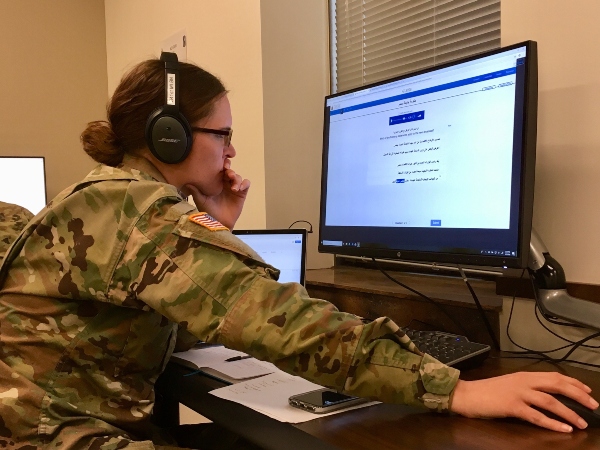
Army Signals Intelligence Voice Interceptors (MOS 35P), also known as Army Cryptologic Linguists, identify and analyze foreign language communications using signals intelligence equipment.
This role supports intelligence operations by collecting, translating, and processing communications relevant to assigned missions.
Signals Intelligence Voice Interceptors differ from other intelligence specialties by requiring proficiency in a foreign language in addition to technical training.
Understanding the education, qualifications, training, and duties associated with MOS 35P helps clarify how this role supports Army intelligence operations.
It is also similar to the role of an Army Signals Intelligence Analyst (MOS 35N) with the exception that an MOS 35P also needs to understand a second language.
Related Article – Army Human Intelligence Collector (MOS 35M): Career Details
Education, Qualifications, Training, and Duty Stations

The U.S. Army relies on Signals Intelligence Voice Interceptors (MOS 35P) for national security.
The information that an Army Signals Intelligence Voice Interceptor is able to identify is generally spoken or worded in a foreign language, so knowledge of a second or even third language is required.
Here are all the Education, Qualifications, Training, and Duty Stations you need to become 35P MOS:
Education
You won’t be able to enlist in the U.S. Army without a high school diploma or GED.
After speaking with an Army recruiter, you will eventually take the Armed Services Vocational Aptitude Battery (ASVAB) at a nearby high school or MEPS station.
The ASVAB is an assortment of tests that help determine a Military Occupational Specialty (MOS).
Prospective Signals Intelligence Voice Interceptors (MOS 35P) must meet the required Skilled Technical (ST) score on the ASVAB.
Additionally, Signals Intelligence Voice Interceptors must complete the Defense Language Aptitude Battery (DLAB).
The DLAB evaluates how well a native English speaker can learn a new language.
Your score on the DLAB determines the level of difficulty for language training and if you are the right fit for 35P MOS.
Applicants must receive a qualifying score on the Defense Language Aptitude Battery.
Related Article – Air Force Airborne Cryptologic Linguist (1A8X1): Career Details
Qualifications
Prospective Army Signals Intelligence Voice Interceptors (MOS 35P) must also receive a “Top Secret” security clearance from the Department of Defense in addition to scoring well on the ASVAB and DLAB.
The background check for a Top Secret clearance is intensive.
Certain criminal convictions may disqualify an applicant from eligibility for MOS 35P.
Prior service in certain organizations may affect eligibility based on Department of Defense policies.
Recruits are also expected to demonstrate good voice quality.
They should speak the English language, as well as an additional foreign language, “fluently and idiomatically, without accent or impediment.”
Lastly, 35P MOS must have normal color vision (no color blindness).
While not mandatory, the Army also suggests that prospective MOS 35P demonstrate an interest in speech, communications, and foreign languages.
Those that enjoy reading and writing, as well as being good at working with people, will make great additions to the Army’s intelligence team.
Related Article – Army Interpreter (MOS 09L): Career Details
Training
Once you begin your journey in the U.S. Army, you will arrive at boot camp or Basic Combat Training.
BCT lasts 10 weeks for all new recruits, regardless of Military Occupational Specialty.
After the completion of BCT, you will move forward to Advanced Individual Training (AIT).
Like many other US Army careers, AIT for Army Signals Intelligence Voice Interceptors (MOS 35P) is incredibly in-depth.
Advanced Individual Training length varies based on language requirements and training progression.
Training takes place at the Defense Language Institute Foreign Language Center (DLIFLC) in Monterey, California.
The DLIFLC is a joint service school managed by the Army but also supervised by the Department of Defense.
If you already fluently speak a foreign language, you may receive permission to bypass DLIFLC training.
If not, the amount of time you spend there will depend on how quickly you master a second language.
You will learn how to identify foreign communications from an assigned geographic area.
You will also analyze foreign communications to support missions.
There is also training dedicated to procedures for handling classified information and preparing reports.
Related Article – Navy Cryptologic Technician Interpretive (CTI): Career Details
Duty Stations
Those serving in the Army in MOS 35P can expect to be potentially based at one of the following duty stations:
Inside the Continental US (CONUS)
- Fort Bliss, TX
- Fort Campbell, KY
- Fort Carson, CO
- Fort Cavazos, TX
- Fort Drum, NY
- Fort Gordon, GA
- Fort Irwin, CA
- Fort Johnson, LA
- Fort Liberty, NC
- Fort Meade, MD
- Fort Moore, GA
- Fort Riley, KS
- Goodfellow AFB, TX
- Joint Base Lewis-McChord, WA
- Joint Base San Antonio, TX
Outside the Continental US (OCONUS)
- Fort Wainwright, AK
- Joint Base Elmendorf-Richardson, AK
- USAG Bavaria, Germany
- USAG Hawaii
- USAG Humphreys, South Korea
- USAG Italy, Vicenza
- USAG Wiesbaden, Germany
- USAG Yongsan-Casey, South Korea
What does an Army Signals Intelligence Voice Interceptor Do?

As we mentioned at the beginning of this article, the role of an Army Signals Intelligence Voice Interceptor (MOS 35P) is very similar to the position of a Signals Intelligence Analyst (MOS 35N).
The purpose of both Military Occupational Specialties is to identify foreign language communications with signals equipment.
The biggest difference between MOS 35P and MOS 35N is that Army Signals Intelligence Voice Interceptors must know a second language.
Job Duties of 35P MOS
A Signals Intelligence Voice Interceptor (MOS 35P) has an important job in combat situations that take place in foreign countries where there is a language barrier.
The role of 35P MOS involves a lot more than just translating and communicating foreign languages.
Your job duties will include:
- Identify and analyze foreign communications.
- Recognize changes in transmission modes as well as tip the appropriate authority.
- Provide translation expertise to other analysts.
- Produce transcriptions and translations from foreign communications.
Army Signals Intelligence Voice Interceptors use signals equipment based on a geographic area to retrieve signals and categorize them by type.
Signals Intelligence Voice Interceptors are skilled at recognizing changes in transmission modes and tipping the appropriate analytical or intercept authority.
Related Article – List of Army Bases in the US
What does an Army Signals Intelligence Voice Interceptor make?

The Army pays its service members based on rank and years of service.
Your pay is not tied to your Military Occupational Specialty (MOS), although occasionally the Army will offer retention bonuses or special allowances for hazardous jobs.
For an idea of how much you will make in the U.S. Army based on rank, please reference the table below:
| Insignia | Pay Grade | Rank | Abbreviation | Minimum Monthly Pay |
|---|---|---|---|---|
| E-1 (less than 4 months) | Private | PVT | $2,226 | |
| E-1 (after 4 months) | Private | PVT | $2,407 | |
 | E-2 | Private Second Class | PV2 | $2,698 |
 | E-3 | Private First Class | PFC | $2,837 |
 | E-4 | Specialist or Corporal | SPC | $3,142 |
 | E-5 | Sergeant | SGT | $3,342 |
 | E-6 | Staff Sergeant | SSG | $3,401 |
 | E-7 | Sergeant First Class | SFC | $3,932 |
 | E-8 | Master Sergeant | MSG | $5,657 |
 | E-8 | First Sergeant | 1SG | $5,657 |
 | E-9 | Sergeant Major | SGM | $6,910 |
 | E-9 | Command Sergeant Major | CSM | $6,910 |
 | E-9 | Sergeant Major of the Army | SMA | $6,910 |
Benefits
The U.S. Army has numerous benefits included with a monthly salary:
- Medical Insurance
- Vacation Time
- Special Pay
- Retirement
- Housing: Allowances for living expenses, utilities, and maintenance.
- Food: Allowance for the on-base dining hall and access to tax-free department and grocery stores.
- Education: Army members can earn full tuition, merit-based scholarships, allowances for books and fees, plus an annual stipend for living expenses.
Job Reviews
Job experiences for Army Signals Intelligence Voice Interceptors vary based on assignment and individual circumstances.

The job reviews break down the good and bad about the U.S. Army.

Regardless, the vast majority of reviews have very good things to say about the opportunities and ability to progress working MOS 35P.

Related Article – Army Intelligence Analyst (MOS 35F): Career Details
Civilian Job Opportunities
There are several Signals Intelligence Voice Interceptors (MOS 35P) that advance with government agencies or embassies following the conclusion of their service term with the Army.
You can work as a translator for agencies like the Department of Defense or the National Security Agency (NSA).
Additionally, places like universities and businesses that conduct operations overseas are in need of highly qualified translators.
Other Army Signals Intelligence Voice Interceptors advance to serve as radio operators, database administrations, business operations specialists, or computer operators.
What People Get Wrong About Army Cryptologic Linguists
A common misconception is that Army Cryptologic Linguists only perform translation duties.
While language skills are essential, MOS 35P also involves signals collection, analysis, transcription, and reporting using specialized equipment.
Some people believe that prior fluency in a foreign language is required to qualify.
In reality, many Cryptologic Linguists learn their assigned language through formal training after enlistment.
Another misunderstanding is that this role is limited to office-based work.
Depending on assignment, Signals Intelligence Voice Interceptors may support operational units and intelligence missions in a variety of environments.
There is also confusion about security requirements.
MOS 35P requires eligibility for a Top Secret security clearance, which includes an extensive background investigation.
Finally, some assume that language assignments are permanent.
Language requirements and assignments can change based on Army needs and mission priorities.
Summary
An Army Signals Intelligence Voice Interceptor (MOS 35P) is responsible for identifying foreign communications with signals equipment.
The role is very important to national security and can advance you into a career with a government agency following your term in the U.S. Army.
Resources:
- https://www.goarmy.com/careers-and-jobs/browse-career-and-job-categories/intelligence-and-combat-support/cryptologic-linguist.html
- https://www.indeed.com/cmp/U.S.-Army/reviews?fjobtitle=Cryptologic+Linguist
