
Army height and weight standards are one of the most common reasons otherwise qualified applicants are delayed or disqualified from enlistment.
These standards are used to assess whether a recruit meets the Army’s baseline physical readiness requirements before entering training.
This page is for individuals preparing to enlist in the U.S. Army, applicants checking eligibility before visiting MEPS, and families helping someone understand enlistment requirements.
It explains how Army height, weight, and body fat standards work and how they are applied during the enlistment process.
While the Army allows certain weight-related waivers and preparatory programs, height requirements remain fixed, and all applicants must meet medical and physical screening standards at MEPS.
Policies can differ between new recruits and currently serving soldiers.
Below, you’ll find current Army height, weight, waist measurement, and body fat standards, how measurements are taken, waiver policies, and official charts used during enlistment screening.”
What People Get Wrong About Army Height and Weight Standards
A common misconception is that weight alone determines eligibility.
In reality, the Army evaluates height, weight, waist measurement, and body fat percentage together, and applicants who exceed weight limits may still qualify if they meet body composition standards.
Another misunderstanding is that waivers are automatic.
Weight waivers and preparatory programs are conditional, depend on current Army policy, and are not guaranteed for every applicant.
Finally, standards for new recruits and active soldiers are often confused.
Policies such as ACFT exemptions apply to serving soldiers, not applicants attempting to enlist for the first time.
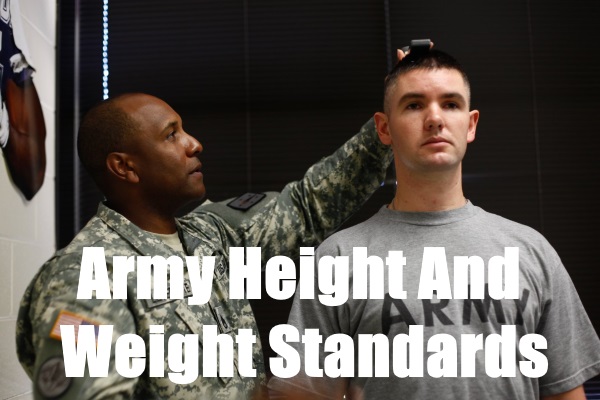
How Are Weight and Height Measurements Taken?

Army personnel takes official weight and height measurement to determine an applicant’s physical condition.
This is part of the physical exam of the Military Entrance Processing Station (MEPS) every applicant must follow and pass before being sworn in as a recruit.
Related Article – Army MOS List: A List Of All 159 Army Jobs
Both height and weight measurements are rounded up or down to the nearest whole digit.
The rounding off depends on whether it is more or less than .5 lb. For instance, if your weight is 119.6 lbs, the official weight that will be noted down will be 120 lbs.
If your weight exceeds the maximum limit provided for by the U.S. Army, then the MEPS officials may opt to carry out body fat percentage tests before giving you the go-ahead to be a recruit.
Waist Measurement and WHtR Standard
The U.S. Army now uses waist measurements as part of body composition screening when an applicant exceeds height and weight limits.
Applicants who exceed their maximum allowable weight are evaluated using waist circumference to determine whether their waist-to-height ratio (WHtR) is below the Army’s established threshold.
A WHtR of less than 0.55 is used as a screening standard for both men and women. Applicants who meet this standard may pass body composition screening without additional body fat testing.
Maximum Waist Circumference for WHtR < 0.55 (All Genders)
The table below shows the maximum allowable waist circumference by height to meet the WHtR < 0.55 screening standard:
| Height (inches) | Maximum Waist (inches) for Pass (< 0.55 WHtR) |
|---|---|
| 58 | < 31.9 |
| 59 | < 32.45 |
| 60 | < 33.0 |
| 61 | < 33.55 |
| 62 | < 34.1 |
| 63 | < 34.65 |
| 64 | < 35.2 |
| 65 | < 35.75 |
| 66 | < 36.3 |
| 67 | < 36.85 |
| 68 | < 37.4 |
| 69 | < 37.95 |
| 70 | < 38.5 |
| 71 | < 39.05 |
| 72 | < 39.6 |
| 73 | < 40.15 |
| 74 | < 40.7 |
| 75 | < 41.25 |
| 76 | < 41.8 |
| 77 | < 42.35 |
| 78 | < 42.9 |
| 79 | < 43.45 |
| 80 | < 44.0 |
Army Body Fat Percentage Maximums For Men
| Age Group | Max Body Fat % |
|---|---|
| 17–20 | 20% |
| 21–27 | 22% |
| 28–39 | 24% |
| 40+ | 26% |
Army Body Fat Percentage Maximums For Women
| Age Group | Max Body Fat % |
|---|---|
| 17–20 | 30% |
| 21–27 | 32% |
| 28–39 | 34% |
| 40+ | 36% |
In March 2022, the Department of Defense set policies to improve and standardize fitness standards across the Armed Forces.
Setting body fat percentage standards is one method for determining physical fitness. The new DoD policy specifies both minimum and maximum percentages that the various branches can use to make the determination.
The new policy notes that female service members may not have more than 36 percent body fat, while male servicemembers must have less than 26 percent body fat.
However, no service branch can set minimum limits below 26 percent for women and 18 percent for men.
Height Requirements
The U.S. military has a specific height range that all recruits fall in.
The reason they have a strict height range is that the military doesn’t have a flexible budget or time to tailor-make customized uniforms and equipment for personnel outside the set height ranges.
Besides, the tanks, shipboard, and airplane jobs will be difficult if someone exceeds the set height standards.
The acceptable height range for male Army applicants is between 60 inches and 80 inches.
Therefore, if you fall outside this range, you might be rejected.
For female applicants, the cause for rejection to the U.S. military is a height less than 58 inches or more than 80 inches.
Related Article – Army APFT Test Standards For Males and Females
Growth Allowance
The minimum age for joining the US military is 17 years, although this calls for parental consent.
This means that there is still room for growth.
However, as long as you passed the physical exam of MEPS, you cannot be disqualified if you attain a height exceeding the set standards. It should be noted that you may be disqualified for certain MOS ratings if there are height restrictions.
The most notable case of a military member is that of David Robinson, a renowned basketball player.
He started his military career within the official height standards but went on to add more than six inches in his first four years at the Naval Academy.
At the time of joining the military, he was 6’7″, but in four years, he had grown to 7’1″. This means he had exceeded the 80 inches height standard. Rather than receiving an honorable discharge, he was allowed to see off his contract.
He played professional basketball but continued serving active duty. He later served in Naval Reserves doing recruitment and promotion campaigns for the Navy.
Weight Requirements
Weight Requirements follow a standard chart that takes gender, age groups, and height into account to determine the maximum and minimum weight limits.
For instance, a recruit who is between 17 and 20 years, with a height of 60 inches, should not exceed 128 lbs for females and 132 lbs for males.
Related Article – Military Diet Review: My 7 Day Results On The 3-Day Diet
Weight Waiver
If you exceed the maximum weight limit for your height, gender, and age group, you may be granted a weight waiver as long as you are under the maximum body fat percentage for your age and gender.
ACFT Test
For existing soldiers who don’t pass the height/weight requirements, scoring high enough on the Army Combat Fitness Test (ACFT) may be enough.
In March 2023, the Army decided that an ACFT score of 540, with a minimum of 80 in all six events, exempts active soldiers from height/weight requirements for up to 8 months. It exempts Reserve and Guard members for up to 15 months.
The Need to Stay Fit In the Army
Keeping within the weight and height standards of the Army is a must for both active duty and reserve soldiers.
Related Article – How To Lose Weight For The Military: Your 30-Day Plan
More often, the physical activities of the Army ensure their weight and body fat composition stays within limits. However, for those assigned desk duties, they have to get into a regular physical fitness routine to keep their bodies fit.
The Army does not condone overweight individuals and soldiers with poor body composition for prolonged periods since this may lead to a decreased individual performance thereby causing disruption to their respective units.
In order to answer the call of duty to defend our Nation every service member must be physically fit.
Resources
10 Best Army Jobs For Civilian Life

You guys need to take into consideration on the guys that lift weights and go to the gym. I played football until I joined the army I am 67″ and weigh 210 pounds age 25. I have never been 169lbs always been over and have tried everything to get down to that and it’s impossible for me to.
there are ways to go around and working out is taken into consideration. if you don’t make Height and Weight standards you go to the body fat percentage category. if you are under or at the percentage you pass whats called tape. that would mean you are fit work out are whatever your doing is working for you. if you are over is when all else has failed and you would be labeled as over weight.
I cant even join the army. I’m 5’1, weigh 170, and female. My required weight is 132. I’ve never been that weight my entire life. I’ve lost weight from 192 and can go any further. When I weighed 192 and was taped test it came out as 38% body fat. Then when I lost 20 pounds and came back to be tape test in went up to 42%. The tape test is bogus. I’m very solid and just muscle. I fail my tape test because of my butt. My waist is 32 and my hips is 42. The tape test doesn’t do well with different body types.