Delta Force and Navy SEALs are elite special operations units within the United States Military, each with distinct missions, command structures, and selection processes.
While both units conduct high-risk operations and require advanced training, they are organized under different branches and fulfill different operational roles.
Understanding how Delta Force and Navy SEALs differ requires examining their mission focus, recruitment pipelines, and operational scope.
This article explains the key distinctions between Delta Force and Navy SEALs, including what each unit does and how personnel are selected.
Jump To A Section
What Is Delta Force?
Delta Force is short for 1st Special Forces Operational Detachment-Delta (1st SFOD-D).
It’s usually shortened to Delta Force, Combat Applications Group, or CAG.
Related Article – The Ultimate Guide To Becoming A Private Military Contractor
Soldiers are known to go by the name “operator,” a term that originates with the Green Berets. DELTA was formed in 1977, 25 years after the Army Special Forces was established. It is headquartered in Fort Liberty, North Carolina.


Also known as “The Unit,” Delta Force operates under Task Force Green within the United States Army.
The elite special mission unit is under the operational control of the Joint Special Operations Command. It handles counter-terrorism missions along with hostage rescue situations.
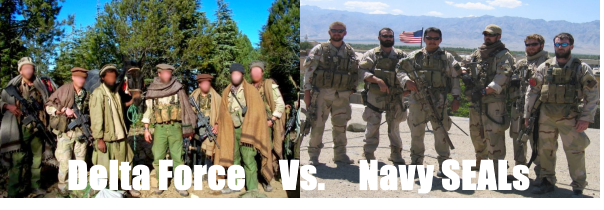
It is often compared to the U.S. Navy SEALs, SEAL Team 6, or DEVGRU, which is considered the maritime counterpart of the U.S. Army Delta Force. The two serve as the primary counter-terrorism special-ops in the United States Armed Forces.
Delta Force is notorious for performing some of the most sophisticated, classified, and dangerous missions in the U.S. Military.
Related Article – Green Berets Vs. Army Rangers: 5 Major Differences
What Are Navy SEALs?
The U.S. Navy SEALs is short for “Navy, Sea, Air, and Land Teams.” It is more commonly referred to by its abbreviation. The primary special ops force is a segment of the Naval Special Warfare Command.
The Navy SEALs were established in 1962, ten years after the formation of the Army Special Forces. It was the second special-ops unit to get created in the United States, fifteen years before DELTA.
SEALs perform small-unit maritime military operations. They originate and return from a body of water like an ocean, sea, river, swamp, or coastline.


U.S. Navy SEALs are one of the most respected units in all of the military because these highly trained soldiers are capable of operating in all environments, including sea, air, and land.
Navy SEALs have historically supported joint operations with other U.S. government organizations, though specific selection or assignment processes are not publicly detailed.
The joint operations the SEALs serve with SOG go back to Vietnam and remain evident to the present day.
Related Article – Air Force Office of Special Investigations (7S0X1): Career Details
What Does Delta Force Do?
The vast majority of operations that are assigned to Delta Force are classified and never known to the general public.
However, it is known that The Unit serves some of the most important and dangerous missions in the U.S. Military.
DELTA has been awarded some special honors for their work in service in missions like Operation Urgent Fury and the Modelo Prison Hostage Rescue Mission.
Delta Force also assisted in the capture of Manuel Noriega and was active during Operation Iraqi Freedom and Operation Enduring Freedom. Delta Force has participated in multiple operations related to Afghanistan, though specific awards and citations are not fully disclosed publicly.

There are some notable differences between Delta Force and SEALs. In addition to having different training and selection processes (more information, below) Delta Force operators also come from different backgrounds.
Unlike SEALs that are only selected from one branch of the U.S. Armed Forces, DELTA operators come from a variety of different units across different branches of the U.S. military.
Some of these operatives originate from the SEAL community. In fact, DELTA members first trained and worked along with SEALs before moving to Delta Force.
Related Article – Navy Special Warfare Combatant Craft Crewman (SWCC): Career Details
Therefore, their roots are more aligned with SEAL training and culture, though they also incorporate Delta Force methods – establishing a collection of the two different cultures.
Regardless, both units are capable of executing some of the most challenging military operations ever witnessed.
For example, DEVGRU was responsible for the rescue of Captain Phillips out at sea, and for Operation Neptune Spear in Pakistan resulting in the death of Osama bin Laden.

What Do Navy SEALs Do?
U.S. Navy SEALs are regularly considered one of the most, if not most, physically fit and demanding special units in all of the U.S. Armed Forces.
Like Delta Force, most of what the Navy SEALs have seen in the field is not widely reported because the information is highly classified.
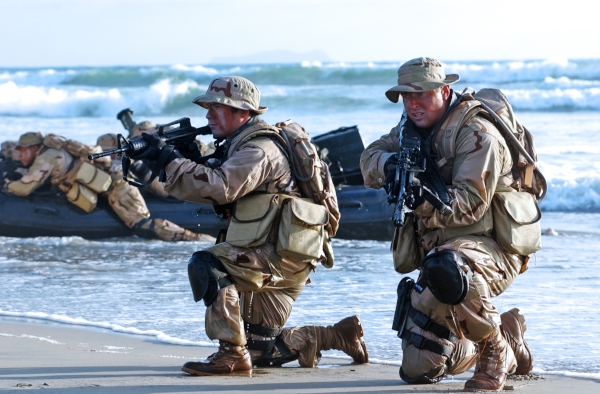

Navy SEALs operate on some of the most dangerous and demanding missions known to the U.S. Military.
SEALs are a rare military force in that they are equipped to handle missions on any landform. They are specialists in the water, yet also serve missions on land and air.
The special-ops force is broken into several different teams and structures. SEAL teams are small units that are based out of different places in the United States or abroad.
It has heavily influenced other special units around the globe.
What People Get Wrong About Delta Force vs. Navy SEALs
One common misconception is that Delta Force and Navy SEALs perform the same missions.
Although both units conduct counterterrorism and direct action operations, their mission sets, tasking authorities, and organizational roles differ based on service structure and command relationships.
Another misunderstanding is that Delta Force is simply an “army version” of the Navy SEALs.
Delta Force is a joint special mission unit that selects personnel from multiple branches, while Navy SEALs are a Naval Special Warfare force recruited exclusively through the U.S. Navy.
Many people also believe that Navy SEAL Team Six and Delta Force are interchangeable.
While both units fall under Joint Special Operations Command, they maintain separate selection processes, training pipelines, and operational cultures.
There is also confusion about how secrecy applies to both units.
Operational details for Delta Force and certain SEAL units are classified, but publicly available information exists regarding their general missions, training pathways, and historical involvement in major operations.
Finally, some assume that joining either unit requires direct enlistment into the force.
In reality, Delta Force candidates are selected from experienced service members, while Navy SEALs follow a defined training pipeline after initial enlistment or commissioning in the Navy.
Delta Force Selection Process
The length and structure of the Delta Force selection and training process are not fully disclosed and vary depending on operational requirements.
Before a potential candidate can even begin screening for Delta, they will have already served in the special operations community.
Typical candidates are plucked from the Green Beret or Army Ranger population and will have served in that capacity for several years.
Here are the different stages of completing physical testing, as well as mental testing and OTC.
Related Article – 20 Health Conditions That May Disqualify You From Joining The Military

Stage I of Physical Testing
The U.S. Army has advertised Delta Force recruitment since the 1990s.
The book “Inside Delta Force” by Eric Haney is a very detailed insight into the selection process for U.S. Delta Force.
It begins with a selection course that includes standard tests like push-ups, sit-ups, and inverted crawls. Prospective operators are also asked to complete a 2-mile run in a designated amount of time in addition to a 100-meter swim (that is also completed fully dressed).
Stage II of Physical Testing
Candidates are then put through a series of land navigation courses in order to further assess physical fitness.
The course is incredibly challenging. It reportedly is an 18-mile all-night land navigation course that soldiers attempt to complete while carrying a 40 lb. rucksack.
The rucksack weight is then increased over the duration of the course. The demands and time requirements to complete the task also are intensified.
Stage III of Physical Testing
The physical testing ends with a 40-mile march that includes a 45 lb. rucksack over extremely challenging terrain.
Though details have been reported about the demands of the physical testing course, no one knows the exact time it is required to complete the course in order to qualify for DELTA.
The information is left confidential and only the senior officer and NCO in charge of the selection process are aware of the time limits.
Related Article – Army APFT Test Standards For Males and Females
Mental Testing for Delta Force
In addition to the physical requirements to make U.S. Delta Force, candidates must also pass a mental portion of the exam.
It reportedly includes numerous psychological tests.
After completing the exams, candidates are then placed in front of a board of DELTA instructors, psychologists, and a DELTA commander. The board asks the candidate a barrage of questions in order to dissect every mental component of the soldier.
After the interview process, the unit commander will approach the candidate and notify the individual if he or she has been selected for the special-ops forces.
Public information regarding eligibility and selection criteria for Delta Force candidates remains limited. However, because operators need to blend in, Delta Force has regularly recruited women operatives for specific mission objectives since the 1980s.
Operator Training Course (OTC)
If the person is selected to continue the training portion of Delta Force, the soldier then undergoes an intense six-month training period known as Operator Training Course (OTC).
OTC teaches the specialized skills of the unit including counter-terrorism and counterintelligence techniques. The training also includes firearm accuracy and other specialized weapons training.
It is reported that during OTC, the soldier maintains little to no contact with family and friends.
A few of the members in training, or current Delta Force members, may pursue further training and testing in order to get considered for the Special Activities Division (SAD) of the CIA.
The training includes preparation for the highly sought-after and confidential Special Operations Group (SOG).
Types of OTC Training
The different types of training that one can expect during the Operator Training Course (OTC) include:
- Marksmanship: Operators are known to develop into some of the best marksmen available. The training intensifies as the shooting accuracy increases.
- Demolitions and Breaches: Trainees are given the expertise and knowledge to pick locks, make bombs with common materials, and more.
- Combined skills: Hostage handling skills are addressed along with advanced driving skills and tradecraft.
Delta Force is clearly one of the most elite armed forces not only in the United States but in the entire world as well.
Navy SEALs Selection Process
Like Delta Force, the U.S. Navy SEALs endure one of the most intense training and testing periods of any member of the United States Armed Forces. It is intended to locate only the most physically and mentally prepared for the specialized unit.

Physical Requirements for Navy SEALs
The U.S. Navy has many different physical requirements necessary to join its elite task force.
The candidate must pass a series of physical tests including a pre-enlistment medical screening, ASVAB, AFQT, C-SORT, and PST.
Physical screening is extremely intense. It reportedly includes passing a 500-yard swim, a series of push-ups, sit-ups, pull-ups, and 1.5 mile run in very demanding times.
Navy SEAL Training
When candidates are able to successfully pass physical screenings, they are then accepted into the actual training for the special ops unit.
SEALs endure one of the most rugged and intense training periods of any soldier. The average candidate spends more than a year going through and completing formal training.
Once the training is complete, the graduate is honored with a Special Warfare Operator Naval Rating and Navy Enlisted Classification (NEC) 5326 Combatant Swimmer (SEAL).
Naval officers receive a similar honor though with the designation of Naval Special Warfare (SEAL) Officer.
Related Article: How To Check If Someone Was A Navy SEAL
Navy SEAL Training Timeline
Though terms are subject to change and cannot be taken as a cardinal rule, here are some general expectations for training time and completion:
- Naval Special Warfare Prep School = 8 weeks
- Basic Underwater Demolition/SEAL Training (BUD/S) = 24 weeks
- Parachute Jump School = 3 weeks
- SEAL Qualification Training = 26 weeks
SQT graduates then progress to Navy SEAL Trident and subsequently spend 18 months of pre-deployment training before becoming officially “deployable.” The training includes:
- Individual Specialty Training = 6 months
- Unit Level Training = 6 months
- Task Group Level Training = 6 months
Those that enlist in U.S. Navy SEALs with a medical rating attend an additional level of training. The same is true of officers.
Women in the U.S. Navy SEALs
Women became eligible to pursue Navy SEAL training after combat role restrictions were lifted, though no female candidates have completed SEAL qualification as of publicly available reporting.
There are reports that the U.S. Military plans to encourage female soldiers to consider joining the elite force in the future, but they do NOT plan to lower the training standards.
Conclusion
The U.S. Army Delta Force and U.S. Navy SEALs are two of the most demanding and challenging special units to join in all of the military.
The entrance exams, requirements, physical testing, mental testing, and training are highly demanding.
However, it does lead to one of the most thrilling and fulfilling careers in all of the U.S. Armed Forces.
Related Article – Army MOS List: A List Of All 159 Army Jobs
If you are considering pursuing a special-ops team further, it is a good idea to start with a general branch of the U.S. Military (Army, Navy, Air Force, etc) and learn more about entrance requirements.
Then, read more about military culture and what to expect. If it still seems like a good fit to you, then consider enlisting and then pursuing an elite force.
Most operators spend a long time before they reach that point, having to endure and get accustomed to standard military culture first.
References
https://www.navy.com/careers/navy-seal

I think you made a mistake. It is more appropriate to compare Delta to DEVGRU (SEAL team 6) because they are both tier one Special Operations Forces and select from the best of the Green Berets/Rangers with Delta and the best of the SEALs with DEVGRU.
I am interested I the training of DEVGRU.
Yeah, you’re sort of right. I think what I’m gonna end up doing is just adding a quick side by side table demonstrating the differences between Delta and DEVGRU. Stay tuned!
A slight error on the Delta training time line – all of that is AFTER they have already become Green Beret and/or Ranger Training or any other specialized population. The SEAL Training you listed was from non-seal to SEAL.
Yup good call. I just added a blurb about that, thanks for pointing it out!