The Next Generation Squad Weapon (NGSW) program represents the U.S. Army’s biggest update to infantry small arms in decades, designed to boost lethality, range, and performance against modern threats like body armor.
Developed to replace the M4A1 carbine and M249 Squad Automatic Weapon (SAW), the NGSW includes the M7 rifle (formerly XM7), M250 automatic rifle (formerly XM250), 6.8x51mm common cartridge ammunition, and the M157 fire control optic (from Vortex).
These systems provide greater effective range, better barrier penetration, suppressed fire capability, and integrated digital fire control for faster target acquisition and engagement.
Close combat units, including infantry, Rangers, and some special operations forces, are receiving these weapons as fielding accelerates across the Army.
By 2026, the program has moved beyond prototypes: the weapons achieved type classification in 2025, initial fielding started in 2024, and widespread distribution continues with thousands procured annually.
This guide for 2026 explains the current status, key features, how the system works, training involved, and what it means for soldiers and future small arms modernization.
Table of Contents
#1. What Is NGSW?


The Next Generation Squad Weapon (NGSW) Program is an effort to develop prototype rifles that would enhance operations and lethality in combat for military troops.
U.S. Army Infantry, Airborne Rangers, and Special Operations Forces are heading this program in anticipation of changing situational threats and methods of combat.
The NGSW program began after a U.S. Army Small Army Ammunition Configuration (SAAC) study in 2017, demonstrating the need for advanced technology in fire control and bullet design.
As a result, the Army developed the NGSW program to acquire rifles, one with a 6.8 mm round and one with a fire-control system, through funding and three prototyping contracts to gun makers.
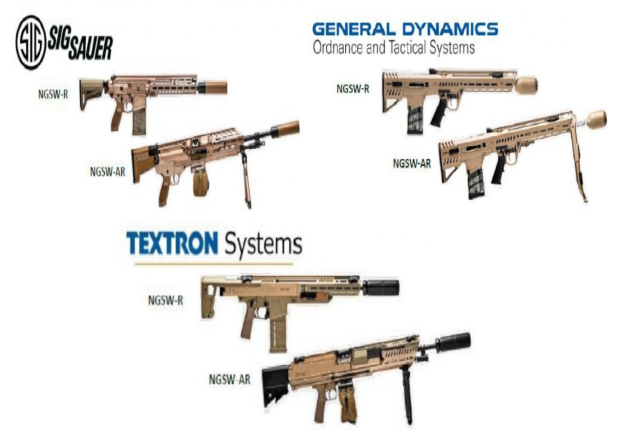
The NGSW-R rifle was the planned replacement for the M4A1, and the NGSW-AR automatic rifle was the planned replacement for the M249 Squad Automatic Weapon and M240 machine gun.
The purpose of the NGSW rifle and automatic rifle is to incorporate the following to increase performance:
- Improved ergonomics
- Signature-suppressing capabilities
- Data power transfer
- Lightweight case
- New rail design
- Longer range
- Greater lethality
Five vendors in total began the prototype competition.
For weapons and ammunition, these were the initial vendors: Sig Sauer, General Dynamics-OTS, and Textron Systems.
The two initial vendors for fire control were Vortex Optics and L3Harris.
#2. NGSW Competitors


Initially, three weapon and ammunition vendors in addition to two fire control vendors were in competition to develop NGSW prototypes with the option for production based on performance.
Sig Sauer, Inc., and LoneStar Future Weapons (acquired by True Velocity) were the arms manufacturers competing in the NGSW program.
General Dynamics turned their weapons design project over to LoneStar with collaboration by Beretta to manufacture parts.
Therefore, there is a partnership among LoneStar Future Weapons (True Velocity), General Dynamics, and Beretta in competition with Sig Sauer.
Both LoneStar Future Weapons and True Velocity Ammo are based in Texas.
LoneStar uses advanced technology to manufacture next-generation defense solutions.
True Velocity is also an advanced technology and composite manufacturing company.
Sig Sauer is known for manufacturing firearms to meet the needs of military, law enforcement, and commercial markets.
Sig Sauer is actually a member of a global business network of firearms manufacturers.
Related Article – Army Rifle Qualification
#3. NGSW Requirements
The Army had some very specific requirements for the NGSW program.
In 2018, the Army decided to implement an intermediate caliber round of 6.8 mm for the Next Generation Squad Weapon program.
This general-purpose ammunition falls between the 5.56 mm and 7.62 mm calibers currently used at the squad and platoon levels.
In addition, the 6.8 mm version outperforms both of the aforementioned calibers.
In addition to accommodating this common ammunition and utilizing a Small Arms fire-control system, the rifles are required to accurately fire on targets 2,000 ft away.
The NGSW requirement for maximum length is 35 inches.
The maximum weight for the NGSWs, including attachments, is set at 12 lbs.
This is five pounds less than the M249 SAW and over 10 pounds lighter than the M240 machine gun.
A lower rifle weight enables soldiers to carry extra equipment and maneuver more easily.
Therefore, this ammunition and the new weapon systems will benefit soldiers in terms of improved accuracy, range, signature reduction, and lethality.
Innovations incorporated in the NGSW rifles will also allow for future expansion, adjustment, and advancement of these weapons.
General Dynamics/LoneStar/Beretta Design
This bullpup design features a compact platform with magazines loaded behind the trigger, a long barrel length, higher muzzle velocity, and increased range.
The NGSW-R and NGSW-AR are nearly identical in design, though the automatic rifle comes with a bipod.
The bullpup configuration reduces the overall length of the rifles and provides better balance.
However, these rifles also handle differently than the Army’s current weapons systems and would require training for troops to use effectively.
Sig Sauer Design

Sig Sauer’s NGSW-R features a short-stroke, gas piston system.
This removes the need for a receiver extension and buffer tube.
It also features a 13-inch barrel and collapsing buttstock.
Ergonomically, this design is similar to the existing M4 carbine though it is heavier and has a strong recoil.
Sig Sauer’s NGSW-AR, the SIG LMG, is lighter than standard automatic rifles with reduced recoil and easier control.
It is belt-fed with a side-loading design, which allows for optics to be mounted on the top of the weapon.
In addition, it has a quick-detachable suppressor and similar ergonomic controls to the M4.
#4. Candidates Removed From The NGSW Program
Three other defense companies provided weapons designs for the NGSW program: Textron Systems, FN-America, and PCP Tactical.
Textron Systems developed the Textron CT System rifle and LSAT light machine gun with Olin Winchester CT polymer cased-telescoped cartridge.
FN-America developed the HAMR rifle and EVOLYS machine gun with cartridges from Federal Cartridge Company.
PCP Tactical developed the Desert Tech MDR rifle and machine gun with PCP Ammunition polymer case-metal cartridge.
Vortex Optics and L3 Technologies also provided prototypes for weapons optics that include a ballistic computer.
This allows for the future capacity to link with night vision devices and connect them with the weapon site for the acquisition and engagement of targets.
#5. Who Won The NGSW?
Vortex Optics was offered a 10-year deal to provide the fire control system. Sig Sauer was awarded a 10-year deal to provide the rifles and ammunition.
Overall, the NGSW program is designed to benefit military soldiers by significantly increasing lethality and accuracy.
The Sig Sauer NGSW-AR design is similar to the ergonomics of the existing assault rifle.
However, this lightweight, belt-fed machine gun is lighter than the M249 SAW and consists of features to minimize recoil.
In addition, the Sig Sauer NGSW-R resembles the ergonomic control of the M4 carbine, including the barrel length, collapsible buttstock, and short-stroke gas piston system.
GD/LoneStar/Beretta offered a bullpup configuration in which the action (mechanism) and magazine are located behind the trigger.
The weapons put forth by both manufacturing teams had pros and cons.
One important element to consider is that the Army has never utilized weapons with bullpup design.
This means that soldiers and other service members would have needed training to become effective at using the GD/LoneStar/Beretta models.
Testing with the Sig Sauer XM7 rifle and XM250 automatic rifle focused on how well they integrated with the M157 fire control system manufactured by Vortex.
User acceptance was also a consideration.
Testing included over 20,000 hours of soldier hands-on testing, with the 75th Ranger Regiment and National Guard participating.
Sig Sauer has taken all feedback from the Soldier Touch Point system to heart and replicated the Army’s test setup at their test center in New Hampshire.
Product Quality Testing (PQT) starts July 2023, with the Army hoping to deliver units to soldiers as scheduled in the 2nd quarter of FY24.
Related Article – USMC Rifle Qualification
What People Get Wrong About Next Generation Squad Weapon (NGSW)
Many assume the NGSW is still in early testing or prototype phase, with no real deployment yet.
In fact, by 2026 the M7 rifle and M250 automatic rifle have achieved type classification standard (May 2025), transitioned from experimental XM designations, and are actively fielding to close combat units like the 25th Infantry Division and others, with accelerated procurement planned for thousands more in FY2026.
Another misconception is that the program failed or got canceled due to weight, recoil, or soldier feedback issues.
While early concerns existed (including some officer critiques on weight and ergonomics compared to the M4), the Army addressed them through product improvements like a lighter M7 variant (reduced by about 0.7 lbs), and fielding continues with positive integration in training and operations.
People often think the NGSW is Army-only and all services are adopting it.
The Marine Corps recently confirmed it will not field the M7, opting to retain the M27 Infantry Automatic Rifle for its unique expeditionary needs, while monitoring developments.
Some believe the 6.8mm round makes the weapons too heavy or impractical for squad use.
The design prioritizes overmatch against peer threats with superior range and penetration; weight reductions and ergonomic similarities to current systems help, though it requires training for suppressed operation and the digital optic.
Finally, a common view is that it’s just new guns without broader impact.
The NGSW integrates advanced fire control, suppression, and ammo for enhanced squad tactics, influencing future doctrine, logistics, and even potential special operations use.
Getting these facts straight helps understand the program’s real progress and value in modernizing infantry firepower.
Conclusion
The NGSW program was established in 2017 to replace the M4 Carbine, M249 SAW, and M240 machine guns with rifles that use common 6.8 mm caliber cartridges and fire control systems.
These replacement rifles are intended to provide soldiers with higher caliber weapons and more effective ammunition during combat.
Though the NGSW competition was a big win for Sig Sauer and Vortex Optics and resulted in 10-year supply contracts for these winning manufacturers, these weapons can also be considered a win for service members.
The Army has recognized that its current weapons and calibers need improvement in their lethality, ergonomics, weight, signature-suppressing capability, and performance at range.
Therefore, the new rifles should allow soldiers and other service members more efficacy in performing missions.
NGSW weapons and ammunition are anticipated to be fielded to soldiers in close-combat forces by March of 2024.