Navy aircrewmen serve as enlisted flight crewmembers across a wide range of naval aviation platforms, including fixed-wing aircraft, helicopters, and unmanned aerial systems.
Since the early development of naval aviation, Navy aircrewmen have supported flight operations by performing mission-critical duties that contribute to aircraft safety, mission execution, and crew survivability.
Assigned to operational squadrons around the world, Navy aircrewmen fulfill specialized roles that vary by aircraft type and service rating, working as part of integrated aviation teams within the United States Navy.
Related Article – Navy Jobs List: A List Of All 71 Ratings In The US Navy
Jump To A Section
Who Can Be Navy Aircrew?


Navy Aircrewmen are a step away from the Special Warfare community. Because of the intensive job requirements, the physical requirements necessary to serve as part of Navy aircrew are high. It is recommended that applicants are comfortable in the water before joining, or capable of becoming comfortable in the water during training. Below are the basic requirements for Navy Aircrewman applicants:
- Must have a high school diploma
- Must have a combined ASVAB line score of VE + AR +MK + MC = 210 or VE + AR +MK + AS = 210
- Must score a satisfactory-medium on a Navy Physical Readiness Test (PRT) while in the Delayed Entry Program (DEP)
- Must sign a Hold Harmless Agreement prior to participating in a PRT
- Must have normal color and depth perception
- Must have vision correctable to 20/20 in both eyes
- Must have normal hearing
- Cannot have a speech impediment
- Must participate in the “reading aloud” test
- Must meet aviation duty minimums and maximum nude body weights of 103 to 245
- Must be able to obtain and maintain a Secret security clearance
Disqualifying Conditions For Aircrewman
Because of the hazardous nature of this program, the following medical conditions are considered a disqualifying factor:
- Hay fever
- Asthma
- Bee or wasp allergy
- Food allergy
- Chronic motion sickness
Due to the level of hazard and intensity related to this occupation, Aircrewmen are subject to heightened moral turpitude standards.
These standards generally are not waivable, and may result in an application denial to the Navy Aircrew ratings:
- Any drug-related conviction
- Drug use in the three years prior to application
- Repeated offenses involving alcohol
- Serious indebtedness
- Any offense that is sexual in nature
- Domestic violence convictions
Related Article: Can You Join The Military With A Felony?
Note: Drug waivers are considered on a case-by-case basis.

_pose_for_a_photo_following_a_successful_Search_and_Rescue_(SAR)_mission_off_the_coast_of_Malta.jpg)
Navy Aircrew Training and Qualifications
The first step in your Navy Aircrew training cycle is going to be attending Recruit Training, more commonly referred to as boot camp.
Navy Recruit Training takes place at Recruit Training Command Great Lakes in Great Lakes, Illinois. Here, Recruit Division Commanders (RDCs) will teach you the basic military skills and knowledge necessary to begin work in the United States Navy.
While at RTC Great Lakes, you will also learn basic Navy ship handling, small arms usage, firefighting, and Naval heritage.
Barring any unforeseen circumstances, this training normally lasts about 10 weeks.
Related Article – Is Navy Boot Camp Hard?
NACCS
Once you have made it through Navy Recruit Training, you transfer to Naval Air Crew Candidate School (NACCS) at Naval Air Station (NAS) Pensacola in Pensacola, Florida.
Here candidates will learn water confidence, basic search and rescue techniques, stroke development, and long-distance swimming stamina.
The first week of this training will require the candidates to participate in a thorough Navy flight physical to ensure they meet Navy flight standards.
The following three weeks will consist of intense physical training, as well as waterborne survival skills training, all of which are vital to the future Navy Aircrewman’s career.
“A” School
Immediately after completion of NACCS, candidates will attend Accession School (or A School) of their assigned service rating.
Your “A” School could last between 7 and 23 weeks depending on the assignment to one of the following five “A” Schools:
- Aircrewman Mechanical (AWF)
- Aircrewman Operator (AWO)
- Aircrewman Tactical Helicopter (AWR)
- Aircrewman Helicopter (AWS)
- Aircrewman Avionics (AWV)
AIRR
For those who volunteer, after “A” School they will attend the Navy Aviation Rescue Swimmer (AIRR) School in Pensacola, Florida.
This course provides instruction in aircraft-based search and rescue procedures and survival skills.
Navy AIRR School is considered one of the most challenging and physically demanding courses in the U.S. Navy.
FRS
The next step in any Navy Aircrewman’s journey is a Fleet Replacement Squadron (FRS).
While stationed with an FRS, you gain experience and training on the specific type of aircraft you will be assigned to during your career.
This training will last between 6 and 32 weeks depending on what type of aircraft you are assigned to; aircraft assignment will also determine location, as there are FRS squadrons all over the United States.
Initial Squadron
You will receive orders to your first squadron upon completion of your FRS training. Here you will continue on-the-job training, and begin becoming an expert in your assigned aircraft type.
Upon completion of required Naval Aviation Training and Operations Procedures Standardization (NATOPS) qualifications, Sailors are eligible to be awarded Navy Aircrew wings.
This breast insignia identifies qualification as a Navy Aircrewman while serving in that capacity.
Life as Navy Aircrew
There are five types of Navy Aircrewmen.
Although they serve together in the same community, they each have a different job onboard an aircraft.
The following are the descriptions of what each service rating within the Navy Aircrew designator does.
AWF
Aircrewman Mechanical (AWF) are members of a fixed-wing integrated tactical crew, and serve aboard one of the following aircraft:
- C-2 Greyhound
- C-9 Skytrain
- C-12 Beechcraft
- C-20 Gulfstream IV
- C-37 Gulfstream V
- C-40 Clipper
- C-130 Hercules
- E-6 Mercury
- P-3 Orion
You will perform primary in-flight and ground duties as an aircraft Flight Engineer, Crew Chief, Loadmaster, Reel Operator, or Aircrew Readiness Manager.
AWFs are responsible for aircraft maintenance, weight and balance calculations, aircraft systems rigging, aircrew administration duties, performing flight and ground training, moving cargo, performing Medical Evacuations (MEDEVACs), transporting passengers, carrying small arms, and supporting Special Warfare operations.
AWFs will directly contribute to aircrew training by helping Sailors attain and maintain the squadron’s aircrew qualifications, and ensure they are knowledgeable on all aircraft systems, passenger and cargo handling, safety procedures and equipment, federal and military regulations for passenger transport, emergency procedures, and aircraft equipment.
AWO
Aircrewman Operators (AWO) are responsible for the intelligence information used by aircrews during operations and tactical missions.
They will serve aboard one of the following aircraft:
- P-3C Orion
- P-8A Poseidon
As an AWO you will be detecting, analyzing, classifying, and tracking surface and subsurface contacts.
You will be operating a highly advanced sonar system that utilizes buoys, Radio Detection and Ranging (RADAR), Electronic Support Measures (ESM), Magnetic Anomaly Detectors (MAD), Identification Friend or Foe (IFF) systems, and Infrared Detectors (IR).
You will be planning, handling classified material, and training members of the crew in support of the mission.
Your daily duties will have you handling ordnance, inspecting acoustic equipment, and operating equipment such as:
- Advanced imaging multi-spectral sensors
- RADAR systems
- Hand-held cameras.
AWS
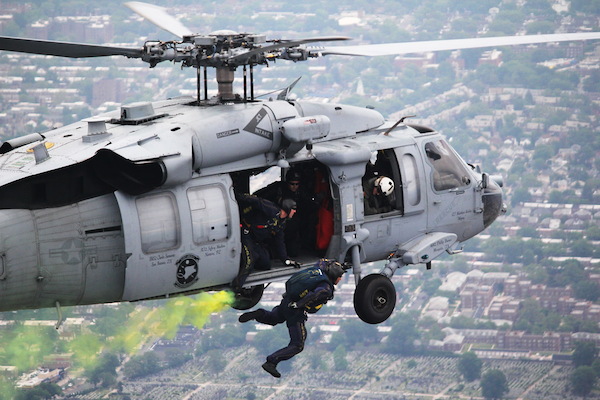
Aircrewman Helicopter (AWS) are members of helicopter-integrated tactical crews that perform Search and Rescue (SAR) operations and Airborne Mine Countermeasure (AMCM) operations.
AWSs serve aboard four primary types of aircraft:
- HH-60H Rescue Hawk (Seahawk)
- MH-60S Knighthawk (Seahawk)
- CH-46 Sea Knight
- MH-53 Sea Dragon
As an AWS, you will perform SAR and AMCM operations utilizing sonar, magnetic, mechanical, and acoustic minesweeping systems.
You will also be performing search and rescue missions, as well as inserting or extracting special forces, or airlifting critical supplies to ships at sea.
You will be responsible for aircrew operations administration, flight and ground training, movement of cargo internally and externally, MEDEVAC missions, passenger transport assignments, aerial gunnery operations, small arms handling, Naval Special Warfare (NSW) insertion and extraction, Vertical Replenishment (VERTREP), and Night Vision Device (NVD) operations.
You will also be responsible for observing for safety of flight concerns.

AWV
Aircrewman Avionics (AWV) serve as members of a fixed-wing tactical aircrew attached to patrol, reconnaissance, and command and control aircraft.
You will be responsible for the aircraft’s avionics systems, safety gear, emergency procedures, and aircraft electronic equipment.
You will be performing in-flight and ground duties as an aircraft technician, Electronic Intelligence (ELINT) specialist, and airborne communications expert.
Part of your job will also have you responsible for piloting and maintaining Unmanned Aerial Vehicles (UAV), operating photographic equipment, and Communications Material Security (CMS) handling.
Your primary duty as an AWV is going to be maintaining the electronic systems onboard the aircraft.
AWR
Aircrewman Tactical Helicopter (AWR) operates tactical systems to detect, identify, and engage submarines. As an AWR, you find yourself onboard one of the following helicopters:
- SH-60B Seahawk
- SH-60R Seahawk
You will operate Unmanned Aircraft Systems (UAS) and their payloads.
You also will be manning tactical support centers at shore installations and tactical mobile units in expeditionary MTOC units.
AWRs serve as the primary rescue swimmer during Search and Rescue (SAR) operations.
Sea/Shore Rotation
In the Navy, you will swap between deployable “sea” duties and generally nondeployable “shore” duties.
There are situations where these rotations can change, but as a general rule the Navy will do everything in its power to ensure all Sailors are able to meet their proper sea/shore rotations.
The sea-to-shore assignment rotation for Aircrewman Mechanical (AWF) is as follows:
- First sea tour will be 54 months
- First shore tour will be 36 months
- Second sea tour will be 36 months
- Second shore tour will be 36 months
- Third sea tour will be 36 months
- Third shore tour will be 36 months
- Fourth sea tour will be 36 months
- Fourth shore tour will be 36 months
The sea-to-shore assignment rotation for Aircrewman Tactical Helicopter (AWR) is as follows:
- First sea tour will be 48 months
- First shore tour will be 36 months
- Second sea tour will be 36 months
- Second shore tour will be 36 months
- Third sea tour will be 36 months
- Third shore tour will be 36 months
- Fourth sea tour will be 36 months
- Fourth shore tour will be 36 months
The sea-to-shore assignment rotation for Aircrewman Operator (AWO) is as follows:
- First sea tour will be 48 months
- First shore tour will be 36 months
- Second sea tour will be 36 months
- Second shore tour will be 36 months
- Third sea tour will be 36 months
- Third shore tour will be 36 months
- Fourth sea tour will be 36 months
- Fourth shore tour will be 36 months
The sea-to-shore assignment rotation for Aircrewman Avionics (AWV) is as follows:
- First sea tour will be 54 months
- First shore tour will be 36 months
- Second sea tour will be 36 months
- Second shore tour will be 36 months
- Third sea tour will be 36 months
- Third shore tour will be 36 months
- Fourth sea tour will be 36 months
- Fourth shore tour will be 36 months
The sea-to-shore assignment rotation for Aircrewman Helicopter (AWS) is as follows:
- First sea tour will be 51 months
- First shore tour will be 36 months
- Second sea tour will be 36 months
- Second shore tour will be 36 months
- Third sea tour will be 36 months
- Third shore tour will be 36 months
- Fourth sea tour will be 36 months
- Fourth shore tour will be 36 months

_4_during_a_humanitarian.jpg)
Pay and Compensation
Your pay is going to be based on a combination of your rank and time in service.
Related Article: Navy Enlisted And Officer Ranks And Pay
Navy Aircrewmen may hold varying pay grades at the time they become rated, depending on accession timing and advancement. This means your starting base yearly salary could be roughly $27,108 as an E-3 with fewer than two years and max out at $102,322 as an E-9 with 30 years of service.
This, of course, does not include Basic Allowance for Housing (BAH), or Basic Allowance for Subsistence (BAS).
A Naval Aircrewman will be eligible for Flight Pay while attached to a squadron, which can range from $150 to $400 a month.
Again, this does not factor in your BAH or BAS allowances. Basic Allowance for Housing (BAH) amounts vary based on rank, dependency status, and duty location.
Although it fluctuates semi-annually, Navy Aircrewmen typically enjoy higher advancement opportunities than the Navy average.
This means your advancement as a Navy Aircrewman may be accelerated as compared to other Navy ratings.
Civilian Opportunities
Navy Aircrewmen receive many skills through their Navy training and experience. The civilian career opportunities they have available often depend on the service rating in which they served.
The following are some of the post-Navy career opportunities for Navy Aircrewmen:
AWS
- Aircraft Cargo Handling Supervisor
- Emergency Management Director
- Emergency Medical Technician
AWF
- Aircraft Mechanic
- Airline Flight Engineer
- Aviation Inspector
AWO
- Commercial Diver
- Airfield Operations Specialist
- Intelligence Analyst
AWR
- Database Administrator
- Emergency Medical Technician
- Aircraft Mechanic
AWV
- Aviation Inspectors
- Avionics Technicians
- Electronics Engineering Technicians
Through the Navy Credentialing Opportunities On-Line (COOL) program, Navy Aircrewmen have the ability to earn credentials they can use in the civilian world. For free, they may earn certifications as:
AWS
- Certified Safety Specialist (WSO-CSS)
- General Communications Technician
- Flight Engineer (FAA)
AWF
- Certified Aerospace Technician
- Certified Safety Specialist (WSO-CSS)
- Flight Engineer (FAA)
AWO
- Certified Safety Specialist (WSO-CSS)
- General Communications Technician
- GMDSS Radio Operator License (DO)
AWR
- Certified Safety Specialist (WSO-CSS)
- General Communications Technician
- Flight Engineer (FAA)
AWV
- Autonomous Navigation Systems (ANS)
- Onboard Communication & Safety Systems Standards (OCS)
- Aircraft Electronics Technician (AET)
- Certified Aerospace Technician
- Fiber Optics Technician (FOT)
Related Article: 15 Best States For Military Retirees And Veterans
Additionally, Navy Aircrewmen can receive training and certification through the United States Military Apprenticeship Program (USMAP) or the Department of Labor Registered Apprenticeship (DOL-RAP) program in the following fields:
AWS
- Airfield Operations Specialist
- Computer Operator
- Emergency Management Director
- Emergency Medical Technician
- Paramedic
- Training and Development Specialist
AWF
- Aircraft Mechanics and Service Technician
- Aircraft Structure, Surfaces, Rigging, and Systems Assembler
- Airfield Operations Specialist
- Airframe & Powerplant Mechanic
- Computer Operator
- Emergency Management Director
- First-Line Supervisor of Mechanics, Installers, and Repairers
- Training and Development Specialist
AWO
- Aircraft Mechanic and Service Technician
- Airfield Operations Specialist
- Computer Operator
- Database Administrator
- Emergency Management Director
- Intelligence Analyst
- Radio Operator/Maintainer
- Training and Development Specialist
AWR
- Aircraft Mechanics and Service Technician
- Airfield Operations Specialist
- Computer Operator
- Database Administrator
- Emergency Management Director
- Emergency Medical Technician
- Intelligence Analyst
- Paramedic
- Training and Development Specialist
AWV
- Aircraft Electrician
- Aircraft Mechanics and Service Technician
- Airfield Operations Specialist
- Avionics Technician
- Computer Operator
- Electrical and Electronic Engineering Technologist / Technician
- Electrical and Electronics Installer / Repairer, Transportation Equipment
- Electrical and Electronics Repairer, Commercial and Industrial Equipment
- Electronics Technician
- Emergency Management Director
- Intelligence Analyst
- Optical-Instrument Assembler (Optical Goods)
- Training and Development Specialist
On top of all that, there is active duty Tuition Assistance and the GI Bill.
Tuition Assistance will pay up to $250 a credit, for 12 credits a year, and a total of 120 credits over a lifetime.
The Post 9/11 GI Bill provides 36 months of tuition, an annual book stipend, and Basic Allowance for Housing.
What People Get Wrong About Navy Aircrewmen
One common misconception is that all Navy aircrewmen perform the same duties regardless of aircraft or assignment.
In reality, responsibilities vary significantly depending on the specific aircrew rating, aircraft platform, and operational mission. Each rating is trained for distinct technical, tactical, and administrative roles that are not interchangeable.
Another misunderstanding is that Navy aircrewmen are members of Naval Special Warfare or Special Operations forces.
While some aircrewmen may support special operations missions or serve alongside those units, the Navy Aircrewman rating itself is a conventional aviation warfare specialty with its own training pipeline and qualification standards.
It is also often assumed that Navy aircrew training is limited to flight-related tasks.
In practice, training includes a combination of aviation systems knowledge, survival skills, emergency procedures, mission-specific systems operation, and ongoing qualification requirements throughout a Sailor’s career.
Some people believe that Navy aircrewmen only deploy at sea.
Although many assignments involve embarked or deployable units, shore-based squadrons, training commands, and staff assignments are also a regular part of the sea and shore rotation cycle.
Finally, there is a misconception that Navy aircrew experience directly translates to a single civilian career path.
While the skills gained can be applicable in multiple civilian fields, post-service employment opportunities vary widely based on rating, certifications earned, and individual career choices.
What is it Like to be a Navy Aircrewman?
Navy Aircrewmen serve in a career field that is both very demanding and rewarding.
Serving on a Navy aircrew gives you the chance to perform Search and Rescue missions, anti-submarine warfare operations, reconnaissance functions, and Navy Special Warfare support.
If being part of a well-trained team and saving lives is something that interests you, Navy Aircrewman is the job for you!
References / Resources
Naval Aircrew Candidate School Course Overview
Aviation Rescue Swimmer School
NATOPS General Flight And Operating Instructions
