Military enthusiasts and recruits often wonder about the term squid a common slang nickname for Navy Sailors along with other colorful monikers.
These nicknames reflect inter-branch banter tradition and the unique culture of naval service.
Squid originates from the nautical theme implying Sailors are sea creatures while others like swabby or bluejacket highlight roles or uniforms.
Understanding their meanings and origins provides insight into military humor and camaraderie.
While some terms are affectionate others stem from friendly rivalries among branches.
In 2026 these nicknames remain part of veteran stories and training lore.
This guide explains the top 11 including squid with context and usage.
Explore this fun aspect of Navy identity.
1. Squid


A term used in the old Navy (not the store), Squid is what other branches
(especially Marines) generally called sailors.
The term refers to the aquatic animal and how it can swim fast in a straight line but similar to inexperienced motorcyclists, have trouble quickly changing directions.

Back in the 1960s, it wasn’t uncommon for a sailor to spend their deployment money on motorcycles with little to no riding experience. Hence, the term squid (which swim fast but crash into everything).
Old school sailors would often get a Navy Squid tattoo etched on their legs or back. Here’s a cool example:

The term isn’t tossed around too much in today’s Navy, but I’m sure you can hear an old Marine or two calling an old sailor in a VFW bar a “squid” occasionally.
Related Article – Navy Tattoo Policy: What IS And What ISN’T Allowed
Sample Navy Squid joke:
A Squid and a Marine are in the bathroom peeing in the urinal. The Squid washes his hands and says smugly, “In the Navy, they teach us to wash our hands after peeing.”
The Marine looks at him and says, “In the Marines they teach us not to pee on our hands.”
Source: Leatherneck.com
2. Boot

In the fleet, many enlisted members straight out of RTC may be referred to as a “boot.”
As the term suggests, a recruit out of boot camp may hear this title with or without the intention of insult.
Related Article: How Hard Is Navy Boot Camp?
A sailor should take this nickname as a grain of salt and see it simply as an opportunity and motivation to gain more experience. Volunteer for as much training as is available, and benefit from earning your warfare pins.
3. Doc
Hospital corpsmen are often called “Doc” due to their wide capabilities to treat injuries and save lives on the battlefield.
No, corpsmen are not physicians, but they do assist doctors and dentists.
Corpsmen are typically the first line of medical support for Marines, and “Doc” is considered a term of endearment for the corpsman rating.
To take this title one step further, corpsmen can earn the unofficial title of “Devil Doc” from their fellow Marines in two ways.
The first is by passing the Fleet Marine Force test to earn an FMF pin, in which Navy corpsmen learn USMC history, traditions, and much more.
The second way is to take part in deployment with Marines and earn their Combat Action Ribbon (CAR).
Related Article: 10 Best Navy Jobs For Civilian Life In 2018
4. Frogman
“Frogman” is a title bestowed upon Navy divers who deploy on tactical assault missions.
In the United States Navy, this nickname applies to SEALs, Special Warfare Combatant-craft Crewmen, Special Amphibious Reconnaissance Corpsmen, Search and Rescue Swimmers, and Explosive Ordnance Disposal (EOD) units.


The word was used by John Spence, an enlisted naval diver, noted as being the first combat “Frogman” in WWII. His training led to the establishment of the Navy SEALs.
Check out the ballad of the Frogman here.
Related Article: BUD/S Class 234: Where Are They Now?
5. Mustang
An enlisted sailor who becomes an officer in the Navy is often referred to as a “Mustang.”
A mustang officer can be a chief warrant officer, limited duty officer, staff corps officer, or a line officer.
The reference comes from the mustang horse, how it is not a thoroughbred. After being captured, a mustang can be tamed but may unexpectedly revert to its old ways and as a result, the owner must keep an eye on it constantly.

Yet, being a feral animal, it may have better survival instincts than their thoroughbred counterparts.
6. Nuke
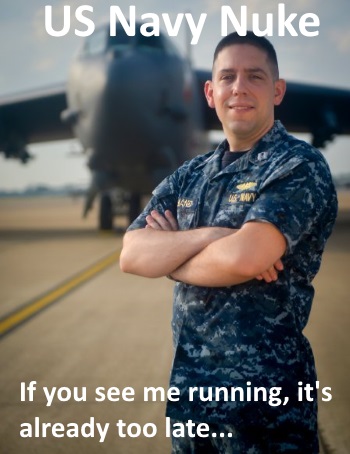
A “nuke” is the term used for sailors with any job dealing with the nuclear field in the Navy. Nukes constitute both enlisted and officers.
Related Article: 5 Absolutely Worst Jobs In The Navy
Electrician’s mates (EM), electrician’s technicians, and machinist’s mates (MM) are three enlisted nuke positions. Sailors may also hear it used as “nuking” something when they are overthinking a simple task.
Being a veteran, I catch myself using this term constantly around my civilian counterparts and enjoying explaining its origin.
7. Salty Dog
A retired sailor or someone with many years spent aboard a ship at sea in the Navy is considered a “Salty Dog.”
It is used by shipmates to show credibility in all ship-board matters. Often these experienced sailors are known as an “Old Salt.”
A Salty Dog is someone who knows his/her way around the Navy, has been in a long time, and has learned to cope with it while maintaining their military bearing.
Extremely proficient in his/her job and doesn’t take crap from anyone!
8. Sardines
Sailors often refer to submariners as “Sardines.” The term is derived from the packed and claustrophobic atmosphere of a nuclear-powered U.S. Navy submarine.
Every inch of a submarine is conserved.
Berthing areas are in short supply, and often the torpedo room doubles as an extra bunk room.
With more sailors than beds, the term “hot-racking” was created, where sailors either share bunks or sleep in shifts.
9. Seabee

Sailors in the Construction Battalion (CB) rates are called Seabees. Builders (BU), Construction Electricians (CE), Construction Mechanics (CM), Engineering Aides (EA), Equipment Operators (EO), Steelworkers (SW) and Utilitiesmen (UT) comprise the Seabee Community.
The Seabees were created at the beginning of WWII to replace civilian construction companies that worked for the US Navy before WWII.
Prior to Pearl Harbor, the Navy hired civilian contractors to build facilities all over the world.
Related Article: 5 Best Combat Jobs In The US Navy
When hostilities with the Japanese broke out, the US Navy could not arm civilian workers to protect themselves from snipers or invaders.
Additionally, the Navy didn’t have enough personnel to optimally protect civilian workers where construction was taking place.
As a result, many civilians were killed.
The Seabees were formed within the Navy to bring in skilled construction workers and train them in military tactics and how to protect themselves.
Therefore, they were now active military war participants and were armed while performing their construction tasks.
The Seabees were formed on March 5, 1942, and have been an active part of the Navy ever since serving in every conflict around the world.
As their motto goes, “We build, we fight.”
10. Shipmate
Plainly speaking, a shipmate is literally what you call a mate on one’s own ship.
Being a U.S. Navy sailor means being more than just a part of a team, but also a family. Especially those who are stationed on ships, sailors are around their fellow shipmates for an extended period of time, away from their own family and loved ones.
Over time, shipmates share memories and develop a certain camaraderie. Many may say “shipmate” is a derogatory term, but it depends on the context of the conversation.
It can be used sarcastically to address a sailor who has done something wrong, or the term can convey a sense of unity.
11. Spyglasses
Given commonly to sailors with the IT rating, Information Systems Technician, for enlisted personnel that specialize in communications technology and special operations.
They ensure proper security measures are taken place at all times and respond to immediate threats such as viruses.
ITs decipher information and operate and maintain global satellite telecommunications in the Fleet.
What People Get Wrong About What Is A Navy Squid 11 Slang Nicknames For Navy Sailors
Many assume squid is a derogatory term used only by other branches overlooking its lighthearted use among Sailors themselves as self-deprecating humor.
In reality nicknames like squid derive from naval history emphasizing maritime ties rather than negativity.
People often think all slang is modern slang not realizing terms like bluejacket date to the 1800s referring to uniform colors.
Another misconception is that nicknames like swabby imply laziness when it highlights deck-swabbing duties essential to ship maintenance.
Families sometimes believe these terms foster division ignoring how they build bonds through playful rivalry in joint operations.
Others confuse squid with specific ranks or roles thinking it targets officers when it applies broadly to all Navy personnel.
Some view anchor clanker as an insult to mechanics not appreciating its nod to engineering contributions aboard ships.
People frequently overlook regional variations assuming universal use when some like tin can sailor refer to destroyer crews specifically.
Another common error assumes nicknames fade with time when 2026 sees them thriving in social media veteran groups and recruiting.
Clearing these points helps appreciate the affectionate cultural role of slang in boosting morale and identity among Navy Sailors.

Spent eight years on submarines, both fast attack and boomer. Never heard ANYONE refer to submariners as “Sardines.” We were (are) “Bubbleheads.” So-called due to the inclinometers in Control that measure up or down angles during surfacing and dives.