
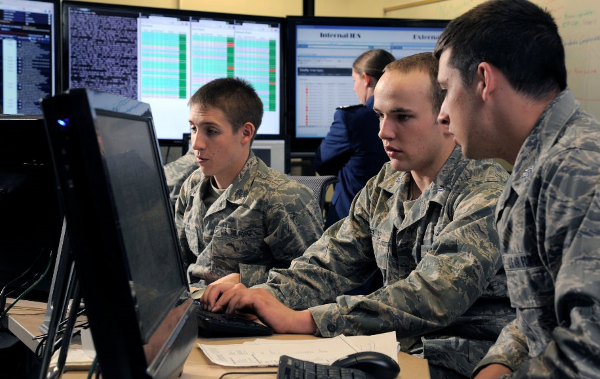
Air Force Cyber Warfare Operators serve in a specialized enlisted role focused on cyberspace operations.
Designated under Air Force Specialty Code 1B4X1, the career field supports both defensive and offensive cyber missions.
The role requires advanced technical training and adherence to strict qualification standards.
This article explains the responsibilities, requirements, training pipeline, and career considerations for Air Force Cyber Warfare Operators.
Related Article – Air Force Cyber Systems Operations (3D0X2): Career Profile
Jump To A Section
Requirements and Qualifications
To become a Cyber Warfare Operator in the United States Air Force, there are specific requirements and qualifications one must meet, which include:
- United States Air Force Enlisted Airman (prior qualification in any AFSC or Airmen in the Cyber Transport Systems Pipeline displaying the ability to succeed in the CWO Pipeline).
- High school diploma, GED with 15 college credits, or GED.
- Must be between the ages of 17 and 39.
- ASVAB score of at least General: 64.
- Demonstrated weight lift of 40 pounds.
- Mandatory knowledge of computer operating systems, software applications, protocols, addressing and hardware.
- A minimum score of 60 on the Air Force Electronic Data Processing (EDP) test.
- Must be eligible for a Top Secret/SCI (Sensitive Compartmented Information) security clearance.
https://www.youtube.com/watch?v=PzKNMhJQU_A
Related Article – Air Force Grooming Standards: Haircuts, Mustaches, Beards, And More
Training and Career Path
Since Cyber Warfare is (primarily) a retrain-only AFSC, we will forgo the Basic Military Training (BMT) requirements that all Air Force personnel must go through at Joint Base (JB) San Antonio-Lackland, TX.
Instead, we will delve straight into the requirements of a Cyber Warfare Operator, or CWO.

Technical Sergeant Ryan Barkman, an Air Force Cyber Warfare Operator, checks a rack-mounted server. (Source: US Air Force Photo)
Air Force Cyber Warfare Technical Training
Cyber Warfare Operators attend the CWO Schoolhouse at Keesler Air Force Base.
Technical training length varies based on course requirements and individual qualifications.
For CWOs who do not have the CompTIA Security+ certification, training is an additional month, as they also have to take IT Fundamentals and Security+.
Related Article – Army Airborne School: Requirements, Length, Packing List, And More
Cyber Warfare Operations Apprenticeship training consists of proficiency in:
- Computer Operating Systems
- Software Applications
- Database Concepts
- Common Programming Languages
- Hardware Components
- Networking Fundamentals
- Protocols
- Network Addressing
- Network Infrastructure
- Telecommunications Theory
- Data Communications
- Wireless Technologies
- Cryptography
- Cyber Operation Laws
Successful completion of this course is required to earn the right to wear the Air Force Cyberspace Operator Badge.

After technical training, most will go through Initial Qualification Training (IQT) depending on the weapon system their unit uses.
IQT can last anywhere from four months to three years. There is a wide range of difficulty in IQT.
In general, however, OCO positions have a longer and more difficult IQT.
Related Article – Cyberspace Operations Officer: Pay, Training, And More
How Much Are Air Force Cyber Warfare Operators Paid?
Pay for an Air Force Cyber Warfare Operator is identical to all other enlisted personnel (in all branches), based on an airman’s rank and length of service.
| Rank | Monthly Pay (per month) |
|---|---|
| E-1 Airman Basic +4 months | $1,917 |
| E-2 Airman | $2,149 |
| E-3 Airman First Class | $2,259 |
| E-4 Senior Airman | $2,503 |
| E-5 Staff Sergeant | $2,730 |
| E-6 Technical Sergeant | $2,980 |
| E-7 Master Sergeant | $3,445 |
Air Force Airmen with AFSC 1B4X1 may also be entitled to other forms of compensation including a basic allowance for housing (BAH) and base allowance for subsistence (BAS) pay if eligible.
US Air Force Cyber Warfare Operators are also eligible for Special Duty Assignment Pay (SDAP).
Additionally, AFSC 1B4X1 is one of the Air Force Specialty Codes included in the Regular Air Force Selective Retention Bonus Listing dated 3 July 2019.
The bonus is calculated by multiplying one month of an airman’s salary by the number of years reenlisting, and then by a multiplier specific to the number of years of service and the career field.
What’s Life Like as an Air Force Cyber Warfare Operator?
Air Force Cyber warfare operators consistently work with combat, network management, surveillance, and reporting systems.
They must protect data and network systems above such passive defense measures such as anti-virus software and firewalls.
Provided directives, they must be able to interpret those into specific procedures as well as develop and execute operation plans.
Related Article – Army Cyber Network Defender (MOS 25D)
Specifically, Air Force Warfare Operators must:
- Conduct DCO to defend DoD and other friendly cyberspace assets. This includes passive and active cyberspace defense operations that preserve the ability to utilize friendly cyberspace capabilities and protect data, networks, net-centric capabilities, and other designated systems. It does not include passive defense measures intended to maintain and operate the DODIN (i.e., configuration control, patching and firewall operations).
- Conduct OCO to project power by application of force in and through cyberspace. This includes targeting adversary cyberspace functions and/or using first-order effects in cyberspace to initiate cascading effects into the physical domains to affect weapon systems, C2 processes and critical infrastructure/key resources.
- Conduct specific cyberspace actions including cyberspace defense, cyberspace operations in support of intelligence operations, cyberspace operational preparation of the environment and cyberspace attack in order to support OCO and DCO.
- Provide C2 of cyberspace operations in support of DoD, interagency and Coalition Forces to establish situational awareness of both friendly and adversary operations.
- Develop operational tasks and orders, evaluates mission feedback, and aligns with strategic intent.
- Develop and execute TTPs.
- Analyze national defense guidance and strategic objectives to create operational policies.
- Implement policies through the development of TTPs in support of assigned cyber capability execution.
- Plan, conduct, and evaluate exercises to enhance operational readiness.
- Establish performance standards, train and conduct evaluations to ensure personnel are proficient, qualified, and certified.
- Ensure units meet operational readiness goals and adhere to operational procedures.
- Participate in research and development as well as operational testing and evaluation to determine possible new or modifications to existing capabilities.
- Assess and reverse engineer network nodes and infrastructure devices (including operating systems and software applications) to determine capabilities, functionalities, limitations and vulnerabilities.
- Apply forensic and reverse engineering TTPs to determine the extent of the battle damage sustained during cyberspace attacks (may require partnering with other DoD, interagency and Coalition Forces).
Reviews from current and former Air Force Cyber Warfare Operators are overwhelmingly positive on the job site indeed.com where the job boasts a rating of 4.5 out of a possible 5.

Airmen posting on the site cited benefits, opportunities, training, guaranteed pay, and the opportunity to travel.
Respondents did have a few gripes (or cons). One reviewer was unhappy with frequent management changes, another not a fan of long work hours, and yet one more Cyber Warfare Operator disliking having to be on-call 24/7.


Cyber Warfare Operations is primarily a desk job, but one of the best ones in the Air Force.
CWOs normally work in an operations center or a planning cell.
Job hours vary for Cyber Warfare Operators depending on the mission’s unit. Some CWOs will work 0730-1630.
Others will be required to work Panamas (12 hour days, two on, two off, three on, or three off).
It is all dependent on the unit to which they are assigned.
Occasional on-call duty, however, should be expected by all CWOs.
CWOs working in offensive units normally work at a very high tempo.
The top three traditional bases for 1B4X1 are:
- Joint Base San Antonio – Lackland
- Fort Meade, Maryland
- Scott Air Force Base, Illinois
But, there are many other Air Force bases that need Cyber Warfare Operators, as well.
Keep in mind, however, that these bases have many fewer billets than the top three.
The number of active-duty Cyber Warfare Operators fluctuates based on force structure and staffing requirements.
Demographic distribution within AFSC 1B4X1 varies over time and is subject to change.
Related Article – 10 Best Air Force Jobs For Civilian Life
What People Get Wrong About Air Force Cyber Warfare Operators
A common misconception is that Air Force Cyber Warfare Operators work exclusively on offensive cyber missions. In reality, the career field includes both offensive and defensive operations, and assignments depend on unit mission and operational needs.
Some people assume that civilians can directly enlist into AFSC 1B4X1. While policies have evolved, the career field has historically been limited and subject to specific eligibility pathways rather than open entry.
Another misunderstanding is that cyber warfare roles are similar to basic IT support jobs. The responsibilities extend beyond routine network maintenance and involve operational planning, execution, and command-and-control functions.
There is also confusion about work environment, with the belief that cyber operations are low-tempo or flexible. Duty schedules, operational tempo, and on-call requirements vary widely depending on assignment and mission demands.
Civilian Career Opportunities
The career opportunities for a Cyber Warfare Operator leaving the Air Force are excellent. In fact, they cannot be overstated.
Civilian compensation for former 1B4X1 personnel varies based on role, location, experience, and employer.
Government contracting positions that utilize and take advantage of the CWO’s Top Secret/SCI clearance are even more lucrative.

Air Force enlistees in the Cyber Transport Systems Pipeline who shine during training are sure to get tapped for the Cyber Warfare Operations Pipeline since the demand is so high.
If you are a dedicated Air Force airman in the cryptological or intelligence field, possess the necessary qualifications, have “the right stuff,” and are looking to be a player in the cyber arena, starting off as an Air Force Cyber Warfare Operator could just be your ticket.
As from Brigadier General Brian Kelly stated at the inception of the Air Force’s Cyber Warfare program two years ago,
“You join the Air Force, we’re going to give you all the training you need. They’re not going to be masters by the time they graduate [from technical training], but they’re going to have enough skills to be successful in learning new things at that first base we send them to. There are not a lot of other companies that invest that much time. … They’re going to expect you to already know, and already have all your certifications. They’re not going to help you do that.”
Related Article – How To Get Into The Air Force Academy
References
Official Air Force Career Webpage
Air Force Reserve Webpage for Cyber Warfare Operations
Indeed USAF Cyber Warfare Reviews
Air Force Times – Re-enlistment Bonuses
Josephino Cambosa: Cyber Warfare Operator
Air Force Times – Cyber Warfare Enlisted Opportunities
