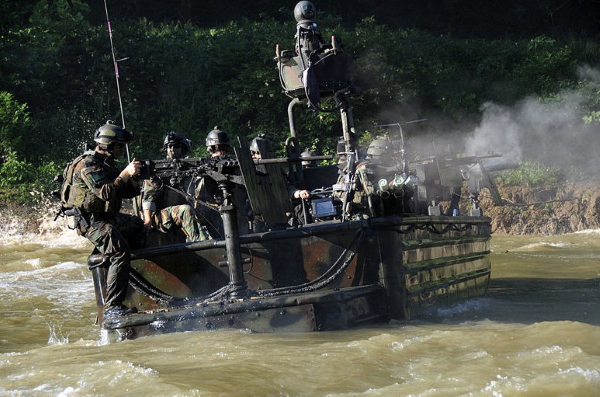
Navy Special Warfare Combatant Craft Crewmen, known as SWCC, are the elite boat drivers and operators who support Navy SEALs and other special operations forces.
They crew high speed special operations craft, insert and extract SEAL teams, provide fire support, and conduct maritime interdiction missions in some of the most dangerous waters on earth.
It is a small, extremely demanding community that combines small boat handling, weapons expertise, and special operations tactics.
This 2026 guide explains exactly what the SWCC job involves, the rigorous training pipeline, daily life, pay, and the real pros and cons so you can decide if this is the right path.
Related Article – Delta Force Vs. Navy SEALs
Jump To A Section
History of SWCC
Prerequisites And Qualifications
Training Pipeline
Navy SWCC vs. Navy SEALs
Weapons And Vessels
Summary
Intro To SWCC
Special Warfare Combatant Craft Crewmen are skilled at inserting other special operations forces by water and then extracting them back out safely after their missions have been completed.
It’s a Navy specialty that requires you to be in excellent physical condition, a fast thinker, and have a vast amount of intestinal fortitude when the going gets tough.
This is what it takes to fulfill their motto of ‘”On Time, On Target, Never Quit!’
Here is a YouTube video that shows more of what Special Warfare Combatant Craft Crewmen do:
A Brief History of Special Warfare Combatant Craft Crewmen
SWCC Special Forces can trace their roots back all the way to WWII.
More specifically, they were those that operated very fast small attack craft called PT Boats (patrol torpedo boat).
Their role was further expanded during the Vietnam War in an effort to interdict the supply lines that the Viet Cong were using rivers for.
They also played key roles in supporting Navy SEAL missions during the Vietnam War too.
Their craft SWCC operators used had evolved during the Vietnam War from larger PT Boats to smaller and faster ‘swift boats.’
These boats more closely resemble the craft that are currently being used by Special Warfare Combatant Craft Crewmen at the present time.
Over the next few decades, these navy specialists became part of what would be called SBU’s (special boat units).
They have been tasked with such prominent roles as operating MK III patrol boats to help protect Kuwaiti Tankers from Iranian attacks during operation Earnest Will to securing oil drilling platforms in the Persian Gulf when Saddam Hussein was intent on blowing them all up during Operation Desert Shield.
Although the official Navy job title of Special Warfare Combatant Craft Crewmen was not born until April of 1994, these elite Navy small craft operators already had established a long and storied history.
Related Article – Navy Gunner’s Mate (GM): Career Details
Special Warfare Combatant Craft Crewmen Prerequisites and Qualifications
To become a Special Warfare Combatant Craft Crewmen, one has to be extremely physically and mentally fit to serve.
Here are the requirements that one must meet in order to qualify and enter into the SWCC training pipeline.
- Must be between the ages of 17 and 30
- Be a High School graduate or have a GED
- Have normal color vision and depth perception
- Be judged to have good moral character and drug-free
- Have best eye vision of 20/70 or better and worst eye vision of 20/100 or better and must be correctable to 20/20 without using Radial Keratotomy
- ASVAB minimum requirements: Verbal Expression + Arithmetic Reasoning = 103 and a minimum Mechanical Comprehension score of 51
- Pass a physical examination required for divers
- Be physically fit enough to handle small craft operations and parachute duties
- Completion of a current National Agency Check, Local Agency Checks and Credit Checks
- Completion of a current Single Scope Background Investigation (SSBI) that leads to the ability of the recruit to obtain a secret or higher-level security clearance
- Pass an initial Physical Screening Test
- Before entering into service they will go through a special operations mentorship program. This will get the SWCC candidate mentally and physically prepared for the SWCC orientation training that will take place immediately following basic military training.
- Complete 8 weeks of Navy Basic Recruit Training held at Great Lakes Naval Training Center in North Chicago, Illinois
Related Article – Navy SEAL Training
Here is what it takes to pass the Navy Special Warfare Combatant Craft Crewmen initial physical screening test:

Related Article: DEVGRU: Selection, Squadrons, Gear, Notable Missions, And More
Special Warfare Combatant Craft Crewmen Training Pipeline
These are the training stages that a new recruit must conquer in order to earn the title of Special Warfare Combatant Craft Crewmen.
Stage 1: Naval Special Warfare Preparatory School (NSW Prep)
Location: Great Lakes Naval Training Center – North Chicago, Illinois
Duration: 8 weeks
This training stage has one purpose only and that’s to see if a new recruit is worthy to go on to further SWCC training.
It prepares the recruit physically and mentally for the extreme demands that will be placed on them as they go through further SWCC training.
It ends with a pass/fail physical fitness test that each recruit must pass or they will no longer be considered for further SWCC pipeline training.
Here is what this modified Navy SWCC Physical Screening Test involves:
-
-
-
-
- 1000-yard swim – with fins (20 minutes or under)
- Push-ups: at least 70 (two-minute time limit)
- Pull-ups: at least 10 (two-minute time limit)
- Curl-ups: at least 60 (two-minute time limit)
- Four-mile run – with shoes and pants (31 minutes or under)
-
-
-
Stage 2: Naval Special Warfare Orientation (NSWO)
Location: Naval Special Warfare Center – Coronado, CA
Duration: 2 weeks
This is a training course designed to further acclimate a new SWCC recruit into the Special Forces lifestyle.
Recruits will go through further physical training, learn Navy Special Forces history, and learn what will be expected of them as they progress through the SWCC training pipeline.
Stage 3: Basic Crewman Selection (BCS)
Location: Naval Special Warfare Center – Coronado, CA
Duration: 5 weeks
This is when training gets really physically and mentally exhausting.
It is also designed to be the team-building phase of SWCC training.
During these 5 weeks, every recruit will be pushed to their mental and physical limits.
It will also further develop recruits swimming skills, basic seamanship, and small boat handling skills.
The last few days of this course are what is known as “The Tour”. It’s a three-day period during where recruits apply the skills, teamwork, and mental toughness they have gained under various weather conditions and with limited sleep.
Related Article – Navy Electronics Technician (AT): Career Details
Stage 4: Crewman Qualification Training (CQT)
Location: Naval Special Warfare Center – Coronado, CA
Duration: 15 weeks
Although the extremely physical and mental part of SWCC is now over, recruits will still be pushed hard physically and mentally every day during this phase of training too.
The main emphasis of this stage of training is core tactical knowledge and then learning how to apply those skills in the field.
A new recruit will be taught to be proficient at marksmanship, seamanship, maritime navigation, waterborne patrolling, communications, engineering, SERE tactics, and basic combat casualty care.
Navy SWCC vs. Navy SEAL
Although the training for both of these Navy Special Forces jobs is similar, their missions are completely different.
Navy SEALS do not generally operate the small fast craft that takes them on and off the shore.
They also are tasked with going much further inland than SWCC operators do.
Their primary mission is covert intelligence gathering and small squad actions.
They also do not carry or use the firepower that is on SWCC combat crafts.
Navy SEALS are also deployed via submersibles and aircraft as much as they are by small fast craft; although SWCC boats are occasionally dropped by air, this is not done nearly as much as with navy SEALS and they are not trained for submersible insertions.
Related Article – Navy Vs. Air Force
SWCC Weapons and Vessels

_reloads_an_M2HB_.50_caliber_machine_gun.jpg)
Special Warfare Combatant Craft Crewmen are not like other Special Forces troops that carry all of their tactical gear on them when they go on missions.
They rely on the weapons that are embedded into the various fast attack watercraft that they use.
The amount of lethal firepower that can be laid down by SWCC combat craft is amazing, to say the least.
These powerful weapons consist of:
- GAU-17/A 7.62mm mini-guns
- .50 caliber MSHB machine guns
- M60 and M240 7.62mm belt-fed machine guns
- 40mm automatic grenade launchers
Related Article – Navy SEAL Weapons and Gear: 24 Rifles, Handguns, Shotguns, and More
Some of the heavily armed watercraft that SWCC operators use includes:
- Combat Rubber Raiding Craft (CRRC)
- NSW Rigid Hull Inflatable Boat (NSW RHIB)
- Combatant Craft Assault (CCA)
- Combatant Craft Medium (CCM)
- Combatant Craft Heavy (CCH)
Here is a video that shows some of these weapons and specially designed watercraft in action.
What People Get Wrong About Navy SWCC (Combatant Craft Crewman)
Many people assume SWCC is basically just “boat drivers for SEALs” with a relatively easy life compared to actual SEALs.
In reality SWCC operators are fully qualified special warfare personnel who often face the same dangers as the SEALs they support.
They regularly operate in hostile waters, take direct fire, and conduct high risk insertions and extractions under fire.
Another widespread myth is that the training is much easier than BUD/S.
The SWCC pipeline is extremely difficult in its own way, with intense small boat handling, weapons training, and maritime special operations tactics.
Attrition rates are high and the physical and mental demands are significant.
Some applicants believe SWCC is only for those who want to avoid long swims or running.
The truth is SWCC candidates still go through a modified version of the same physical screening as SEAL candidates and must maintain extremely high fitness standards throughout their career.
Many assume that once you finish training you will spend most of your time on calm water training.
In reality SWCC teams deploy frequently to high threat areas and conduct real world missions that can involve rough seas, enemy contact, and extended operations far from support.
A frequent error is thinking the job has limited advancement or civilian value.
Experienced SWCC operators often move into instructor roles, senior enlisted leadership, or transition into high paying civilian maritime security, law enforcement, or government contracting positions with their specialized skills and security clearance.
Finally many believe SWCC is a stepping stone to becoming a SEAL.
While some do cross over, most SWCC operators stay in the community for their entire career and take great pride in their unique mission set.
Understanding these realities helps candidates approach the SWCC pipeline with accurate expectations and prepares them for one of the most specialized and respected roles in Naval Special Warfare in 2026.
Summary
Without a doubt, these Navy Special Forces troops deserve a lot more credit for what they do than they receive.
They are very versatile Special Forces Operators that can quickly be tasked with successfully completing many navy onshore and inshore missions.
They can handle the watercraft they use and the weapons mounted on those vessels extremely proficiently.
SWCC operators can act covertly when necessary or meet an enemy head-on in the open with a vast array of firepower.
They are also experts at inserting and extracting other Special Forces troops including those of other branches of the military.
SWCC operators will continue to play a vital role in Navy Operations well into the future.
Related Article – Navy SEALs Vs Marines
References:
https://www.nsonswmentor.com/SWCC_Pipeline_Brief_26JUN17.pdf
