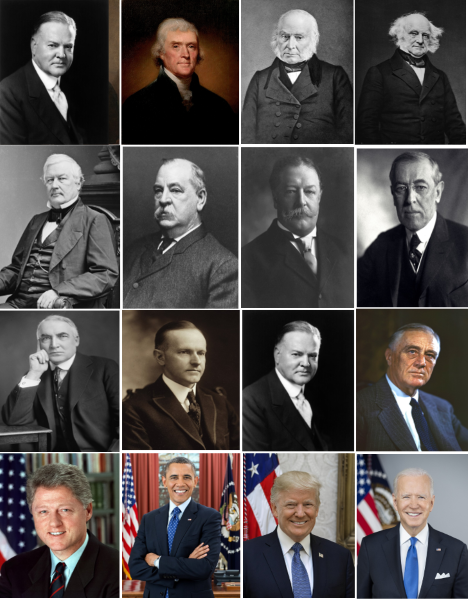
Many U.S. Presidents have served in the military, while others never wore the uniform.
Throughout American history, military service has been common among presidents, but it is not required to become commander-in-chief.
Below is a complete list of every U.S. President, including those who served in the military and those who did not, along with details about their service records.
Table of Contents
31 Presidents That Served In The Military
1. George Washington


George Washington (1st U.S. President) joined the military as a colonist.
By the time he was 23, he was in command of all troops in the Virginia militia.
In 1775, at the start of the Revolutionary War, Washington was made General and Command-in-Chief of the Continental Army.
Most historians agree that the American Revolution would not have succeeded without Washington’s strategic leadership.
He held this position as General until 1783, when he returned home as a private citizen and was then elected by unanimous vote as the first U.S. president in 1789.
2. Thomas Jefferson


Thomas Jefferson (3rd U.S. President) spent nearly nine years serving in the military from 1770-1779.
At the beginning of the Revolutionary War, Jefferson was a colonel in the Virginia militia.
In 1775, he took command of the Albemarle County militia, an area in which he later built his Monticello home.
3. James Madison


James Madison (4th U.S. President) served from 1775-1781 and was a colonel in the Virginia Militia.
Though he was commander of the Orange County Regiment, he was in very poor health.
As a result, he was precluded from active military service.
4. James Monroe


James Monroe (5th U.S. President) served from 1775-1778 and became a major in the Continental Army.
As a member of the 3rd Virginia Regiment, Monroe distinguished himself on the battlefield and was wounded in Trenton during Washington’s Christmas Eve victory.
Monroe resigned to study law under Thomas Jefferson.
5. Andrew Jackson


Andrew Jackson (7th U.S. President) served in the U.S. Army, U.S. Volunteer Army, and the Tennessee militia.
Though Jackson had no formal military experience, he was a quick, tough, and decisive leader, leading to his troops nicknaming him “Old Hickory.”
He was promoted to major general during the War of 1812.
His successful defense of New Orleans made him a “common man” hero among Americans, which led to his political popularity as well.
6. William Henry Harrison


William Henry Harrison (9th U.S. President) served in the military from 1812-1814.
He served as a major general in the Kentucky militia at the outset of the War of 1812.
Harrison then took command of the Army of the Northwest.
In 1814, Harrison resigned from the Army and later received a gold medal for his victories during the War of 1812.
7. John Tyler

.jpg)
John Tyler (10th U.S. President) served as a military captain during the War of 1812.
Tyler was a member of the Virginia Militia in 1812 and was then elected to the House of Representatives.
8. James K. Polk


James K. Polk (11th U.S. President) was commissioned captain of a militia cavalry regiment in 1821.
Though his military service was brief, Polk was a member of the Tennessee militia and was later appointed as colonel on Governor William Carroll’s staff.
9. Zachary Taylor


Zachary Taylor (12th U.S. President) spent a total of almost 40 years in the U.S. Army, from 1808-1849.
He served in the War of 1812, the Black Hawk War, and the Second Seminole War.
Taylor became a major general in the Army during the Mexican-American War.
In fact, it was his service during this war that earned him the reputation of national hero at its conclusion and helped to elect him president.
10. Millard Fillmore


Millard Fillmore (13th U.S. President) served most of his time in the military after his presidency.
Fillmore was a strong supporter of Lincoln during the Civil War.
In 1961, as a major, Fillmore commanded the Union Continentals, which was a corps of male home guards over the age of 45 in upstate New York.
This corps trained to defend Buffalo and its surrounding area against a Confederate attack.
In addition to performing military drills, they participated in parades, funerals, and other ceremonial functions, including guarding Lincoln’s funeral train in Buffalo.
Fillmore stayed active with the Continentals until close to his death.
11. Franklin Pierce


Franklin Pierce (14th U.S. President) served in the Mexican-American War from 1846-1848.
He entered military service as a private, recruiting men for the New Hampshire militia.
By 1847, Pierce was a brigadier general, leading victories in Mexico City.
However, he suffered an injury after being thrown from his horse, and missed the final victory at the Battle of Chapultepec.
Due to his injury, Pierce returned to his New Hampshire home in 1848.
12. James Buchanan


James Buchanan (15th U.S. President) served as a private during the War of 1812, the last president to serve during that war and the only president who held an enlisted rather than officer rank in the military.
During the time of Buchanan’s service in 1814, he helped defend the city of Baltimore, Maryland, from the British invasion as a member of the Pennsylvania militia.
13. Abraham Lincoln


Before Abraham Lincoln’s (16th U.S. President) extraordinary leadership of the Union during the American Civil War, he was a captain in the Illinois militia.
Lincoln served for part of 1832, during the Black Hawk War.
14. Andrew Johnson


Andrew Johnson (17th U.S. President) served in the military from 1862-1865.
In 1862, Lincoln appointed him to military governor for Tennessee.
Johnson then served as a brigadier general in the U.S. Army until 1865.
15. Ulysses S. Grant


Ulysses S. Grant (18th U.S. President) was the first president to have attended a service academy.
He graduated from West Point in 1843, but did not plan to make a career of military service.
During Grant’s time in the Mexican-American War, he changed his mind and proved to be one of the most influential leaders of the Civil War and a symbol of Union victory.
In 1864, Lincoln appointed Grant as General-in-Chief.
Grant’s strategy to direct Sherman’s march across the South while he worked to defeat Lee’s army in northern Virginia led to victory over the Confederacy.
On April 9, 1865, General Robert E. Lee surrendered at Appomattox Court House, where Grant generously stipulated terms of surrender that avoided treason trials.
16. Rutherford B. Hayes


Rutherford B. Hayes (19th U.S. President) fought in the Union Army during the Civil War from 1861-1865.
He reached the rank of major general, and during his active duty service he was elected to Congress though he refused to campaign for the office.
17. James A. Garfield


James A. Garfield (20th U.S. President) entered the Army in 1861 as a lieutenant colonel fighting for the Union during the Civil War.
In 1863, Garfield was promoted to major general and, at the time, he was the youngest officer to hold this position.
In December of 1863, Garfield resigned from the military to serve the U.S. House of Representatives, though he never actually campaigned for the position.
18. Chester A. Arthur


Chester A. Arthur (21st U.S. President) served in the military from 1858-1863.
He was a member of the New York militia and eventually rose to the rank of brigadier general.
Though Arthur was related to members of the Confederacy, he fought on the side of the Union in the Civil War.
Arthur never fought in a battlefield position during his five-year military career.
19. Benjamin Harrison


Benjamin Harrison (23rd U.S. President) was the grandson of President William Henry Harrison.
Harrison served in the U.S. Army, fighting for the Union during the Civil War from 1862-1865.
He recruited volunteers for the Army in Indiana.
In 1865, Abraham Lincoln nominated Harrison for the rank of brevet brigadier general of volunteers.
Brevet was a type of military commission bestowed for outstanding service, promoting an officer to a higher rank without corresponding pay.
20. William McKinley

.jpg)
William McKinley’s (25th U.S. President) military service spanned from 1861-1865.
He enlisted in 1861 in the Union Army and achieved the rank of brevet major just before the end of the Civil War.
McKinley resigned from the Army at the end of the war.
21. Theodore Roosevelt

.jpg)
Theodore Roosevelt (26th U.S. President) believed strongly in military service, and especially the importance of the Navy in terms of national defense.
In 1897, President William McKinley appointed Roosevelt assistant secretary of the Navy.
In 1898, Roosevelt left the political world and organized the Rough Riders, a volunteer cavalry group to fight in the Spanish-American War, and was promoted to colonel.
Roosevelt was posthumously awarded the Medal of Honor in 2001 for his service in the Army while fighting in Cuba.
22. Harry S. Truman

.jpg)
Harry S. Truman (33rd U.S. President) served in the U.S. Army from 1919-1945.
He was denied entry to West Point due to extremely poor eyesight.
Truman then enlisted in the Missouri National Guard, having memorized the eyesight test.
At the start of World War I, Truman recruited soldiers for his unit and was promoted to captain of Battery D in France.
He later achieved the rank of colonel in the Army Officer Reserve Corp.
23. Dwight D. Eisenhower


Dwight D. Eisenhower (34th U.S. President) was commissioned as a second lieutenant after graduating from West Point.
He served in both World War I and World War II, from 1915-1948, exhibiting leadership and military skills that included several appointments and promotions.
Eisenhower is one of just a few to achieve the 5-star rank of General of the Army in 1944.
He also served from 1951-1952 as first Supreme Allied Commander of the North Atlantic Treaty Organization.
In 1952, Eisenhower retired from active duty to run for U.S. president.
24. John F. Kennedy


John F. Kennedy (35th U.S. President) joined the Navy after graduating from Harvard in 1940.
He served from 1941-1945 and showed great leadership and courage during World War II.
He earned a Navy and Marine Corps Medal and a Purple Heart due to rescuing survivors after an attack from a Japanese warship.
Kennedy earned the rank of lieutenant before a physical disability caused him to separate from service.
25. Lyndon B. Johnson


Lyndon B. Johnson (36th U.S. President) served in the Navy.
He was on active duty status, beginning his service as lieutenant commander just three days after the attack on Pearl harbor in 1941.
Johnson served until 1942 when he was released from active duty.
He remained as commander in the U.S. Navy Reserve until 1964.
26. Richard M. Nixon

.jpg)
Richard M. Nixon (37th U.S. President) applied to the U.S. Naval Reserve in 1942.
Though Nixon could have been exempted for government work and his status as Quaker, he served on active duty in the South Pacific during World War II.
When released from active duty, Nixon continued his service as a commander in the Navy Reserve until 1966.
27. Gerald R. Ford

.jpg)
Gerald R. Ford (38th U.S. President) enlisted in the Navy just after the Japanese attack on Pearl Harbor.
Serving in the Pacific Theater during World War II, Ford’s ship was part of strikes and landings.
However, his ship was damaged by a typhoon and he was transferred to the Athletic Department at California’s St. Mary’s College and Navy Pre-Flight School.
Ford exited the U.S. Naval Reserve in 1946, at the rank of lieutenant commander.
28. Jimmy Carter

.jpg)
Jimmy Carter (39th U.S. President) was commissioned in the U.S. Navy in 1946.
He served on surface ship duty for two years and then applied to submarine service.
Carter eventually became a lieutenant, working on creation of nuclear power submarines.
In 1953, he resigned just after the death of his father.
29. Ronald Reagan


Ronald Reagan (40th U.S. President) was known for portraying service members in the movies.
However, he served in the U.S. Army from 1942-1945.
Reagan was called for active duty service during World War II, yet his eyesight precluded him from participating in combat.
Therefore, he spent the majority of his service in the Army Air Corps First Motion Picture Unit.
Reagan recorded training videos and acted in patriotic films.
He was promoted to captain during his time in the motion picture unit.
30. George H.W. Bush

.jpg)
George H.W. Bush (41st U.S. President) became the Navy’s youngest pilot at the time of his enlistment on his 18th birthday.
Bush served during World War II from 1942-1945, flew 58 combat missions, and was promoted to lieutenant, junior grade.
In 1944, Bush’s plane was shot down by Japanese fire over the Pacific Ocean, earning him the Distinguished Flying Cross for heroism under fire.
31. George W. Bush


George W. Bush (43rd U.S. President), son of President George H.W. Bush, served as a first lieutenant in the Texas Air National Guard.
His service spanned from 1968-1973, during the Vietnam War.
However, Bush did not receive any overseas duty during the conflict.
While many presidents served in the armed forces, several commanders-in-chief never served in the military.
Below is the complete list of presidents who did not have prior military service.
16 U.S. Presidents That Did NOT Serve in the Military
In general, most people assume that every President of the United States was previously in the military.
However, the reality is many U.S. Presidents never served in the Armed Forces.
In fact, a significant portion (about 35%) of former presidents were not in the military, including the current U.S. President, Donald J. Trump.
The number of presidents who didn’t serve in the military alludes to the fact that military service is not a requirement for the title “Commander-in-Chief.”
Rather, recent trends indicate that military service is not a factor many voters consider when determining the best candidate.
It’s demonstrated by the fact that 4 of the last 5 Presidents of the United States were not in the military.
Now, let’s examine the 16 Presidents who didn’t serve in the military ranked in chronological order from first to last/current Commander-in-Chief:
#1. John Adams


- U.S. President: 1797 – 1801
- Party: Federalist
John Adams, the second President of the United States, was also the first never to serve in the military.
Despite lacking a military background, Adams is widely considered one of the most important leaders of the American Revolution.
As a result, his lack of military experience was never questioned during his term following George Washington, whom he served under as Vice President.
Adams was best known as a lawyer and diplomat allowing him to avoid military service.
Be that as it may, thanks to his diplomacy with France, the Revolutionists earned a crucial military ally during its warfare with Great Britain.
Adams was also noteworthy for avoiding conflict during his presidency which, ironically, included a newly formed rivalry with France.
#2. Thomas Jefferson

(cropped).jpg)
- U.S. President: 1801 – 1809
- Party: Democrat
President Jefferson, widely considered the Father of the Democratic Party, started a trend common with the political party.
He is among the most noteworthy Presidents who didn’t serve in the military prior to taking the Oath of Office.
Nevertheless, Jefferson (like John Adams) was involved in the American Revolutionary War from a diplomatic standpoint.
Moreover, the Declaration of Independence and many of the founding principles of the nation would not be in existence without his contributions.
Thus, Thomas Jefferson served 8 years as U.S. President despite not having a military background.
Jefferson struggled to maintain international relations with France which had deteriorated under the former Adams administration.
#3. John Quincy Adams


- U.S. President: 1825 – 1829
- Party: Republican
President John Quincy Adams was another 19th-century U.S. President that didn’t serve in the military.
John Quincy Adams followed in the footsteps of his father, becoming President without having a military background.
He quickly accented the political ranks in the Massachusetts State Senate and thus was not obligated to enlist in the still-developing U.S. Continental Army.
After leaving the oval office, John Quincy Adams remained in the House of Representatives until his death in 1848.
He worked as a lawyer and expanded U.S. foreign relations in countries like Russia and the Netherlands.
#4. Martin Van Buren


- U.S. President: 1837 – 1841
- Party: Democrat
Martin Van Buren, another prominent Founding member of the Democratic Party, was a stark contrast to his predecessor – Andrew Jackson.
Van Buren was elected to office in 1837 despite lacking a military background, which was much different from President Jackson, a self-described “military man.”
At the time, the United States was not only expanding global interests but was also dealing with conflicts involving Native Americans.
Nevertheless, President Van Buren spent the majority of his only term dealing with the nation’s first real financial crisis.
#5. Millard Fillmore


- U.S. President: 1850 – 1853
- Party: Whig Party
Millard Fillmore, the 13th U.S. President, is otherwise unforgettable aside from being the last member of the Whig Party to run the White House.
Thus, much has changed since 1850 aside from Fillmore being like many current U.S. Presidents who didn’t serve in the military.
President Fillmore avoided service yet accomplished much despite being overlooked in the history of U.S. Presidents.
Fillmore was raised from humble beginnings and worked his way toward law school.
He joined the United States Congress before the age of 30 and backed Zachary Taylor as President.
Then, after President Taylor’s death in 1850, Fillmore took over the oval office without having a background in the military.
Related Article – Was Ron Desantis A Navy SEAL?
#6. Grover Cleveland

.jpg)
- U.S. President: 1885 – 1889 / 1893 – 1897
- Party: Democrat
Currently, Grover Cleveland is the only 2-term U.S. President that did not do so in consecutive terms.
Thus, Cleveland served his first term between 1885 – 1889, before taking office yet again as the 24th U.S. President in 1893.
President Cleveland was drafted during the American Civil War yet avoided military service because of his law practice.
It’s rumored that Cleveland offered another individual $150 (an incredible amount of money at the time) to act as a replacement.
At the time, bribing someone else to replace you in the Civil War was completely acceptable due to the Conscription Act of 1863.
Thus, what Cleveland did may be considered cowardly yet was legal at the time, and common among wealthy members of the elite.
#7. William Howard Taft


- U.S. President: 1909 – 1913
- Party: Republican
William Howard Taft is quite the oxymoron in that he once served as “Secretary of War.”
Be that as it may, Taft never went to war during his tenure nor served in the military prior to becoming Commander-in-Chief.
Rather, Taft was an Ohio Superior Court and U.S. 6th Circuit Court of Appeals judge.
Later, he would become the first U.S. President to also join the Supreme Court as a Chief Justice.
For this reason, few consider the lack of military experience relevant given the contributions Taft made after his presidency in the Supreme Court.
Taft, a graduate of Yale, was able to avoid military service despite several bloody conflicts during his lifetime.
The prominent Skull and Bones member became the “Secretary of War” under President Roosevelt.
#8. Woodrow Wilson

.jpg)
- U.S. President: 1913 – 1921
- Party: Democrat
President Wilson took over office during a pivotal stretch early in the 20th century in the United States.
Woodrow Wilson was a long-time politician that also helped the country survive the First World War.
Ironically, he was able to do so without having any previous military experience.
Some historians argue this is because Wilson grew up during the cruel era of the American Civil War, which later helped shape his foreign policy.
Wilson was elected governor of New Jersey in 1920 and would become the 28th President of the United States one year later.
He is best known for being the U.S. President that declared war on Germany leading to America’s involvement in The Great War.
During WWI, President Wilson left most of the military decisions to the generals and focused on diplomatic efforts.
Later, the visionary of the League of Nations, a precursor to the United Nations (UN) helped end World War I.
#9. Warren G. Harding


- U.S. President: 1921 – 1923
- Party: Republican
Next, the 29th President of the United States – Warren G. Harding – also didn’t serve in the military.
Harding was unusual for being a Republican and lacking any military credentials.
Rather, he was a prominent newspaper publisher who then got involved in politics and became the 29th U.S. President in 1921.
Despite it, Harding didn’t make it a full term and died from a heart attack in office 2 years later.
Since then, Harding’s administration has been marred by scandals, including extra-marital affairs.
#10. Calvin Coolidge

.jpg)
- U.S. President: 1923 – 1929
- Party: Republican
Calvin Coolidge, a Republican, became the 4th consecutive President who didn’t serve in the military during an era between WWI and WWII.
By the end of his presidency, the U.S. economy would collapse into the Great Depression.
However, for now, most was well during the early years of the administration thanks to the “Roaring Twenties.”
President Coolidge, who took over following the death of Harding (and also was reelected in 1924) was previously the governor of Massachusetts.
Like many other former Presidents who didn’t serve in the military, Coolidge was a lawyer.
Related Article – Bob Ross Military Career
#11. Herbert Hoover


- U.S. President: 1929 – 1933
- Party: Republican
Herbert Hoover continued the trend of U.S. Presidents in the 1920s and 1930s that were not in the military.
The Republican and 21st President of the United States was an ambassador for much foreign policy, including the Commission for Relief in Belgium.
The time overseas provided some interesting experiences, including witnessing the Boxer Rebellion firsthand in China.
Furthermore, the Commission for Relief helped evacuate over 100,000 Americans stranded in Europe.
Thus, President Hoover was quite successful in foreign conflicts despite not having any military service.
#12. Franklin D. Roosevelt


- U.S. President: 1933 – 1945
- Party: Democrat
Franklin D. Roosevelt (FDR) is arguably one of the most famous Presidents in the history of the United States.
Despite it, Roosevelt did not serve in the military and lacked experience in this realm.
The man responsible for digging the country out of the Great Depression was unprecedented in many regards.
For example, FDR became the first (and last) U.S. President to serve more than 2 terms.
The only U.S. President to get elected to 4 terms is known for many noteworthy achievements.
He helped navigate the United States out of an economic crisis while also implementing important domestic policy.
However, by the 3rd and 4th terms, President Roosevelt would have to shift his attention to the ensuing Second World War.
World War II began in 1939 with the United States officially getting involved in 1941.
FDR, unlike his cousin Teddy Roosevelt, never served in the military yet had a lifelong “commitment” to the U.S. Navy.
In fact, it has been noted that President Roosevelt housed over 10,000 books related to the United States Navy.
He claimed to have read all but one of those books and would have served in the military branch if not for being diagnosed with polio in 1921.
President Roosevelt is responsible for establishing the U.S. Navy Reserve and the Council of National Defense.
#13. Bill Clinton


- U.S. President: 1993 – 2001
- Party: Democrat
It would take several decades before another President was elected that didn’t previously serve in the U.S. military.
Accordingly, Bill Clinton became the next U.S. President in 1993 to not have any military experience.
Of course, Clinton is one of the most infamous Presidents not to serve in the military primarily because he was a “draft dodger.”
Clinton was drafted into the War in Vietnam yet was able to defer military service in order to attend Georgetown University.
There, he became a Rhodes Scholarship and was offered the opportunity to study at the University of Oxford in England.
However, by this time, the U.S. draft laws had changed regarding students attending graduate or law school.
Accordingly, Clinton was allowed to continue studying at Oxford so long as he joined the ROTC program.
Notwithstanding, it was the nearest Clinton would ever get to military service as he quickly climbed the political ladder in his home state of Arkansas thereafter.
President Clinton took over the White House at the age of 46 masked by controversy surrounding his Vietnam-era draft notice.
Today, there are varying opinions on whether Clinton really dodged the Vietnam draft or took heat for being part of the anti-war efforts.
#14. Barack Obama


- U.S. President: 2009 – 2017
- Party: Democrat
Barack Obama became the first African-American President in 2009.
He was reelected to a second term, despite not having a military background.
President Obama inherited the fallout from the invasions in Iraq and Afghanistan, along with the ensuing War on Terror.
Obama, like many of the previous presidents who didn’t serve in the military, took the route of law school instead.
He was the President of the Harvard Law Review before becoming a young senator in Illinois in 1996.
President Obama captured the historic 2008 presidential election, becoming the first black President in U.S. history.
#15. Joe Biden


- U.S. President: 2021 – Present
- Party: Democrat
Joe Biden, the current and 46th President of the United States, has become somewhat of a familiar recent trend.
Biden is the fourth President of the previous 5 elected that has not been in the military.
It’s a trend comparable to the 1920s and 30s. practically a century ago.
President Biden was able to avoid military service, much like former presidents Trump and Clinton.
Biden received medical exceptions and student draft deferments while attending the University of Delaware and Syracuse University.
Like nearly every other U.S. President who didn’t serve in the military, Biden pursued a career in law.
Biden matched his predecessor, Donald Trump, by seeking 5 military draft deferments.
The first 4 deferments were related to his undergraduate education while the fifth was a medical reason because of asthma.
For this reason, Biden received the status “I-Y” meaning he would only be drafted in the event of a national emergency.
Biden became a public defender before at age 30 becoming the 6th youngest senator in U.S. history.
Biden was in public office for decades before serving as the Vice President for the Obama Administration from 2008 – 2016.
President Biden had previous failed attempts at the presidency in 1988 and 2008.
Related Article – Did Joe Biden Serve In The Military?
#16. Donald Trump


- U.S. President: 2017 – 2021
- Party: Republican
President Donald Trump is known for being a strong supporter of the U.S. military despite never serving in the Armed Forces himself.
Trump attended the New York Military Academy, a private military-style boarding school in New York, but he did not go on to pursue a career in the military after graduation.
During the Vietnam War era, Trump received four student deferments while attending college.
After graduating from the University of Pennsylvania, he was later granted a medical deferment due to bone spurs in his heels, which made him ineligible for the draft at the time.
Because of these deferments, Trump did not serve in the Vietnam War.
Instead, he went on to build a career in real estate and business, eventually becoming a well-known television personality through the show “The Apprentice” before entering politics.
Trump first served as the 45th President of the United States from 2017 to 2021, and later became the 47th President after winning the 2024 election.
He is one of several U.S. Presidents who did not have prior military service before becoming Commander-in-Chief.
Related Article – Was He In The Military?
Do Presidents Have To Serve In The Military?
Military service is not a requirement for holding the highest office in the United States.
Therefore, many former presidents were not in the United States Armed Forces, including many recent candidates.
However, the majority of former presidents have a military background (31 U.S. Presidents compared to 16 never in service).
And, for comparison, Democrats have the highest number of presidents who didn’t serve in the military (8) followed by Republicans with 6.
In general, the public likes to endorse a candidate that has prior military service especially when leading the country under the title “Commander-in-Chief.”
Still, it’s not a Constitutional requirement that the President has previously served in the military.
In fact, the U.S. Constitution does not discourage military veterans from running for public office yet restricts a sitting military general from holding the Office of the President.
Conclusion
There are some that assume it comes with the territory yet many former presidents were not in the U.S. Armed Forces.
In fact, one-third of former U.S. presidents were not in the military prior to becoming elected.
The trend has been similar with recent presidential candidates, including 4 of the last 5 U.S. Presidents.
The last U.S. President to serve in the military was George W. Bush, who was in the Air National Guard.