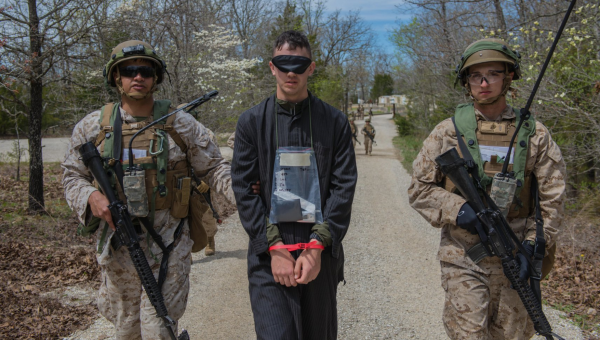
Military law enforcement plays a role in maintaining order and security on military installations and during deployed operations.
Within the U.S. Marine Corps, these responsibilities are carried out by Marines assigned to the Military Police occupational field.
Marines designated under MOS 5811 perform law enforcement and security duties that support base operations, force protection, and the safety of service members and their families.
This article outlines the requirements, training process, pay structure, daily responsibilities, and post-service career considerations associated with Marine Corps MOS 5811.
Related Article – Marine Corps MOS List and ASVAB Scores: Details Of All 123 Jobs
Jump To A Section
Marine Corps Military Police Requirements and Qualifications
- Must be a U.S. citizen
- Be eligible for a Secret security clearance
- Possess a GT score of 100 or higher on the ASVAB
- Must have normal color vision
- Vision correctable to 20/20
- Must have a valid driver’s license from any state
- Be at least 64 inches tall
- Be at least 18 prior to completion of formal school
- Must meet Marine Corps medical and psychological screening standards
- Be articulate with easy-to-understand speech
- No history of drug and alcohol abuse or any convictions associated with drugs, alcohol, or physical violence
- Successfully complete the Law Enforcement Military Police Course at Fort Leonardwood, Missouri
Related Article – Marine Corps Grooming Standards: Hair, Beard, And Nail Regulations
5811 Training and Career Path
Marines must first attend basic training at one of two locations, MCRD San Diego, CA, or Parris Island, SC.
Which one you attend depends largely on where you live. For the majority, anyone living west of the Mississippi River will attend MCRD San Diego, and anyone east will attend Parris Island, SC, with a few exceptions.
Until recently, female Marine recruits only attended boot camp at Parris Island. However, the Marines have finally integrated Basic Training.

After basic training, all Marines who are not infantry will attend Marine Combat Training for 3 weeks.
Individuals interested in becoming military policemen will be sent to the United States Army Military Police School where they will attend the Law Enforcement Military Police Course under the Marine Corps Detachment at Fort Leonardwood, MO.
The training lasts up to 20 weeks, during which Marines will learn everything from firearms handling, defensive driving tactics, penal codes, military laws, and security prevention tactics for a military installation.
Additionally, Marines will spend several hours doing patrols and on-the-job training while at the school and when first arriving at their duty assignment.
After a period of time with their unit, Marines in the 5811 MOS may be eligible to attend more advanced training and schools to increase their skill sets.
Additional training opportunities may include military working dog handler, accident investigation, or other law enforcement–related courses, subject to eligibility.
It is imperative that military policemen and women, understand military laws and regulations as well as civilian laws and regulations.
They must be willing to undergo rigorous training and be prepared to step forward and be the frontline who stands between attackers and military service members.
How Much Are Marine Corps Military Police Paid?
Marines in MOS 5811 receive standard military pay and allowances, with additional incentives dependent on assignment and location.
Those pay adjustments are varied by location and individual, so they will not be discussed in this article. However, the basic pay for all members of the military from ranks E2 through E4 will be added in this article.
Related Article: 7 Benefits Of Joining The Marine Corps
This is simply due to the fact that almost everyone interested in joining the military police as their first MOS will be between the ranks of E2 and E3 by the time they attend and complete the basic Law Enforcement Military Police Course.
However, Marines interested in a lateral move to this MOS after 2 years may be around the rank of E4, so they have also been included in this pay chart.
The pay scales for these ranks are shown below.
Pay Grade Time in Service Monthly Pay
E2 <1 year $2,149
E3 <2 years $2,259
E3 >2 years $2,402
E4 >2 years $2,503
It is important to note that members of the Marine Corps receive additional incentives to help compensate for the low starting wages.
Marines receive free medical, dental, and eye insurance.
Additionally, they get free or discounted room and board and receive at least 2 free meals per day with the possibility of having 3 to 4 meals per day.
These are all benefits that are free and not deducted from the initial pay for single Marines.
Related Article: Marine Corps Ranks And Pay
Day in the Life of MOS 5811
This is one of the few military occupations which require someone to be on duty 24 hours per day, 7 days per week.
An individual serving as a military policeman, or woman, will become accustomed to working shift work with a schedule being something like 4 nights on, 3 days off, and 3 days on, with 4 nights off.
Of course, this will vary by command and the needs of the Marine Corps, but shift work will be a common part of life for anyone serving as a 5811 marine MOS.
What can be expected while on shift? Well, every shift will be different.
One aspect of being a policeman, or woman, in the military, that is uniquely different from their civilian counterparts, is the fact that Marine Military Police are often tasked with standing guard duty at gates.
Therefore, a shift may be nothing more than monitoring a gate post for up to 12 hours, verifying the credentials of persons entering and exiting the base, and keeping a lookout for any suspicious vehicles or activity.
When not standing post at a gate, military police will be tasked to patrol sections of the base.
The base will be sorted into patrol zones where a varied number of officers will be required to patrol and monitor those zones during their shifts.
Military police drive normal-looking police cars but will wear their military uniforms instead of specific police uniforms.
Their uniforms will have a badge on the pocket, and they will be wearing a service belt that consists of their sidearm, nonlethal force weaponry, handcuffs, and any other tools and equipment that may be necessary to safely perform their job.
Their daily lives are never the same and, much like policemen and women in the civilian world, they may encounter a multitude of unique problems daily.
While deployed, military police may be asked to stand guard duty at gates, escort VIPs around dangerous territory, or establish positions of security and overwatch in a city for specific events.
Two recent persons who served in the 5811 MOS found the job to be enjoyable, but they both agreed it could be stressful and extremely demanding.
They both enjoyed their time serving as military policemen but desired to pursue other careers outside of the military.
One of the reviewers mentioned that it was difficult having to relocate regularly, and the transition of going to a new unit was stressful and undesirable.
This is something worth considering for anyone interested in joining the military.


What People Get Wrong About Marine Corps Military Police (MOS 5811)
A common misconception is that Marine Corps Military Police perform the same duties as civilian police officers in all situations. While there are overlapping responsibilities, Marine Military Police primarily operate within military installations and under military law, with authority and jurisdiction defined by military regulations rather than civilian statutes.
Another misunderstanding is that all Marines regularly carry weapons while on base, making military police unnecessary. In reality, most Marines do not routinely carry weapons in garrison environments, which is why dedicated law enforcement personnel are assigned to installation security and policing duties.
There is also confusion about deployment roles. While Marine Military Police may deploy, their duties can vary significantly depending on mission requirements. Not all deployments involve patrols, convoy security, or combat-related tasks, and assignments are influenced by operational needs rather than MOS alone.
Finally, MOS 5811 is sometimes assumed to guarantee a direct transition into civilian law enforcement. Although the training and experience are relevant, civilian agencies maintain independent hiring standards, certification requirements, and background checks that must be met separately.
Civilian Job Opportunities
Marines that serve as military police are more than prepared to enter the civilian world and pursue a career as a law enforcement officer for their hometown, their county, or as state policemen for the state that they call home.
It is an easy transition, and some agencies are even offering bonuses and pay incentives for personnel who have military police backgrounds.
Civilian law enforcement compensation and employment outlook vary by agency, location, and hiring standards.
This is a lucrative salary with plenty of growth opportunities for anyone interested in advancing their careers as law enforcement officers.
Additionally, time in military service can be counted towards retirement for anyone interested in serving a full 20 years as a federal law officer.
Related Article: 10 Best Marine Corps Jobs For Civilian Life
For individuals not interested in continuing their time as police officers, careers abound in private security.
Private security firms are becoming more prominent with more demands for individuals with advanced training.
These firms may be able to pay better than local police agencies, but this is situational.
In addition, Marines who have left the military police may find opportunities to work for government contractors in countries abroad.
Finally, there are several federal agencies in need of military members who have a thorough understanding of how to write police reports, follow the chain of custody, and handle evidence without tampering with it.
If none of these options sound promising, then Marines will find many opportunities available for using their Post 9/11 GI Bill.
There are countless schools and training programs around the country where Marines can use their GI Bill to complete a school and immediately find work with a trade or vocation.
College and 4-year universities are also an option for anyone who is looking to pursue education through their GI Bill.
See Also
How To Become A Marine Corps Police Officer
Army Military Police (MOS 31B): Career Details
National Guard Military Police Career Details
Marine Corps Dog Handler (MOS 5812): Career Profile