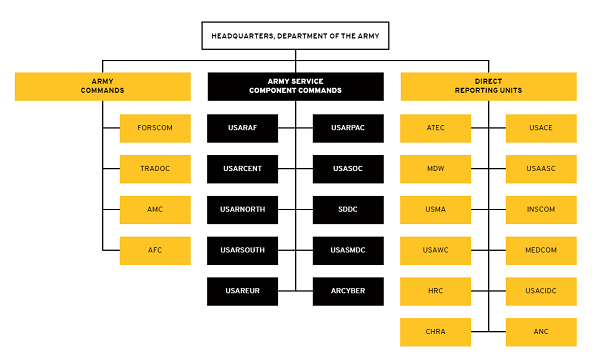
To understand the Army chain of command, you must first know that the Department of the Army falls under the Department of Defense of the United States of America.
There is both an operational and institutional side to the chain of Command.
The operational side covers the numbered armies, divisions, brigades, battalions, and corps in the field.
The institutional side of the Army supports the operational side. This side provides infrastructure that allows the operational side to deploy fully trained and equipped troops.
Related Article – Air Force Chain of Command
Chain of Command/Organization
- President of the United States
- Secretary of Defense
- Secretary of the Army
- Army Chief of Staff
- Sergeant Major of the Army
- Army Commands
- Component Commands
- Direct Reporting Units
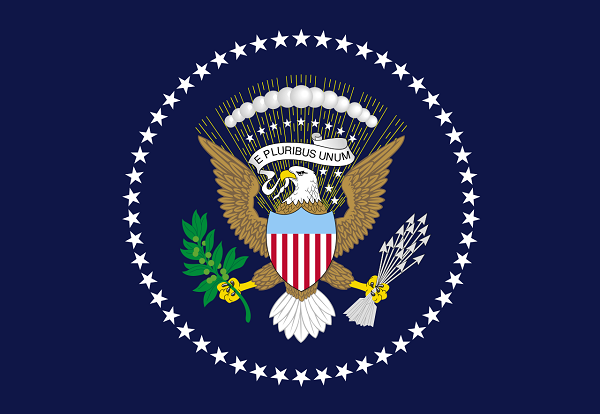
President of the United States
The President of the United States (POTUS) is at the top of the Army Chain of Command.
Currently, President Joe Biden is the President of the United States, making him the Commander in Chief of the U.S. Army.
Secretary of Defense
The Secretary of Defense is a defense policymaker, and he oversees the Defense Department.
Lloyd J. Austin, a West Point graduate, is the current Secretary of Defense.
This former 4-star Army general was sworn in on January 22, 2021.
Secretary of the Army
The Secretary of the Army is a civilian with the Department of Defense responsible for everything related to the Army.
These responsibilities include personnel, weapon systems, reserve units, and even financial management, to name only a few.
Currently, Christine E. Wormuth is the acting Secretary of the Army.
Army Chief of Staff
The Chief of Staff of the Army is a position held by General Randy A. George on a temporary acting basis.
This position is the highest-ranking offer in the Department of the Army, and the person in this position acts as an advisor to the Secretary of the Army.
Also, acting Army Chief of Staff, General George, is an acting member of the Joint Chiefs of Staff, making him an advisor to the National Security Council and the POTUS.
Sergeant Major of the Army
The Sergeant Major of the Army position is the highest possible position for an enlisted member of the Army.
Currently, Michael R. Weimer is the Sergeant Major of the Army.
This position’s responsibilities include advocating for the needs of enlisted members of the Army.
Also, they serve as advisors to the Chief of Staff of the Army.
Army Chain of Command: Army Commands
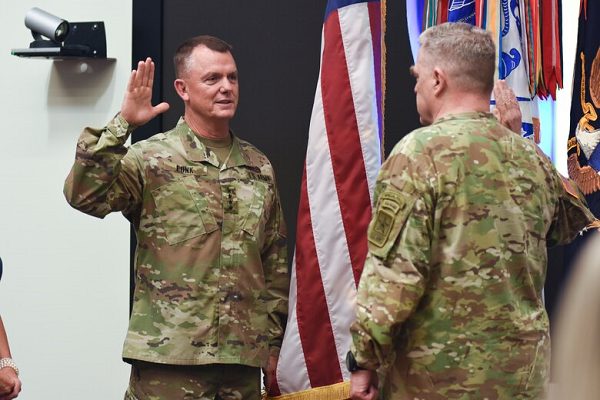
Under the umbrella of the Department of the Army are four Army Commands.
U.S. Army Forces Command (FORSCOM)
The Commanding General for FORSCOM is General Andrew P. Poppas.
FORCOM’s mission is to ensure soldiers are ready for combat and fully trained to meet expectations.
To ensure the mission, FORSCOM prioritizes caring for soldiers, ensuring soldiers are ready for combat, and keeping the forces modern and up-to-date.
U.S. Army Training and Doctrine Command (TRADOC)
General Gary Brito is the commanding General of TRADOC.
TRADOC is responsible for recruiting and training soldiers.
Also, TRADOC provides education and leadership training to ensure soldiers are adaptive and highly competent.
U. S. Army Materiel Command (AMC)
AMC has the unique responsibility of ensuring the supply chain is global and material is ready for the Army.
Currently, the Deputy Commanding General of AMC is General Charles R. Hamilton.
U. S. Army Futures Command (AFC)
The AFC’s goal is to ensure the modernization of the United States Army.
The current Commander for AFC is General James E. Rainey.
Related Article – Navy Chain of Command
Army Chain of Command: Component Commands
There are also Army Service Component Commands under the Department of the Army.
U.S. ARMY EUROPE AND AFRICA (USAREUR-AF)
The Commanding Officer for USAREUR-AF is General Darryl A. Williams.
Also, the mission of USAREUR-AF is to support and promote stability in the European and African regions.
U. S. Army Central (USARCENT)
USARCENT handles the Middle East and Central Asia by providing oversight in the areas.
Also, the Commanding General is Lieutenant General Ronald P. Clark.
U. S. Army North (USARNORTH)
USARNORTH is responsible for both homeland defense and the support of civil authorities.
Also, the Commander is Lieutenant General John R. Evans, Jr.
U. S. Army South (USARSOUTH)
Major General William L. Thigpen is the Commander General for USARSOUTH.
Also, USARSOUTH handles security and other activities in Central and South America, and the Caribbean.
U. S. Army Pacific (USARPAC)
Commanded by General Charles A. Flynn, USARPAC prepares Army forces in the Indo-Pacific area and works to protect the region.
They also work with others in the region to achieve mutual goals and protect both U.S. home lands and those of our allies.
U. S. Army Special Operations (USASOC)
The USASOC commander is Lieutenant General Jonathan P. Braga.
Furthermore, the USASOC works to sustain Special Operation Forces all over the world in all of its missions.
U. S. Army Surface Deployment and Distribution (SDDC)
SDDC integrates global deployment and distribution for the Army and other branches of the military.
Also, this Command works with commercial transportation to ensure their mission.
The SDDC’s current Commander is Brigadier General. Gavin A. Lawrence.
U. S. Army Space and Missile Defense (USASMDC)
The Army Space and Missile Defense’s mission is to develop and provide missile defense for the Army, other U.S. Armed Forces, and allied nations.
Lastly, the Commanding Officer is Lieutenant General Daniel L. Karbler.
U. S. Army Cyber Command (USARCYBER)
USARCYBER handles operations relating to cyberspace, electronic warfare, and anything related to information operations.
Its Commanding Officer is Lieutenant General Maria B. Barrett.
Related Article – Platoon Size: US Army Organizational Structure
Army Chain of Command: Direct Reporting Units
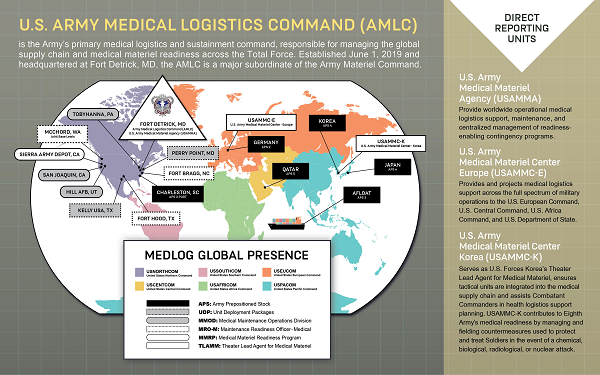
The Direct Reporting Units (DRUs) offer general support to the United States Army.
Also, each unit has a specific and unique mission.
U. S. Army Test and Evaluation Command (ATEC)
ATEC is a Direct Reporting Unit that handles the development, testing, operating, and evaluation of all Army Equipment.
The current commander is Major General James J. Gallivan.
U. S. Army Military Department of Washington (MDW)
MDW is subordinate to the Northern Command, and it provides protection and support within the Washington DC area as well as providing ceremonial honors throughout the United States.
The Commanding Officer for MDW is Major General Trevor Bredenkamp.
U. S. Military Academy (USMA)
Otherwise known as West Point, the USMA is a four-year service academy for the Army.
Its Commander is Lieutenant General Steven W. Gilland..
U. S. Army War College (USAWC)
Located in Pennsylvania, the United States War College is a graduate school for military officials.
Also, this DRU’s Commandant is Major General David C. Hill.
U. S. Army Acquisition Support Center (USAASC)
The USAASC is a DRU to support executive offices with managing resources and the Army’s structure.
Also, the unit’s Director is Mr. Ronald R. Richardson, Jr. Colonel Shane M. Sullivan serves as Deputy Director.
U. S. Army Human Resources Command (HRC)
The Human Resources Command focuses on the career management of soldiers.
Furthermore, this career management starts with basic training and extends until retirement.
The commander of HRC is Major General Thomas R. Drew.
Civilian Human Resources Agency (CHRA)
The Department of the Army created the Civilian Human Resources Agency to handle the civilian workforce’s human resources.
There are Army civilians all over the world, and the CHRA handles everything from recruitment to retirement.
U. S. Army Corps of Engineers (USACE)
The Army Corps of Engineers has three areas of their mission.
They are an engineering regiment that also handles military construction. Also, the Army Corps of Engineers works with civilian organizations, as well.
Finally, the Commanding General is Lieutenant General Scott A. Spellmon.
U. S. Army Intelligence and Security Command (INSCOM)
The Army Intelligence and Security Command handles information, intelligence, and security operations at a national level.
The commander is Major General Michele Bredenkamp.
U. S. Army Medical Command (MEDCOM)
The MEDCOM is a Direct Reporting Unit that provides health services to the Army.
Moreover, this type of medical support is critical while caring for both troops and their families.
Lastly, Lieutenant General R. Scott Dingle is the U.S. Army Surgeon General and Commanding General. Also, the Command Sergeant Major is Diamond D. Hough.
U. S. Army Criminal Investigation Division (USACID)
The Criminal Investigation Division investigates severe violations of military law.
Special Agent Gregory D. Ford assumed responsibility for the command in September 2021 as its first civilian director.
Arlington National Cemetery (ANC)
Arlington National Cemetery is a DRU. This cemetery is for military members and is located in Virginia across the Potomac River near Washington D.C.
The Executive Director is Ms. Karen Durham-Aguilera.
Military Postal Service Agency (MPSA)
MPSA is the DRU responsible for coordinating USPS services for the Department of Defense.
This unit coordinates mail services across the globe for military members and their families as well as Department of Defense offices.
Army Chain of Command: Within your Unit
When you are new to your unit, it is wise to memorize your chain of Command.
This list goes in order from the bottom up.
- First-Line Supervisor
- Company Commander
- Battalion Commander
- Brigade Commander
- Division Commander (or Post Commander)
After this point, you go to your Commander in charge of whatever Army Command under which your unit falls.
For instance, your unit might fall under U.S. Army Materiel Command.
Also, it would help if you memorize your NCO chain of command.
- Platoon Sergeant
- First Sergeant
- Battalion Command Sergeant Major
- Brigade Command Sergeant Major
- Division or Post Command Sergeant Major
- Army Command Commander
- Sergeant Major of the Army
Related Article – Marine Corps Chain of Command
Conclusion
The Army is one branch of the military under the Department of Defense.
There are two parts to the Army and that is the operational and institutional side.
The institutional side supports the operational side, but they both need each other for effectiveness.
The chain of command begins with the President of the United States.
Beyond the executive offices, the Army has four commands.
Next, there are component commands that oversee regions of the world.
Within those commands, there are Direct Reporting Units.
A soldier’s chain of command begins locally where they are stationed.
Also, a soldier should know his chain of command within his unit as well as the noncommissioned officer chain of command.
References:
Born and raised in Woodbridge, NJ, he graduated from the New Jersey Institute Of Technology with an MBA in eCommerce.His hobbies include beach volleyball, target shooting, and lifting.
Rob is also a Commercially rated pilot and Certified Flight Instructor (CFI), with over 1,500 hours of flight time.
- Ikon Pass Military Discount: Learn How To Save Big - January 31, 2025
- RTIC Military Discount: Find Out How To Save Big on Gear - January 30, 2025
- Traeger Military Discount: Learn How To Save Big on Smokers - January 28, 2025