

Missile Technicians (MT) are the Navy’s specialists in maintaining, operating, and repairing strategic and tactical missile systems aboard submarines and surface ships.
They handle Trident II D5 ballistic missiles on Ohio-class SSBNs, Tomahawk cruise missiles on guided-missile submarines and destroyers, and vertical launch systems (VLS), ensuring weapons are ready for launch at any time.
The rating involves electronics troubleshooting, hydraulic systems, mechanical assembly, ordnance handling, and strict adherence to nuclear weapons safety protocols.
MTs work in secure missile compartments, launch tubes, and control rooms, often in confined spaces during long patrols, with high responsibility for mission-critical systems.
This career requires technical precision, security clearance, teamwork under pressure, and the ability to follow detailed procedures flawlessly.
In this updated guide for 2026, we cover entry requirements, the training pipeline, daily duties, current pay structure, advancement opportunities, and how MT experience translates to strong civilian careers in aerospace, defense, electronics, and ordnance handling.
Related Article – Navy Jobs List: A List Of All 71 Ratings In The Navy
Jump To A Section
Training And Career Path
What’s Life Like for a Navy Missile Technician?
Sea/Shore Rotation
Pay And Benefits
Job Reviews
Civilian Career Opportunities
Requirements and Qualifications
To serve as a Missile Technician (MT) in the United States Navy, recruits must meet multiple requirements:
- US citizenship is required
- Must be between the ages of 18 and 41.
- Must have good vision and normal color perception.
- High school diploma or equivalent.
- Must volunteer for duty onboard submarines.
- Must have no adversely adjudicated drug abuse offenses
- Can have no history of drug or alcohol abuse
- Must pass the Navy’s Personal Reliability Program (PRP) screening
- Must be eligible for a security clearance based on a Single Scope Background Investigation (SSBI).
Those hoping to join the Navy as a Submarine Missile Technician must also meet the minimum ASVAB aptitude scores:
Arithmetic Reasoning (AR) + Mathematics Knowledge(MK) + Mechanical Comprehension (MC) +Verbal Expression (VE) >=218.
Related Article: Navy Height And Weight Standards
Missile Technicians incur a six-year active-duty obligation.
The sailors enlist for four years and concurrently sign an agreement to extend their enlistment for an additional two years.
Training and Career Path
Like all other Navy enlisted personnel, MTs must successfully complete 10 weeks of Navy Boot Camp, at the Recruit Training Command, Great Lakes (RTC Great Lakes).
The training Missile Technicians complete is much more extensive than that required of most other ratings in the US Navy.
After Boot Camp, MTs spend four weeks of indoctrination at Basic Enlisted Submarine School, commonly referred to as BESS in Groton, Connecticut.
While still at Groton, Missile Technicians then go on to attend three weeks of classes at the Basic Mechanical Skills School.

Related Article – Navy Fire Controlman (FC): Career Details
A School for Navy Missile Technicians is five weeks long, and these take place at Kings Bay, Georgia.
During A School, MTs learn basic electronics, basic digital theory and the fundamentals of electricity
Class “C” School for Missile Technicians takes place at either Kings Bay, Georgia, or Bangor, Washington.
These advanced classes include 23 weeks of advanced training in electronics, electricity, and mechanical systems. They learn how to repair Trident II missiles and the associated launching systems.
This training entails both group instruction and equipment labs.
Advanced Training and Advanced Rank for MTs
Sailors who will be assigned to SSGNs (the SS denotes submarine, the G stands for guided missile, and the N indicates that the submarine is nuclear-powered) must also attend the five-week AWS Replacement course in Kings Bay, Georgia.
Here, the SSGN-bound MTs further instructed in advanced electronics, electricity, and mechanics as related to the Tomahawk missile system.
MTs enjoy an accelerated advancement to E-4 after successful completion of their training, provided they maintain their eligibility for the MT rating.
An MT could undergo as much as 40 weeks of training prior to deploying to their first duty station.
Related Article – Navy Aviation Support Equipment Technician (AS): Career Details
What’s Life Like for a Navy Missile Technician (MT)?
Missile Technicians are the sailors responsible for the repair, maintenance, and assembly of the nuclear-capable ballistic missiles aboard submarines.
The extensive training that they receive also enables them to maintain and repair the associated electro-mechanical navigation and targeting systems.

On a day-to-day basis, there is no shortage of work for the Missile Technician (MT).
Their numerous and various duties include:
- Maintaining ballistic missiles and their components
- Testing and maintaining missile launch systems, including hydraulic and high-pressure air systems.
- Maintaining and operating ballistic missile fire control systems and equipment for Trident submarines.
- Testing and ensuring the operating efficiency of electrical components, such as distribution panels, controllers, rectifiers, voltage regulators, and transformers.
- Testing, calibrating, and repairing ballistic guidance systems.
- Operating and adjusting optical measuring equipment
- Maintaining logs and preparing reports on testing, calibration, and equipment maintenance.
- Providing security in the missile launch area when aboard submarines and maintaining control of any classified material.
MTs normally work indoors, with the occasional outside duty doing tasks such as missile loading. Their duties are both physical and mental in nature.
You can check out life aboard the USS Wyoming in the YouTube video below:
The most common duty stations for MTs are aboard submarines homeported on the Naval Submarine Bases in Bangor, Washington, and Kings Bay, Georgia.
Navy Missile Technician (MT) Sea/Shore Rotation
I was honestly surprised at the Sea/Shore rotation sailors in the MT rating enjoy. It is about 50/50.
This is one of the best Sea/Shore rotations of any submarine ratings.
| Tour | Sea Tour | Shore Tour |
|---|---|---|
| First Tour | 48 Months | 36 Months |
| Second Tour | 42 Months | 36 Months |
| Third Tour | 36 Months | 36 Months |
| Fourth Tour | 30 Months | 30 Months |
| Fifth Tour | 30 Months | 30 Months |
| Sixth Tour | 30 Months | 30 Months |
| Seventh Tour | 30 Months | 30 Months |
How Much Are Missile Technicians (MT) Paid?
Like the other members of the U.S. Armed Services, the Navy pays Sailors based on rank and length of service.
| Insignia | Pay Grade | Rank | Abbreviation | 2026 Minimum Monthly Pay (<2 Years) |
|---|---|---|---|---|
| N/A | E-1 | Seaman Recruit | SR | $2,407.20 (after 4 months; $2,225.70 for first 4 months) |
 | E-2 | Seaman Apprentice | SA | $2,697.90 |
 | E-3 | Seaman | SN | $2,836.80 |
 | E-4 | Petty Officer Third Class | PO3 | $3,142.20 |
 | E-5 | Petty Officer Second Class | PO2 | $3,342.90 |
 | E-6 | Petty Officer First Class | PO1 | $3,401.10 |
 | E-7 | Chief Petty Officer | CPO | $3,932.10 |
 | E-8 | Senior Chief Petty Officer | SCPO | $5,656.50 (starts at over 8 years) |
 | E-9 | Master Chief Petty Officer | MCPO | $6,910.20 (starts at over 10 years) |
 | E-9 | Fleet/Command Master Chief Petty Officer | FMCPO/CMCP | $6,910.20 (starts at over 10 years) |
 | E-9 | Master Chief Petty Officer of the Navy | MCPON | $6,910.20 (starts at over 10 years) |
In addition, MTs may also receive further compensation, including Basic Allowance for Housing (BAH) and Basic Allowance for Subsistence (BAS).
They may also receive sea pay, submarine pay, or other incentives.
As of the date of this article, monthly submarine pay is currently from $85.00 to $600.00 per month for enlisted Sailors. The final amount depends on rank and time in service as well.
MTs, as do all submariners, receive sea pay in addition to their submarine pay.
Additionally, there are various bonus opportunities available to MTs.
For example, sometimes the Navy offers a Selective Reenlistment Bonus (SRB) for MTs who sign up for additional years.
There is also a Student Loan Repayment Program that Missile Technicians are eligible for.

Job Reviews
Reviews from current and former MTs on indeed.com are varied. Some reference the arduous life onboard a submarine, including long hours and deployment woes.
However, they are surprisingly positive. They also point out such positives as great pay and benefits, as well as the opportunity for training and experience:


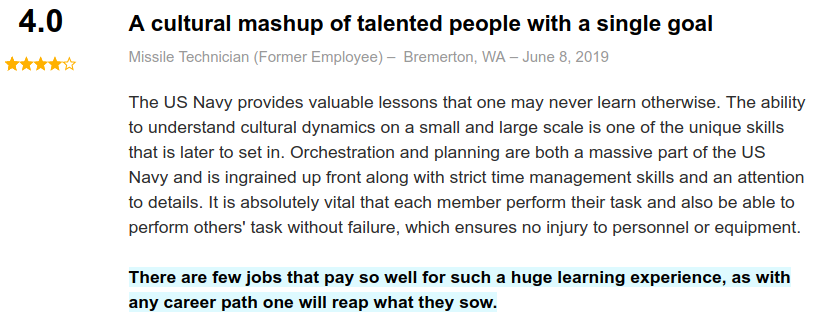

Current and former MTs on glassdoor.com shared similar sentiments:

MT3 (SS) Austin Brossaurd, a Missile Technician aboard the USS Kentucky (SSBN-737) is certainly happy with his choice of the MT rating.
“The job is very rewarding, especially because it’s so important to the mission of the ship. It always keeps you on your toes, which I appreciate. Being able to say I do something that not everyone gets to do is a rewarding feeling for me. Submariners are an elite bunch that I’m proud to be a part of.”
The Department of the Navy’s Credentialing Opportunities Online (COOL) website estimates that only about 450 sailors serve in the elite Missile Technician rating in today’s Navy.
Related Article: 5 Best Navy Combat Jobs
What People Get Wrong About US Navy Missile Technician (MT)
Many assume Missile Technicians spend their time only in simulators or control rooms pushing buttons.
In reality, MTs perform extensive hands-on work including missile handling, tube maintenance, hydraulic and pneumatic system repairs, electronic troubleshooting, warhead assembly/disassembly (for tactical missiles), and periodic missile inspections inside launch tubes and magazines.
Another misconception is that the rating is low-physical-demand desk work.
The job involves heavy lifting, working in confined missile spaces, climbing ladders in launch tubes, wearing protective gear, and handling hazardous ordnance and high-pressure systems during long submarine patrols or surface ship deployments.
People often think entry requires prior missile or nuclear experience or a college degree.
The Navy trains you completely; requirements include ASVAB line scores (AR+MK+EI+GS=222 or VE+AR+MK+MC=222), normal color perception, Secret (or higher) clearance eligibility, U.S. citizenship, and meeting stringent security/background standards—no advanced education or prior experience needed.
Some believe training is short or focused only on electronics.
After boot camp, “A” School at Naval Nuclear Power Training Unit (about 20-24 weeks) covers missile systems fundamentals, followed by specialized pipeline training (including Strategic Weapons System for SSBN MTs), with total initial training often exceeding a year including prototype and qualification phases.
Finally, a common view is that civilian transitions are narrow due to classified nature.
MT skills in high-reliability electronics, ordnance handling, systems maintenance, hydraulics, and security clearance open doors to defense contractors (Lockheed Martin, Raytheon), aerospace firms, nuclear power plants, FAA-certified roles, or federal agencies, frequently with strong starting salaries and certifications like NEC equivalents boosting opportunities.
Understanding these realities prepares candidates for a highly technical, secure, and impactful career in strategic deterrence and tactical strike capabilities.
Civilian Career Opportunities
Civilian career opportunities for former MTs are plentiful and include such jobs as:
- Electrical Equipment Assemblers and Installers
- Electronics Technicians
- Electronics Engineers
- Electrical Engineers
- Ordnance Handling Experts
- Explosive Workers / Blasters
- Equipment Inspectors
In addition, MTs should take advantage of their security clearance in their job search after leaving the Navy.
Sailors in the Missile Technician rating should use any and all educational opportunities offered during their service in the Navy.
The United States Military Apprenticeship Program (USMAP) also allows MTs to complete several of their civilian apprenticeship requirements while on active duty.
Missile Technicians can obtain a number of different national certifications, federal licenses, and state licenses that qualify them for well-paying jobs in civilian life.

If you are thinking of joining the US Navy, and think you can handle life aboard a submarine, consider the benefits of an MT rating.
Missile Technician rating might be your ticket to an exciting career in the Navy’s “Silent Service.”
Related Article – 5 Types Of Military Discharge: Benefits (and Consequences) Explained
References
Navy Personnel Command Missile Technician (MT) Overview
U.S. Navy COOL Summary For Missile Technician (MT)
Navy COOL Missile Technician (MT) Rating Card
MT3 (SS) Broussard Article – The Advocate
Navy Missile Technician (MT) Reviews – glassdoor.com
Navy Missile Technician (MT) Reviews – indeed.com

After the Navy, Travis worked in the Information Technology sector for twenty-five years.
Connect with Travis @MichaelTRose.
- 10 Best Navy SEAL Movies of All Time (Updated For 2026) - June 20, 2024
- Navy Swim Test 2026: Requirements, Scoring & How to Pass - June 20, 2024
- Navy Selective Reenlistment Bonus (SRB) Details For 2026 - June 20, 2024