
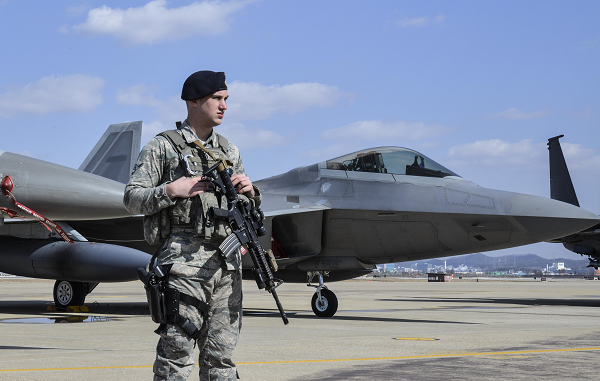
Air Force Security Forces (3P0X1) is the Air Force’s primary ground combat and law enforcement career field.
These airmen protect air bases, secure nuclear weapons, respond to active threats, and enforce military law both stateside and overseas.
It is one of the most physically demanding and operationally diverse enlisted jobs in the Air Force.
This 2026 guide explains exactly what the 3P0X1 career field involves, the full training pipeline, daily responsibilities, deployments, and the real pros and cons so you can decide if it is the right fit for you.
Jump To A Section
What does an Air Force Security Forces Specialist do?
Pay And Benefits
Job Reviews
Civilian Job Opportunities
Summary
Education, Requirements, and Training
Air Force Security Forces specialist positions have similar education and training requirements to other Air Force positions, but it has more requirements listed than other positions.
Education
Individuals wishing to enter into the Air Force as Security Forces specialist must have at minimum a High School Diploma or GED.
They also must meet the minimum Air Force ASVAB requirements.
Related Article – Marine Corps Military Police (MOS 5811): Career Details
Requirements
The standard qualification for Air Force recruits is to have normal color vision and be between the ages of 17 and 39.
Similar to other positions, you must complete a National Agency Check, Local Agency Check, and Credit Check.
You must also have possession of a valid driver’s license that allows you to operate a government motor vehicle.
Some of the less common qualifications that this role requires include not having:
- A history of excessive alcohol or drug use
- Prior drug or alcohol-related incidents
- Any history of sleep disorders
- A history of ADD, ADHD, or perceptional learning disorders
- Fear of working around nuclear weapons
- A record of gang affiliations
- Fear of heights or confined areas
- A speech disorder or noticeable communication deficiency
Related Article: Can You Join The Military With A Felony?
Training

_070815-F-YN203-006.jpg)
Air Force Security Forces are required to complete 7.5 weeks of Basic Military Training.
After completing training, recruits will attend 65 days at Joint Base San Antonio, in Texas.
Security Forces training will be broken down into different blocks.
Block 1
The first block consists of learning Security Forces history, culture, and basic combative skills.
Block 2
Personnel will go to CATM where they will learn how to hand the M-4 and M-9 firearms.
Block 3
This block consists of learning field training where they will carry weapons or participate in simulation rounds.
Block 4
Students will learn the security side of the position. This includes learning skills to diffuse situations and how to properly enter and clear a room.
When training is complete, you will be given your assignment and will be trained on the specific tasks for that specific assignment.
The Air Force video below shares more information on what training for a Security Forces position is like.
What does an Air Force Security Forces Specialist do?
An Air Force Security Forces specialist may have different tasks depending on the role the person is in, but the overall goal is to protect the people, equipment, and assets of the Air Force.
Some roles are similar to those of a civilian police officer.
Individuals could be required to patrol the base, write tickets, and make traffic stops.
Some airmen may investigate incidents and crime scenes.
Related Article – Air Force Explosive Ordnance Disposal (3E8X1): Career Details
Security Forces apprehend and detain subjects.
They will be asked to secure a crime scene and could be asked to testify in court based on any events or investigations they take part in.
They could also be required to apply first aid and life-saving procedures as the first responder at an accident or disaster.
Air Force Specialists are given the task of guarding a missile site and guarding a convoy.
Specialists will be asked to participate in team patrol movements, drills, battle procedures, and non-war military operations.
They may also work as dog handlers and train military dogs.
These dogs are specially trained and bred to sniff drugs, paraphernalia, and explosives as well as track down and bite offenders.
Airmen who are lucky enough to have this position consider military dogs as partners.
Related Article – Army Military Working Dog Handler (MOS 31K): Career Details
In this position, you could be guarding a gate one day and then guarding a flight the next.
No two days are the same, and you have to constantly be alert and ready for anything to happen.
While the position is similar to a civilian police officer, the role includes many more duties and risks.

Some positions that you could hold as Air Force Security Forces include:
CATM: Combat Arms Training and Maintenance-Personnel who use, train, specialize, and maintain small arms.
K9 Handler: Training and working with Military K9 Dogs.
Raven: Aircraft security
DAGRE: Deployed Aircraft Ground Response Element, a team of highly trained individuals who complete enhanced security for Special Operations Command
TRF: Tactical Response Force, Tactics team that protects nuclear weapons bases
EST: Emergency Services Team, which functions as an Air Force SWAT team.
There are many other positions available that all require specific training and have different risks associated with them.
The video below explains different positions and shares more information about what it is like as an Air Force Security Forces specialist.
What does an Air Force Security Forces Specialist Make?
You can gain a great visual of what a Security Forces specialist would make by checking out the table below.
| Insignia | Pay Grade | Rank | Abbreviation | 2026 Minimum Monthly Pay (<2 Years) |
|---|---|---|---|---|
| E-1 | Airman Basic | AB | $2,397 (after 4 months; $2,217 for first 4 months) | |
 | E-2 | Airman | Amn | $2,687 |
 | E-3 | Airman First Class | A1C | $2,826 |
 | E-4 | Senior Airman | SrA | $3,130 |
 | E-5 | Staff Sergeant | SSgt | $3,116 |
 | E-6 | Technical Sergeant | TSgt | $3,401 |
 | E-7 | Master Sergeant | MSgt | $3,932 |
 | E-8 | Senior Master Sergeant | SMSgt | $5,657 (starts at over 8 years) |
 | E-9 | Chief Master Sergeant | CMSgt | $6,910 (starts at over 10 years) |
 | E-9 | Command Chief Master Sergeant | CCM | $6,910 (starts at over 10 years) |
 | E-9 | Chief Master Sergeant of the Air Force | CMSAF | $6,910 (starts at over 10 years) |
The table represents the base pay for all airmen, based on rank and time of service.
Not only does the Air Force offer a base pay, they also offer benefits that are better than most positions in the civilian world.
Benefits
As an airman, you can expect to receive free/low-cost medical and dental.
The Air Force offers paid sick time and 30 days of paid vacation per year.
As an airman, you are eligible to retire after 20 years of service.
You can begin receiving benefits the day you retire.
This is a plan that does not require you to take money out of each check.
As soon as you begin Basic Training, you will be earning college credits.
The credits that you earn in the Security Forces position go directly toward a Criminal Justice degree.
The Air Force offers a few different tuition assistance programs if you wish to pursue that degree or another one.
Related Article – Pros And Cons Of Joining The Air Force
The Air Force offers to assist with up to 100% tuition coverage with the Air Force Tuition Assistance Program, the Post 9/11 GI Bill, and the Montgomery GI Bill.
You will receive a housing and food allowance.
The housing allowance will cover all housing expenses including utilities and maintenance for those who choose to live on-base.
If you choose to live off the base, you will be given a housing allowance that is based on your rank, family status, and location.
In addition to the food allowance, there are tax-free department and grocery stores to help you save extra money.
Individuals can also take advantage of the many recreational options on-base.
The recreational options do not just benefit the airman, but also members of their entire family.
Related Article – 10 Benefits Of Being A Military Wife (and 5 not-so-good things)
Job Reviews
Being in the Security Forces position requires you to make the most out of each situation.
You will not always like each situation that you are placed in.
The position is very stressful and requires a lot of both physical and mental strength.
Most reviews of the position are positive.
What people like about the position is the ability to grow, the benefits that the Air Force offers, and the skills that you learn that could directly relate to careers outside of the Military.
What individuals do not like about the position are the long hours, rotating shifts, and temporary assignments.
Those negative aspects are ones that are similar to any position in law enforcement, in and out of the military.
The reviews below are a good summary of what the majority of individuals on Glassdoor said about the position.


Civilian Job Opportunities
Having the experience and skills gained as an Air Force Security Forces specialist will open the door to many law enforcement opportunities.
The skills directly relate to a police officer or sheriff position.
Job opportunities include working as an investigator or in security.
Individuals could use their skills to work as SWAT members.
There are jobs that are available in private facilities as well as government positions.
An instructor position for Criminal Justice or Firearms training is also a possibility.
Generally, military preference is given in law enforcement positions.
Law enforcement positions are in high demand and have varying pay depending on the position and the type of work.
Related Article – Air Force Intelligence Officer: Career Details
What People Get Wrong About Air Force Security Forces (3P0X1)
Many recruits assume Security Forces is basically “military police” and that the job is limited to writing tickets and guarding gates.
In reality the career field has evolved into a true ground combat force.
3P0X1s regularly train and deploy as infantry-style defenders, conduct mounted and dismounted patrols, and respond to active shooter or terrorist threats on Air Force installations worldwide.
Another widespread misconception is that the job is safer than Army or Marine infantry roles because it is in the Air Force.
Security Forces members have seen significant combat in recent years, especially in contingency locations and during base defense operations.
The casualty rate in certain deployments has been comparable to other ground combat units.
Some applicants believe the training is short and easy compared to other combat arms.
The Security Forces Academy at Lackland is physically and mentally intense, with high attrition rates.
The pipeline includes weapons training, defensive tactics, and law enforcement certification that rivals many civilian police academies.
Many airmen think once you finish tech school you will spend most of your time in an air-conditioned security forces building.
Junior 3P0X1s often pull long shifts at gates, conduct foot patrols in extreme weather, and support high-visibility events with very little downtime.
A frequent error is underestimating the dual nature of the job. You must maintain both law enforcement standards and combat readiness at all times.
The balance between the two can be challenging and requires constant training.
Finally many assume the MOS has limited promotion potential or civilian value.
In reality experienced Security Forces members move into federal law enforcement, private security contracting, and intelligence roles very successfully after their enlistment.
Understanding these realities helps applicants enter the 3P0X1 career field with accurate expectations and prepares them for one of the most dynamic and respected jobs in the Air Force in 2026.
Summary
Being an Air Force Security Forces specialist means you are in charge of protecting the people, assets, and resources of the Air Force.
To join Air Force Security Forces, you have to meet the minimum education, qualifications, and training requirements.
Once you complete all the requirements, you have an opportunity to go into a wide variety of different positions.
Each position has different additional training requirements.
Your duty as Air Force Security Forces could be to patrol the base one day and protect a missile launch site the next.
Individuals can work as a K9 unit or become one of the select few skilled individuals who make up the DAGRE team.
Training is difficult and so is each day.
This position is rewarding and allows you to grow as a person.
Most people are satisfied with making the choice of Security Forces.
The skills that you learn as Security Forces directly relate to several civilian Law Enforcement options that have varying degrees of pay.
References:
