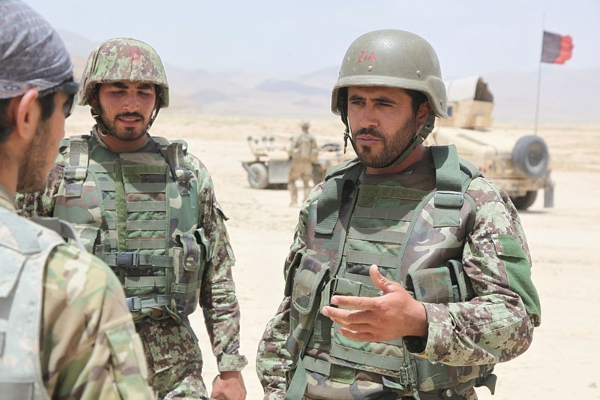
Army Interpreter/Translator (MOS 09L) was a specialized Military Occupational Specialty that existed from 2003 until its inactivation in March 2022.
The MOS was created to recruit fluent speakers of critical Middle Eastern languages to support U.S. Army operations during overseas deployments.
These soldiers served as linguists in combat and operational environments, providing interpretation, translation, and cultural support for U.S. forces.
Although the MOS is no longer active, its role played a significant part in military operations, diplomacy, and tactical decision-making during its period of use.
Education, Qualifications, Training, and Duty Stations

There were specialized educational requirements and training necessary to become an Army Interpreter (09L).
Related Article – Army MOS List: A List Of All 159 Army Jobs
Education
Those who wanted to be considered for the job of Army Translator/Interpreter must have a high school diploma or GED.
Candidates for MOS 09L were required to complete education not the norm for most soldiers.
You need to be proficient in one or more of the following languages:
-
- Arabic-Egyptian
- Arabic-Gulf-Iraqi
- Arabic-Levantine
- Arabic-Libyan
- Arabic-Modern Standard
- Arabic-Moroccan
- Arabic-Tunisian
- Persian-Afghan (Dari)
- Persian-Iranian (Farsi)
- Pushtu/Pashto/Pachto
Furthermore, you need to have a score of at least 50 in the English Comprehension Level Test (ECLT) portion.
Qualifications
In addition to being required to read and speak fluently in at least one of the target foreign languages, MOS 09L also were required to improve their English skills.
These service members trained at the Defense Language Institute English Language Center to improve their English skills.
By the end of training, they had to score at least 80 on the ECLT.
Furthermore, they were required to achieve at least an L2 (listening) and S2 (speaking) rating on the Oral Proficiency Interview (OPI) and score a minimum of 10 on the ASVAB.
NOTE: Some also had to qualify for a Secret security clearance from the Department of Defense in the upper ranks of MOS-09L.
Related Article – Defense Language Aptitude Battery (DLAB) Test Guide
Training
The first step was to complete basic English language training if required by the U.S. Army.
Then, they had to complete 10 weeks of Army Basic Training (or boot camp).
After completing BCT, they progressed to Advanced Individual Training where the focus on training regarded:
- VIP Escort
- Checkpoint Operations
- Medical Support
- Contract Negotiations
- Cultural Awareness
- Training Host-Nation Forces
- Locally Employed Personnel Screening
NOTE: If the Army deemed you did not need English enhancement training, you would skip the first step, complete BCT, then progress to Advanced Individual Training for six weeks at Fort Jackson.
Duty Stations
Those serving in the Army in MOS 09L were based at one of the following duty stations:
Inside the Continental US (CONUS)
- Fort Irwin, CA
- Fort Johnson, LA
Outside the Continental US (OCONUS)
- None
Why MOS 09L Was Inactivated
MOS 09L was inactivated in March 2022 as the Army shifted away from maintaining a standalone interpreter specialty.
Language and interpretation responsibilities were consolidated into other intelligence, linguist, and contracting roles, as well as civilian and local national interpreter programs.
The change reflected evolving operational needs, force structure adjustments, and the reduced requirement for large-scale embedded interpreters following the drawdown of major overseas combat operations.
Although MOS 09L no longer exists, many of its functions continue to be performed by other military occupational specialties, contractors, and partner organizations.
What does an Army Interpreter/Translator Do?

The Army Interpreter/Translator 09LC MOS was “responsible for conducting interpretation and preparing translations between English and a foreign language,” according to the U.S. Army.
Interpreters also assisted soldiers with familiarization training in foreign languages and cultural awareness.
It was not uncommon for translators to specialize in not just one, but multiple languages.
Related Article – Army APFT Test Standards For Males and Females
Direct Lines of Communication
Army Interpreters were incredibly important because often a group of soldiers with very little understanding of the language or knowledge of the culture are shipped overseas.
Translators were fluent in speaking, writing, and reading the language.
They provided direct communication between troops and local civilians and vice versa.
The most common form of interpretation was done orally.
Negotiations
Army Interpreters are incredibly important in negotiations of all kinds from hostage negotiations to creating terms and conditions of an agreement.
When not in combat, translators often held classes and training designed to give other members of the unit a basic understanding of the language, culture, and other norms of the foreign place.
Often, interpreters assisted military contracting officers with a local purchase.
Military Checkpoints
There was a high demand for fluent translators at important intersections and other military checkpoints.
The translator was able to provide interpretation support at military traffic control points.
Additionally, they often assisted security personnel in screening the local population.
Human Affairs
Army interpreters and translators are crucial to establishing human relations between U.S. Military and local cultures.
Interpreters often assisted in the Public Affairs Office.
They are important for addressing the media during crucial events.
As Army interpreters move up the ranks, their duties will become more complex.
Often, 09L MOS began in an office reading and translating foreign language material to English, or vice versa.
Then, they were assigned more responsibilities like translating orally during negotiations and providing guidance to others.
The most respected Army Interpreters served as high-level personal escorts and Top Secret military negotiations.
What does an Army Interpreter make?

The Army has the same base pay for all individuals with the same rank and years of service.
You will notice that as you move up in rank and time of service, you will also get paid more:
| Insignia | Pay Grade | Rank | Abbreviation | Minimum Monthly Pay |
|---|---|---|---|---|
| E-1 (less than 4 months) | Private | PVT | $2,226 | |
| E-1 (after 4 months) | Private | PVT | $2,407 | |
 | E-2 | Private Second Class | PV2 | $2,698 |
 | E-3 | Private First Class | PFC | $2,837 |
 | E-4 | Specialist or Corporal | SPC | $3,142 |
 | E-5 | Sergeant | SGT | $3,342 |
 | E-6 | Staff Sergeant | SSG | $3,401 |
 | E-7 | Sergeant First Class | SFC | $3,932 |
 | E-8 | Master Sergeant | MSG | $5,657 |
 | E-8 | First Sergeant | 1SG | $5,657 |
 | E-9 | Sergeant Major | SGM | $6,910 |
 | E-9 | Command Sergeant Major | CSM | $6,910 |
 | E-9 | Sergeant Major of the Army | SMA | $6,910 |
Benefits
The U.S. Army has several benefits included with a monthly salary:
- Medical Insurance
- Vacation Time
- Special Pay
- Retirement
- Housing: Allowances for living expenses, utilities, and maintenance.
- Food: Allowance for the on-base dining hall and access to tax-free department and grocery stores
- Education: Army members can earn full-tuition, merit-based scholarships, allowances for books and fees, plus annual stipend for living expenses.
- Linguists receive a Foreign Language Proficiency Bonus (up to $400 extra for each language spoken, or a total of $1,000 p/ month).
Related Article – Army Ranks and Pay
Job Reviews
Most Interpreters agree that it is a very demanding job that requires a lot of education and skill, yet is one of the more rewarding in all of the Army.
The benefits of becoming a translator include learning foreign languages, learning about different cultures, communicating and helping people, and helping your government understand human affairs.
The biggest cons are the amount of time spent needing to learn and master one or more languages.
Army Interpreters are also often sent to high-combat, dangerous places like Afghanistan and the Middle East.
Civilian Job Opportunities
Army Interpreters can continue to work as translators for private companies and other government agencies following retirement from the U.S. Military.
There is also a high demand in education for people that have bilingual skills.
The same is true of leadership roles, which may require people working with different nationalities and languages.
Additionally, the Army PaYS program is a recruitment option to consider for military personnel moving to civilian employment.
Lockheed Martin, AAI Corporation, Concucrrent Technologies, URS, and General Dynamics Land Systems are all companies the Army mentions as currently having partnerships with the Army to hire MOS 09L.
Summary
Even though the 09L MOS is no longer active, Army Interpreters/Translators were an important job to the U.S. Military.
Often troops are sent somewhere where they need a specialist that speaks and reads the language, understands the local culture, and can assist with important negotiations and at military checkpoints.
Resources:
- https://www.goarmy.com/linguist/about/interpreter-translator.html
- https://www.goarmy.com/careers-and-jobs/browse-career-and-job-categories/intelligence-and-combat-support/interpreter-translator.html
- https://www.hrc.army.mil/content/5462
