
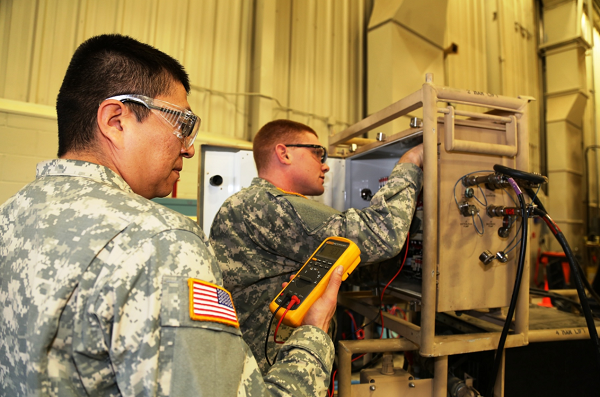
Army Quartermaster Equipment Repairer (MOS 91J) keeps critical support equipment running.
These soldiers repair and maintain laundry systems, field kitchens, refrigeration units, heaters, and other quartermaster gear that soldiers rely on every day in garrison and in the field.
It is a highly technical maintenance MOS that combines mechanical skills, troubleshooting, and the ability to work in fast paced environments.
This 2026 guide explains exactly what the 91J MOS involves, the full training pipeline, daily responsibilities, deployments, and the real pros and cons so you can decide if it is the right fit.
Qualifications and Training
To enter into this MOS recruits must pass all physical/medical exams and take the ASVAB.
A minimum score of 92 on the Mechanical Maintenance (MM) portion of the ASVAB is required to enter into this position, or a combination of 87 on the Mechanical Maintenance and 85 on the General Technical (GT).
Training for this position starts with 10 weeks of Basic Combat Training.
Soldiers will then move onto Advanced Individual Training for 10 weeks.
Advanced Individual Training consists of classroom and field work with practice in marine engine maintenance and repair.
Skills that are helpful in this MOS include:
- Interest in fixing engines and machinery
- Ability to use hand and power tools
- Interest in a job with physical work
Related Article –Air Force Precision Measurement Equipment Laboratory (2P0X1): Career Details
What are the Job Duties of a Quartermaster and Chemical Equipment Repairer?

Quartermaster and Chemical Equipment Repairers supervise and perform maintenance on a variety of equipment.
The equipment that they service performs various tasks for soldiers from water purification and laundry to heat.
Their work is important to keeping unit operations successfully running.
This position requires individuals to be familiar with safety procedures including fire prevention, safety and extinguisher use.
Soldiers in this MOS use a variety of hand and power tools to complete their work.
They are required to be familiar with all types of tools, maintain the tools and service them as needed.
Repairers perform maintenance in garrison or field scenarios.
Their work can vary by day and may require being available at any time.
When repairers receive a call about an issue they will perform damage assessment and repair.
This may require soldiers to refer to manufactures diagrams or computer programming.
They must be knowledgeable on how to disassemble, repair and reassemble all quartermaster and chemical equipment.
Soldiers will service internal combustion engine systems.
These systems include ignition, cooling, fuel and electrical.
One of the first systems that soldiers will learn how to repair and maintain in training are electrical and fuel heater systems and decontamination systems.
They will also maintain and repair dryer/tumbler systems, pumps, protective filter systems, water purification systems, centrifugal pumps and laundry washer/extractor systems.
Chemical equipment they may work on includes smoke generators or they may work on small diesel engines.
One of the pieces of equipment that soldiers will work on includes the Laundry and Dryer System (LADS).
This system is used as a mobile field unit that reuses water and has a recycling and purification system that repairers must work on.
One of the harder systems that Quartermaster and Chemical Equipment Repairers work on includes the Reverse-Osmosis Water Purification Unit.
The valves, timing, sensors and other parts are all managed by electronics that must be repaired by the specialist.
Soldiers in this MOS will work with electrical systems and be required to read schematics and determine electrical flow.
Additional job functions and training details can be found in the Army video below.
[youtube https://www.youtube.com/watch?v=BI1G6ewz5Ag]
Related Article – Army MOS List
Job Reviews
Reviews from Quartermaster and Chemical Equipment Repairers rate the position an average of 4/5 stars.
Most previous repairers recommend the position for the values learned and camaraderie between soldiers.
Positive reviews discuss the benefits, discipline and ability to travel.
Negative reviews discuss long hours, having to work in the elements and stressful situations.
The review below provides details on responsibilities and improvements that being an effective leader can make.

The review below provides an outlook on a typical day as a 91J.

Related Article –Army Utilities Equipment Repairer (MOS 91C): Career Details
Civilian Career Opportunities
Soldiers in this MOS can use the skills and knowledge gained to find civilian work with marine transportation or in commercial fishing and oil drilling industries.
Other potential civilian career opportunities related to job functions of a 91J include Heating and Air Conditioning Mechanic, Water and Wastewater Treatment Operators and Chemical Equipment Operator.
Repairers can earn credentials in safety or electronics while working in this MOS, that can allow for more civilian career opportunities.
This position also qualifies for the PAYS recruiting program, which provides a job interview with a Military friendly civilian employer.
What People Get Wrong About Army Quartermaster Equipment Repairer (MOS 91J)
Many soldiers assume 91J is basically a “fix washing machines” job with an easy life in the motor pool.
In reality these repairers support some of the most essential equipment soldiers use daily.
When a field kitchen or refrigeration unit breaks down during a training exercise or deployment, 91Js are under real pressure to get it working quickly so troops can eat and stay mission capable.
Another common myth is that the job is low stress and rarely deploys.
The opposite is often true. 91Js frequently deploy with combat sustainment units and work in austere conditions where they must repair equipment with limited tools and parts.
Some recruits believe the training is short and simple.
The pipeline after basic training includes several weeks of Advanced Individual Training at Fort Lee with significant emphasis on refrigeration systems, laundry equipment, and complex electrical and mechanical troubleshooting.
Many soldiers think once you finish training you will spend most of your time in a nice shop.
Junior 91Js often work long hours on the flight line, in field environments, and during large scale exercises supporting multiple units at once.
A frequent error is underestimating the accountability.
These soldiers are responsible for expensive, mission essential equipment.
Poor repairs or lost parts can directly affect unit readiness and soldier welfare.
Finally many assume the MOS has limited promotion potential or civilian value.
In reality experienced 91Js promote well and transition very successfully into civilian careers as HVAC technicians, commercial refrigeration specialists, appliance repair experts, and facilities maintenance roles.
Understanding these realities helps soldiers enter the 91J MOS with accurate expectations and prepares them for one of the most practical and in demand maintenance jobs in the Army in 2026.
Summary

Army Quartermaster and Chemical Equipment Repairer (MOS 91J) perform maintenance on chemical equipment, quartermaster machinery, heaters and other related equipment.
This position requires soldiers to be knowledgeable on repair for various systems and engines.
Recruits wishing to join into this MOS must first take the ASVAB and reach the related minimum scores.
Soldiers who have previously held this position recommend the work but note the potential for time away from family and working in stressful situations.
Civilian career opportunities related to this position include jobs in marine repair and heating repair.
Related Article –Army Wheeled Vehicle Mechanic (MOS 91B): Career Details
References
