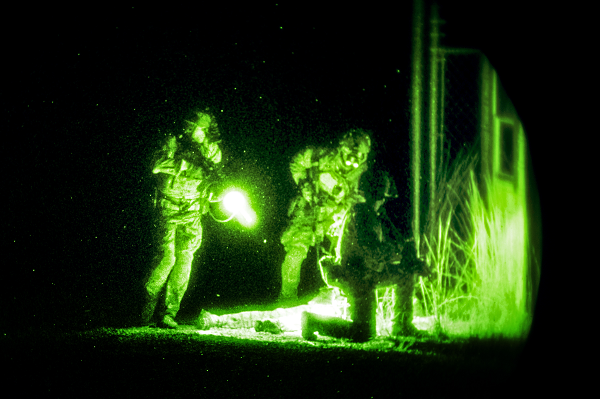
NODS is the military slang for Night Optical Devices. Most people simply call them night vision goggles or NVGs.
They are one of the most important pieces of gear a service member can have in low light or complete darkness.
NODS turn night into day by amplifying ambient light or using infrared.
This 2026 guide explains exactly what NODS are, the different types and generations currently in use, how they work in real operations, and why they have become standard issue across all branches.
Related Article – What Is A POG In The Military?
Table of Contents
What does NODS stand for in the Military?

The term NODS is an acronym for Night Observation Devices, although sometimes it stands in for Night Optical Device.
A common NODS military device for the Navy is the AN/AVS-6 vision goggle.
More recently, the Army is looking at the L3Harris ENVG-B, which mounts to a helmet and is a dual waveband night goggle.
There are several more types of NODS as well, including:
- AGM Global Vision NVG-50
- ATN PS31-3 Night Vision Goggle Gen 3
- PVS-14 Monocular
No matter which brand, they tend to have some overlapping features.
Night Observation Goggles are commonly used by the US Military during operations.
For instance, SEAL Team 6 (aka DEVGRU) wore NODS when they raided Osama Bin Laden’s compound in 2011.
Also, the Persian Gulf War in the 1990s was most fought during the night.
Therefore, the United States military utilized NODS to ensure their campaigns were a success.
For a long time, the United States military dominated night-time fighting partially because of technology.
However, these days, plenty of our adversaries utilize the same technology.
NODS Military Origins

Night vision and low-light devices go way back to the late 1930s. The Germans started experimenting with infrared night vision on tanks.
Eventually, the Soviets began testing NODs a few years later.
Around the same time, the United States began to work on its own technology to make seeing possible for snipers and other troops in low-visibility situations.
By the 1960s, the United States was using NODS during the Vietnam War.
Since the beginning, subsequent versions of NODs that have allowed troops to see in low-light conditions have continued to improve.
These days, NODS include technology such as sensors, thermal optics, image intensifiers, wireless connectivity, and even the ability to switch their views.
Why are they called NODs?
Just like many military acronyms and jargon, using terms like NODS tends to roll off the tongue quicker than Night Observation Device.
This holds true for several other military items, like the ones below.
Related Article – What Is A Navy Squid? 11 Slang Nicknames For Navy Sailors
Other Sayings for Military Equipment
There is a never-ending flow of military slang, terms, and jargon to explore. We gathered up a few.
#1 IED
An IED is an Improvised Explosive Device. Essentially, it’s a homemade bomb.
IEDs were routinely used against coalition forces during Operation Iraqi Freedom (OIF) and Operation Enduring Freedom (OEF).
#2 FROGS
The Navy spends a lot of time on the water, so water training is necessary.
The SEALs have a closed-circuit breathing device called the Full range Oxygen Gas System or FROGS.
#3 Water Buffalo
Anyone spending any time out in the field knows the giant water tank, often on a trailer, contains potable water. Got to fill the canteens somewhere.
#4 Fitty
Those who carry the .50 caliber machine gun may refer to the M2 as a ‘fitty’ as a play on the caliber size.
#5 Birth Control Glasses
While military issue eyeglasses are not top on the list of military equipment, they deserve mention.
When recruits go to basic training, they see an optometrist if they wear prescription eyeglasses.
Since the military values uniformity, everyone gets the same style of glasses.
Recruits refer to these glasses as Birth Control Glasses, or BCGs because they pretty much guarantee abstinence.
BCBs evolved a while ago to a more updated frame, but they still are nothing to write home about.
Related Article – 194 Common Military Terms / Slang / Jargon / Lingo
What People Get Wrong About NODS in the Military
A lot of civilians and even some new recruits believe NODS are basically the same as the cheap green night vision you see in video games or movies.
In reality modern military NODS in 2026 are far more advanced with white phosphor tubes, digital fusion, and thermal overlay capabilities that make the old green tint look ancient.
Another common myth is that all NODS are the same across branches.
The Army, Marines, and Special Forces often use the latest binocular systems like the ENVG-B while many conventional units still use single tube PVS-14s.
The technology gap is huge depending on your unit and mission.
Many people assume NODS work perfectly in total darkness.
They do not.
They need some ambient light to amplify or they rely on infrared illuminators which can give away your position if not used carefully.
Some service members think once you get issued NODS you are automatically an expert. In truth proper use requires extensive training.
Many new users get neck strain, lose depth perception, or experience serious headaches until they learn the correct techniques.
A frequent error is believing NODS are only for special operations. In 2026 every infantry squad, vehicle crew, and even many support roles train and deploy with them.
They are now standard issue for almost every combat and combat support MOS.
Finally many assume NODS never break or run out of power.
The batteries last only a few hours on high settings and the tubes have a limited lifespan.
Proper maintenance and spare batteries are critical in the field.
Understanding these realities helps service members train smarter, maintain their gear better, and appreciate why NODS have become one of the biggest force multipliers in modern warfare.
Conclusion
As we mentioned earlier, the NODS military term means Night Observation Device.
These devices help our military personnel see in low light conditions such as night-time, smoke, or even dust.
There are several different types of NODS between all the military branches.
The history of NODS goes back to World War II, although it is safe to say that technology has evolved exponentially since then.
If you have any questions on any of the above, feel free to leave a comment below.
References: