
A Dishonorable Discharge is the most severe type of military discharge that can be issued to a service member. It is a punitive separation imposed only after a conviction at a general court-martial for extremely serious offenses.
Unlike administrative separations such as an Honorable Discharge, General Discharge, or Other Than Honorable Discharge, a Dishonorable Discharge is considered part of a criminal sentence under the Uniform Code of Military Justice.
Not sure how this discharge compares to others? See our full guide to types of military discharge to understand every classification and how they affect veterans after leaving the service.
This guide explains what a Dishonorable Discharge is, the crimes that can lead to it, and the long-term consequences for employment, benefits, and life after military service.
Jump To A Section
What Is A Dishonorable Discharge?
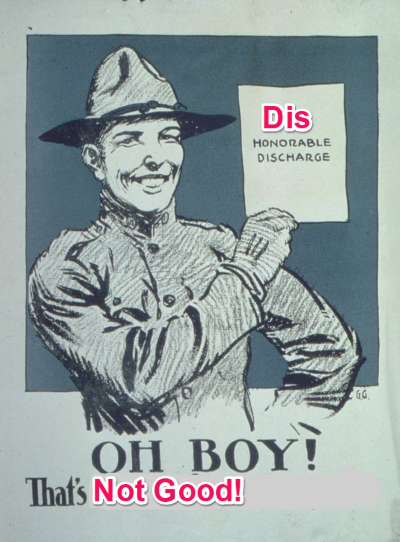

In short, a Dishonorable Discharge is the lowest form of discharge one can receive in the military.
It is a punitive separation that happens as a result of doing something really bad, like rape, desertion, or even murder.
With a Dishonorable Discharge, you forfeit all of the typical benefits you would receive from your military service.
Here’s the longer story:
Basically, a military discharge represents the end of one’s military career.
An Honorable Discharge generally provides you with the benefits that come with being a military veteran, and a General Discharge usually won’t affect any future employment prospects.
However, it is possible to receive a Bad Conduct Discharge if you’ve been given a court martial for bad conduct.
A Bad Conduct Discharge is usually preceded by time in military prison and results in almost all military benefits being forfeited.
As bad as this can be, it is far from the worst type of military discharge someone can receive.
That would be a Dishonorable Discharge, which is considered to be the highest level of punishment that military personnel can receive.
A Dishonorable Discharge is reserved for truly reprehensible crimes such as murder, manslaughter, sexual assault, and desertion.
Because a Dishonorable Discharge follows a criminal conviction at court-martial, it can affect civil rights such as firearm ownership and may create additional legal consequences depending on the offense involved.
They may also find it very difficult to find employment in the civilian sector.
Reasons for a Dishonorable Discharge


There are a few reasons why someone might receive a Dishonorable Discharge, all of which involve crimes that are considered some of the most reprehensible a serviceperson can commit.
For example, a person might be dishonorably discharged if they are Absent Without Leave, or AWOL, for over 30 days.
A person is considered to be AWOL if they intentionally leave their post or fail to return to their post.
Someone may also be dishonorably discharged for sedition, which means they attempted to convince other military personnel to disregard orders or may have even been involved in a plot to overthrow the government.
Murder, Manslaughter, and Sexual Assault
Murder, manslaughter, and sexual assault are also common reasons for a Dishonorable Discharge.
A murder is any intentional action that results in the loss of life, while manslaughter usually involves the unintentional loss of life.
This, of course, does not apply to combat situations when a loss of life would be considered a casualty of war.
Sexual assault can include anything from unwanted touching to rape.
Basically, any unwanted sexual contact that is forced on another individual is considered sexual assault and can result in a Dishonorable Discharge.
Consequences of a Dishonorable Discharge


A Dishonorable Discharge carries some of the most serious long-term consequences a service member can face after leaving the military.
Because it follows a criminal conviction at a general court-martial, it is often viewed similarly to a felony conviction in the civilian legal system.
Veterans who receive a Dishonorable Discharge lose eligibility for nearly all benefits administered by the Department of Veterans Affairs.
This includes healthcare, VA home loans, education benefits such as the GI Bill, and burial in a national cemetery.
In addition to the loss of benefits, the discharge can affect future employment opportunities.
Government agencies, law enforcement departments, and employers requiring security clearances often review a candidate’s military discharge status during the hiring process.
Long Term Consequences
One of the worst parts about receiving a Dishonorable Discharge is that it can affect your life long after your military service has concluded.
A person who was dishonorably discharged from the military typically cannot receive any of the military benefits that they would otherwise be entitled to.
In fact, a Dishonorable Discharge might even disqualify you from ever receiving government benefits, even those you would normally qualify for based on need.
This means that you may not be able to apply for financial aid if you’re unemployed, and you most likely won’t qualify to receive any bank loans that you may need to purchase a home.
Naturally, all of this would extend to financial aid that might be applied to college tuition, so you would have to pay for any college courses you want to take out of your own pocket.
Not only will you almost certainly be unable to qualify for any government benefits that you would need to survive, but you may have a lot of trouble finding employment with a Dishonorable Discharge on your record.
First of all, you almost certainly will be disqualified from any government jobs.
Employment Consequences


Second, your Dishonorable Discharge will show up on any background checks that potential employers run on you.
This may not disqualify you from finding employment, but many employers look at a Dishonorable Discharge in the same way that they look at a felony conviction.
You might be able to find an employer who will hire you just like an employer might hire someone who was convicted of a felony, but it will make your job search much more difficult.
On top of all of the legal and financial troubles that a Dishonorable Discharge can bring, you will also almost certainly be shunned by other military personnel.
Being part of the United States Military is normally a badge of honor, something that should make anybody proud long after their service is complete.
That won’t happen if you have a Dishonorable Discharge on your record.
You’ll be seen as a criminal, a traitor, or a deserter, depending on the reason for your discharge.
Can a Dishonorable Discharge Be Upgraded?
Upgrading a Dishonorable Discharge is extremely difficult.
Because it is issued as part of a criminal conviction by a general court-martial, the discharge is treated differently than administrative separations such as General or Other Than Honorable discharges.
In most cases, veterans seeking to change a Dishonorable Discharge must petition a Board for Correction of Military Records.
The applicant must demonstrate that a legal error occurred during the court-martial process or that the punishment was unjust based on the circumstances.
Successful upgrades are rare and typically require extensive documentation, legal arguments, and supporting evidence.
Veterans pursuing this option often seek assistance from legal professionals or veterans’ advocacy organizations familiar with the military review process.
Dishonorable Discharge Examples
We’ve talked a bit about what kind of conduct can result in a Dishonorable Discharge, but let’s talk about some examples.
Case #1 – Bowe Bergdahl
First of all, there is the case of Bowe Bergdahl.
Bergdahl is a soldier who was captured in Afghanistan in 2009 by the Taliban.


Although he was held captive from 2009 to 2014, an investigation into his disappearance uncovered evidence that his capture occurred because he had abandoned his post.
According to some witnesses, Bergdahl may have been drunk when he was ambushed and captured by the enemy.
He was sentenced to a Dishonorable Discharge in 2017, although he won’t face prison time.
Case #2 – Joshua Kruzik
Another particularly heinous example of a Dishonorable Discharge occurred in 2010 when 23-year-old Marine Joshua Kruzik was left to babysit his friend’s 19-month-old daughter.
While the girl was in his care, Kruzik beat her to death.
Not only did he receive a Dishonorable Discharge, but he was sentenced to 25 years to life for second-degree murder and 25 years to life for assaulting a child.
Case #3 – Charles Ng


Another fairly well-known example of a Dishonorable Discharge happened to Charles Ng, a Chinese immigrant who came to the United States with a student visa. Despite not being a United States citizen, he joined the Marine Corps using false documents in 1980.
He was later arrested and charged with stealing heavy weaponry and machine guns from the Marine Corps base in Kaneohe Bay, Hawaii.
He later escaped, so the court martial added attempted desertion to his charges.
He received a Dishonorable Discharge and was sentenced to serve 14 years in Leavenworth Federal Penitentiary.
He only served 18 months thanks to a plea bargain. Ng was later convicted of 11 counts of first-degree murder and sentenced to death in 1999.
He has been labeled a serial killer and is currently on death row in San Quentin prison.
Frequently Asked Questions About Dishonorable Discharge
What is a dishonorable discharge?
A dishonorable discharge is the lowest form of military discharge one can receive at the end of their military career. In the civilian world, it would be the rough equivalent of being convicted of a felony.
How do you get a dishonorable discharge?
While there are various reasons, the most typical reason one would receive a dishonorable discharge is by committing a reprehensible act. This includes rape, murder, going ‘AWOL,’ and much more.
What happens if you get one?
The consequences of a dishonorable discharge are severe and can result in a prison sentence, affect future employment, and cause a loss of civil rights.
What are the types of military discharge?
The 8 types of military discharge are: Honorable, General, Other Than Honorable, Bad Conduct, Dishonorable, Entry-level separation, Medical Separation, and Separation for Convenience of the Government.
Can I appeal my dishonorable discharge?
While it’s possible, it’s very difficult to do so and can be very costly in terms of time and money.
Does a Dishonorable Discharge Show Up on Background Checks?
While standard civilian background checks may not always display military discharge status, employers who request military records or a DD-214 will see the characterization of service.
Government employers, law enforcement agencies, and positions requiring security clearances are especially likely to review this information.
What People Get Wrong About Dishonorable Discharge
A lot of service members believe a dishonorable discharge is handed out for minor offenses like failing a drug test or going AWOL for a few days.
In reality it is reserved for serious crimes such as murder, sexual assault, desertion during wartime, or repeated serious misconduct after multiple chances.
Most minor issues result in administrative separations like general or other than honorable, not dishonorable.
Another common myth is that a dishonorable discharge only affects your military record.
It is a federal conviction equivalent that appears on background checks for the rest of your life.
Many employers, especially in law enforcement, government, and security fields, will automatically reject you.
Many people assume you can easily upgrade or remove a dishonorable discharge later. In practice it is extremely difficult.
You must prove to a Discharge Review Board or Board for Correction of Military Records that the discharge was unjust or the punishment was too harsh.
Success rates are very low.
Some veterans think they lose all benefits but can still collect VA disability or healthcare.
A dishonorable discharge makes you ineligible for almost all VA benefits including healthcare, education, home loans, and burial in a national cemetery.
A frequent error is believing that a dishonorable discharge only happens at court martial.
While most come from general or special courts martial, it can also result from a bad conduct discharge that is later upgraded in severity during review.
Finally many assume that once you receive it your military service is completely erased.
Your time in service still counts toward Social Security and some retirement calculations, but the characterization is permanently bad and affects almost every aspect of civilian life.
Understanding these realities shows why avoiding actions that could lead to a dishonorable discharge is critical and why honesty and good conduct matter throughout your entire career in 2026.
Other Types of Military Discharge
- Honorable Discharge
- General Discharge
- Other Than Honorable Discharge
- Bad Conduct Discharge
- Hardship Discharge
Conclusion
As you can see, a Dishonorable Discharge is a serious matter that is akin to being convicted of a felony.
It is considered incredibly shameful to other military personnel, and it will impact your ability to receive any financial assistance or find employment.
Since most of the actions that will result in a Dishonorable Discharge are illegal, many military members who do receive a Dishonorable Discharge will also have to face other legal consequences that might include fines and several years in prison.
It’s also a charge that sticks with you for your entire life.
When you enlist in any branch of the United States Military, you are expected to follow the Code of the United States Fighting Force.
This is something that should always make you proud, and rightly so.
On the other hand, there are few things that are more shameful than violating the Code in the most despicable ways possible.
Whether it’s because you leave your post and go AWOL or you commit a violent crime against another human being, a Dishonorable Discharge will ruin your life, your military career, and your reputation.
As with any criminal action that can lead to serious legal consequences, this kind of discharge should be avoided at all costs.

We were told that if you get a dishonorable discharge, you would be given a suit, $25, and a bus ticket home (1976). Has this been changed? i.e. did they up the amount of cash, do you still get a suit or just leave in civilian clothing, and do you still get a ticket home?
From what I understand, getting a Dishonorable Discharge likely means you won’t be going home anytime soon. You have to do something really bad to get one (Murder, Rape, etc.), and in most cases would probably end up in the Brig / prison before they give you a bus ticket.
I had a terrible CO – he was very much a sadist and enjoyed tormenting his troops. He did a surprise barracks inspection on my platoon right after a 16-hour night guard shift. He used a master key to enter my room and started screaming while I lay there asleep. I panicked, jumped out of bed and kicked him in the head, breaking his nose. I was severely injured a few weeks later. He refused to allow me any medical care for a broken neck. When I complained, I was put in for a dishonorable and scrubbed toilets for a few months. I received my honorable but that CO had a friend redact my medical records to hide the accident. I received 100% VA disability, though it took many years. I have a government job with accommodations for my disability. I called my CO once to get a statement about my injuries for the VA. He threatened me saying that he would come to my home and “deal with me”. I found that amusing. He never showed up.