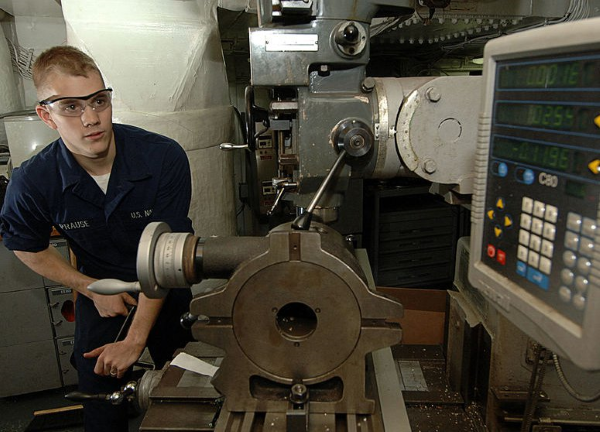
Machinery Repairmen (MR) are the Navy’s skilled machinists and mechanics, responsible for fabricating, repairing, and maintaining a wide range of shipboard mechanical systems and equipment.
They operate machine tools such as lathes, mills, drill presses, grinders, and welders to manufacture or restore parts, valves, pumps, hydraulic systems, refrigeration units, and auxiliary machinery critical to ship operations.
MRs work in shipboard machine shops, engine rooms, or shore facilities, often in hot, noisy, confined spaces, using blueprints, precision measuring tools, and technical manuals to ensure equipment reliability.
The rating requires mechanical aptitude, attention to detail, safety awareness around heavy machinery and hazardous materials, and the ability to work independently or in teams under time pressure.
Whether fabricating replacement parts at sea or performing major overhauls in port, MRs keep the fleet’s mechanical systems operational and mission-ready.
In this updated guide for 2026, we cover entry requirements, the training pipeline, typical duties, current pay structure, advancement opportunities, and how MR experience translates to strong civilian careers in machining, manufacturing, and mechanical maintenance.
Related Article – Navy Jobs List: A List Of All 71 Ratings In The Navy
Jump To A Section
Training And Career Path
What’s Life Like For a Navy Machinery Repairman?
Sea/Shore Rotation
Pay And Benefits
Job Reviews
Civilian Career Opportunities
Summary
Requirements and Qualifications

To serve as a Machinery Repairman (MR) in the United States Navy, there are multiple requirements which must be met:
- Must be between the ages of 18 and 41.
- Normal hearing is required.
- No history of drug abuse.
- Must have vision correctible to 20/20
- High school diploma or equivalent.
- Must volunteer for duty onboard submarines.
ASVAB minimum scores to qualify as a Navy Machinery Repairmen are:
- VE+AR+MK+AS>=205
- VE+AR+MK+MC>=205, OR
- AS+MK+AO>=148
Unlike most Navy Rates, US citizenship is not required to become a Machinery Repairman.
Training and Career Path
Like all other Navy enlisted personnel, MRs must successfully complete 10 weeks of Navy Recruit Training, at the Recruit Training Command, Great Lakes (RTC Great Lakes).
After Boot Camp, a Machinery Repairman will attend Engineering Common Core and A School, also located in Great Lakes, Illinois.
Related Article – Pros and Cons Of Joining The Navy


Together, these courses are 18 weeks long in duration, and sailors, through group instruction and practical application, are introduced to technical documentation and basic mechanical theory.
During their training, they are familiarized with shop tools, equipment, machines, and methods that they will utilize in their rating.
What’s Life Like for a Navy Machinery Repairman (MR)?
A Machinery Repairman is the Navy’s skilled machine tool operator.
From occasionally repairing or overhauling a ship’s auxiliary systems and engines to making custom replacement parts, the MR is the sailor the Navy assigns the job.
Additionally, MRs work on deck equipment such as hoists, condensers, winches, and heat exchange devices.
Related Article: Navy Height And Weight Standards
A Machinery Repairman routinely works a vast array of tasks on a day-to-day basis.
Their numerous and various duties include:
- Engraving, flame spraying, and electroplating operations.
- Prepare specifications to produce replacement parts.
- Producing replacement parts from specifications and sketches using CNC machinery.
- Repairing auxiliary machinery on vessels.
- Operating machine shop equipment including boring mills, power hacksaws, bench grinders, lathes, drill presses, shapers, and milling machines.
Most sailors in the MR rating work indoors in a machine shop-type environment chock full of motor-powered machines.
They are closely supervised and often work closely with others.
Related Article – Army Utilities Equipment Repairer (MOS 91C): Career Details


Navy Machinery Repairman (MR) Sea/Shore Rotation
A Machinery Repairman in the Navy spends about 50 percent of their time on shore duty and 50 percent of their time assigned to the fleet.
| Tour | Sea Tour | Shore Tour |
|---|---|---|
| First Tour | 48 Months | 36 Months |
| Second Tour | 36 Months | 36 Months |
| Third Tour | 36 Months | 36 Months |
| Fourth Tour | 36 Months | 36 Months |
| Fifth Tour | 36 Months | 36 Months |
| Sixth Tour | 36 Months | 36 Months |
| Seventh Tour | 36 Months | 36 Months |
How Much Are Machinery Repairman (MR) Paid?
The Navy bases a sailor’s pay on their rank and length of service.
| Insignia | Pay Grade | Rank | Abbreviation | 2026 Minimum Monthly Pay (<2 Years) |
|---|---|---|---|---|
| N/A | E-1 | Seaman Recruit | SR | $2,407.20 (after 4 months; $2,225.70 for first 4 months) |
 | E-2 | Seaman Apprentice | SA | $2,697.90 |
 | E-3 | Seaman | SN | $2,836.80 |
 | E-4 | Petty Officer Third Class | PO3 | $3,142.20 |
 | E-5 | Petty Officer Second Class | PO2 | $3,342.90 |
 | E-6 | Petty Officer First Class | PO1 | $3,401.10 |
 | E-7 | Chief Petty Officer | CPO | $3,932.10 |
 | E-8 | Senior Chief Petty Officer | SCPO | $5,656.50 (starts at over 8 years) |
 | E-9 | Master Chief Petty Officer | MCPO | $6,910.20 (starts at over 10 years) |
 | E-9 | Fleet/Command Master Chief Petty Officer | FMCPO/CMCP | $6,910.20 (starts at over 10 years) |
 | E-9 | Master Chief Petty Officer of the Navy | MCPON | $6,910.20 (starts at over 10 years) |
Along with the base monthly show above, MRs may also receive additional pay, including Basic Allowance for Housing (BAH) and Basic Allowance for Subsistence (BAS) if authorized to live off base.
They may also receive sea pay and other financial incentives.
In June 2023, the Navy reported that MRs were eligible for Selective Re-enlistment Bonuses (SRB).
Related Article – Army UH 60 Helicopter Repairer (MOS 15T): Career Details
Job Reviews
Reviews from current and former MRs on indeed.com are overwhelmingly positive with many appreciative and grateful for the training they received in the Navy:


The Navy affords MRs the opportunity to not only excel and thrive in their rating but also gives the sailor a sense of purpose.

Take for example the most senior female MR in the Navy, SCMR Tara Horney:
“Literally being at the tip of the spear, in the mix of things, is where I prefer to be. We have no doubt, being here and doing the missions we do, that we are doing important work and can see firsthand why a strong Navy is so important to national security. I go to work every day knowing that what I do is important and our training is more poignant knowing we could actually have to use it out here.”
The Department of the Navy’s Credentialing Opportunities Online (COOL) website estimates that approximately 770 Machinery Repairmen serve in today’s Navy.
Related Article – Navy Aviation Machinist Mate (AD)
Civilian Career Opportunities
There is no shortage of work for former Machinery Repairman once they leave the military. Civilian career opportunities include:
- Engine and Machines Assemblers
- Multiple Machine Tool Setters, Operators, and Tenders
- Machinists
- Plating and Coating Machine Operators
- Plastic and Metal Computer-Controlled Machine Tool Operators
- Industrial Machinery Mechanics
- Tool and Die Makers
- Mobile Heavy Equipment Mechanics
- Machinery Maintenance Workers
Additionally, the Navy COOL Summary For Machinery Repairman (MR) provides links to Betchel, a worldwide employer in engineering, project management, and construction. They are specifically looking for veterans trained and experienced in these highly skilled crafts.

.jpg)
Also on the site is a link to the Troops to Energy website, dedicated to helping transitioning service members find jobs in the energy industry.
Sailors in the Machinery Repairman rating should take full advantage of the on-the-job (OJT) training opportunities and educational opportunities offered.
Related Article: 10 Best Jobs In The Navy For Civilian Life
The United States Military Apprenticeship Program (USMAP) also allows MRs to complete several of their civilian apprenticeship requirements while on active duty.
Those in the Machinery Repairman rating can earn national certifications, federal licenses, and state licenses through the program.
What People Get Wrong About US Navy Machinery Repairman (MR)
Many assume Machinery Repairman is a low-skill job focused on simple fixes like tightening bolts or changing oil.
In practice, MRs perform precision machining, welding, blueprint reading, and complex repairs on high-pressure systems, valves, pumps, refrigeration plants, and auxiliary equipment, often fabricating custom parts from raw stock using manual and CNC machine tools.
Another misconception is that the work is mostly in comfortable shops with regular hours.
MRs frequently work extended shifts in shipboard machine shops during deployments, handle heavy components, operate in extreme temperatures, and respond to emergent repairs at sea where downtime affects propulsion or habitability.
People often think entry requires prior machining experience or a technical degree.
The Navy provides full training; requirements include ASVAB line scores (AR+MK+AS=205 or VE+AR+MK+AS=200), normal color perception, physical standards, and Secret clearance eligibility in some cases, no prior experience or degree needed.
Some believe training is short or lacks depth in real-world applications.
After boot camp, MRs complete “A” School (about 20-24 weeks at Great Lakes) covering machine tool operation, welding, metallurgy, blueprint interpretation, precision measurement, and shop safety, followed by “C” School or on-the-job training for advanced skills like CNC programming or specific ship systems.
Finally, a common view is that civilian transitions are limited to low-paying shop jobs.
MR skills in precision machining, welding, hydraulics, blueprint reading, and quality control transfer directly to high-demand roles in manufacturing, aerospace, shipbuilding, oil and gas, automotive, and heavy equipment industries, often starting at $50,000 to $80,000+ with certifications like AWS welding or NIMS machining boosting pay and opportunities.
Understanding these realities helps candidates approach the rating with realistic expectations for a skilled, hands-on career essential to naval engineering and readiness.
Summary
Those considering the Navy and possessed of manual dexterity, patience, and math skills should take a long look at the MR rating.
Not only will you have the opportunity to serve your country and see the world, but you will also learn the skills and gain the experience to ensure steady employment for the entirety of your working years.
References
Official Navy Mechanical and Industrial Technology Careers Page
Navy Personnel Command Machinery Repairman (MR) Overview
United States Navy COOL Summary For Machinery Repairman (MR)
Navy COOL Machinery Repairman (MR) Rating Card
Leading from the Front: MRCS Tarah Horney
Navy Machinery Repairman (MR) Reviews – indeed.com

There are not two types within the MR Rating and the schools are not 18 weeks long. That was taken from a very old reference.
Hi, Chief Decane
Thanks for pointing that out. I got the 18 weeks long “A” school reference from the Navy COOL Machinery Repairman (MR) Rating Card (which claims it is current as of 06/19) and the two jobs reference from the Navy COOL Summary For Machinery Repairman (MR). Both are listed in the References of the article.
If you can point me to a more accurate source, I’ll get the article updated.
It’s most appreciated.
Thanks,
Travis