Australia is one of America’s closest allies, but it has a longstanding bipartisan policy of no permanent foreign bases on its soil. That doesn’t mean there’s no U.S. military presence, especially considering Australia is a member of the ‘Five Eyes Alliance’.
In 2026, the U.S. military footprint in Australia is larger and more strategically important than ever.
It includes two major joint facilities, annual rotations of up to 2,500 U.S. Marines and sailors in Darwin, expanded access to multiple Royal Australian Air Force (RAAF) bases in northern Australia, and the upcoming Submarine Rotational Force – West (SRF-West) under the AUKUS partnership.
For U.S. service members and their families, this means more opportunities for rotations, training, and even accompanied assignments in places like Darwin, Perth, and Alice Springs.
This guide breaks down everything you need to know, with a special focus on what life is like for troops and kids Down Under.
What People Get Wrong About U.S. Military Bases in Australia
Many Americans assume the U.S. has large sovereign bases in Australia similar to those in Europe (including Germany and Italy) and the African continent.
That being said, that’s simply not the case.
Instead, the U.S. operates through:
- Joint facilities (shared with Australia)
- Rotational forces (temporary deployments)
- Access agreements to Australian bases for training and operations
This setup respects Australian sovereignty while allowing deep interoperability. The presence has grown significantly since the 2011 U.S. “pivot” to the Indo-Pacific and the 2021 AUKUS announcement.
The 2 Permanent Joint Facilities
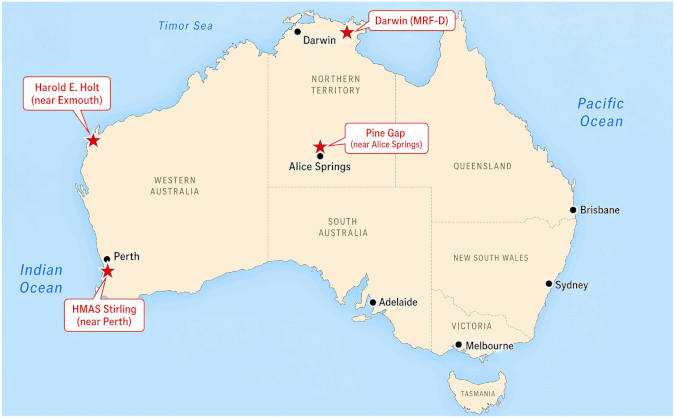
1. Joint Defence Facility Pine Gap (Alice Springs, Northern Territory)

Pine Gap is the most important U.S.-Australian intelligence facility in the Southern Hemisphere. In fact, it’s so important and well-known in Australia that Netflix even had a series dedicated to it.
Located about 11 miles southwest of Alice Springs, it has operated since 1966 as a joint signals intelligence (SIGINT) and satellite communications base.
Key Facts (2026):
- Approximately 800 personnel (roughly 80–90% U.S., with Australian support staff)
- Mission: Satellite tracking, early warning, missile defense data, and intelligence collection supporting U.S. and allied operations worldwide
- Features dozens of large radomes protecting satellite dishes
- Critical for monitoring activities in the Indo-Pacific and beyond
For U.S. personnel assigned here (often Air Force Intel specialists or civilian contractors), tours are typically 2 years. One of the most appealing things about being assigned at the facility is that families can accompany members, and housing is provided in nearby Alice Springs.
The town offers a unique outback lifestyle with good international schools, though it’s basically in the middle of nowhere (about a 3–4 hour flight from major cities).
Related Article – Air Force Bases in the US
2. Naval Communication Station Harold E. Holt (North West Cape, Exmouth, Western Australia)

Named after a former Australian Prime Minister, this Very Low Frequency (VLF) radio station is vital for communicating with submerged submarines and surface ships across the Indian Ocean and western Pacific.
Key Facts (2026):
- Operated primarily by the Royal Australian Navy with significant U.S. Navy involvement
- One of the largest VLF transmitters in the world
- Supports nuclear-powered submarine operations and fleet communications
- Located in a remote but beautiful coastal area near Exmouth
Personnel here support global naval operations, and rotational or short-term assignments are very common.
Beyond Permanent Bases: America’s Growing Rotational and Access Presence in Australia
While Australia maintains its long-standing policy of hosting no large permanent foreign bases, the U.S. military presence has expanded significantly through rotational deployments, access agreements, and major infrastructure upgrades.
These arrangements allow the United States and Australia to deepen interoperability, improve regional deterrence, and respond rapidly to challenges in the Indo-Pacific.
The two most visible examples of this modern presence are the Marine Rotational Force, which includes the Darwin (MRF-D) and the upcoming Submarine Rotational Force – West (SRF-West) under the AUKUS partnership.
In addition, the U.S. has increasing access to several Royal Australian Air Force (RAAF) bases, particularly in northern Australia.
Marine Rotational Force – Darwin (MRF-D)

Since 2012, the U.S. Marine Corps has conducted annual six-month rotations in the Northern Territory as part of the U.S.-Australia Force Posture Initiatives.
2026 Status:
- Each rotation involves approximately 2,500 Marines and sailors
- Based primarily at Robertson Barracks (near Darwin) and RAAF Base Darwin
- Training focuses on interoperability with the Australian Defence Force (ADF), humanitarian assistance, and regional exercises across Australia, Southeast Asia, and the South West Pacific
- The 2025 rotation (MRF-D 25.3) just wrapped up in October 2025; the 15th rotation returns in early 2026
These are unaccompanied rotations for most Marines (no families), but they provide valuable forward-postured experience in the Indo-Pacific. Some command and support elements may have longer or accompanied options.
AUKUS and Submarine Rotational Force – West (SRF-West): Coming 2027


The 2021 AUKUS partnership is transforming the U.S. naval presence in Australia. Starting as early as 2027 at HMAS Stirling (Garden Island, near Perth, Western Australia):
- Rotational presence of up to 4 U.S. Virginia-class nuclear-powered attack submarines and 1 UK Astute-class submarine
- Known as Submarine Rotational Force – West (SRF-West)
- Submarines will rotate through (not permanently based), with increased maintenance, training, and crew support
- Infrastructure upgrades at HMAS Stirling are well underway, including maintenance facilities and housing/support for additional U.S. and UK personnel
This will bring hundreds to over 1,000 U.S. Navy personnel (and some families) to the Perth area over time. It helps Australia prepare to operate its own future AUKUS submarines while strengthening undersea deterrence in the Indo-Pacific.
Perth offers an excellent quality of life for accompanied assignments, including pristine beaches, a mild climate, strong schools, and a vibrant city.
U.S. Access to Australian Bases & Northern Infrastructure Upgrades
The U.S. has growing access to several RAAF and Army bases, especially in northern Australia, for aircraft rotations, training, and prepositioning.
Some of the key locations include:
- RAAF Base Darwin: One of the Australian Air Force’s main forward mounting bases.
- RAAF Base Tindal (near Katherine): Which is currently undergoing major upgrades and renovations, including facilities that will allow housing for up to six B-52 bombers, refueling aircraft, and enhanced runways/hangars.
- RAAF Bases Townsville, Learmonth, Curtin, and Scherger: All of which are used for training, exercises, and potential aircraft deployments.
Australia and the U.S. are investing billions in northern infrastructure to improve resilience, sustainment, and rapid response in the region.
Life for U.S. Military Personnel & Families in Australia


Australia is generally family-friendly for U.S. military members on accompanied tours (Pine Gap, potential SRF-West roles, or longer staff assignments).
Key Practical Info for 2026:
- Visas & Status: U.S. forces enter under the U.S.-Australia Status of Forces Agreement.
- Housing: Provided or subsidized in most cases (on-base or nearby communities). In Darwin and Perth, you can expect modern family housing that’s comparable to military bases in the US. Those stationed at Alice Springs can expect to be assigned to dedicated neighborhoods.
- Schools for Kids: Unfortunately, there are no Department of Defense Education Activity (DoDEA) schools located in Australia. As a result, most use Australian public or private or international schools. Australian schools consistently rank highly across the board, with particularly strong STEM and outdoor programs.
- Healthcare: Access to Australian Medicare or U.S. military / Tricare options depending on status, so you’ll have to check with your commanding officer on that one.
- Cost of Living: While the cost of living is generally high in cities like Perth and Darwin, it is offset by allowances like the Overseas Housing Allowance. Groceries, fuel, and activities are comparable or slightly higher than many U.S. bases, especially when compared to high cost of living areas in the US like California or New York.
- Culture & Lifestyle: Generally speaking, Australians are welcoming to Americans. You can expect to drive on the left, enjoy outdoor spaces like beaches, reefs, and the outback, and embrace “no worries” attitude.
Challenges include remoteness in some areas and separation during unaccompanied rotations. Many families describe the experience as a highlight of their career — unique adventures and strong U.S.-Australia camaraderie.
Comparison Table: U.S. Military Presence in Australia (2026)
| Facility / Presence | Location | Type | Approx. U.S. Personnel | Mission Highlights | Family Accompanied? |
|---|---|---|---|---|---|
| Pine Gap | Alice Springs, NT | Joint Facility | ~ 700 - 800 | SIGINT, satellite intel | Yes |
| Harold E. Holt | Exmouth, WA | Joint Comm Station | Variable (support) | Submarine & fleet communications | Limited |
| Marine Rotational Force-Darwin | Darwin, NT | Rotational (6 months) | Up to 2,500 per rotation | Training, interoperability, exercises | Mostly No |
| SRF-West (from 2027) | HMAS Stirling, WA | Submarine Rotation | Hundreds to 1,000+ | Nuclear sub maintenance & ops | Likely Yes |
| RAAF Tindal & Other Bases | Northern Australia | Access & Upgrades | Variable (rotational) | Bomber/aircraft support, training | Varies |
Frequently Asked Questions (FAQ)
Are there any large permanent U.S. bases in Australia?
No. Australia does not host permanent foreign bases. All U.S. presence is through joint facilities, rotations, or access agreements.
How many U.S. troops are in Australia at any one time?
While it varies, during Marine rotations you can expect up to ~2,500 at any given time. With future submarine rotations and other activities, the number will fluctuate but remain rotational rather than permanent.
Will AUKUS create permanent U.S. bases?
No. The submarines will rotate through HMAS Stirling, but not be permanently based there.
Can military families accompany members to Australia?
Yes for certain assignments (e.g., Pine Gap tours or longer staff roles). Marine rotations are typically unaccompanied do to mission requirements.
What schools do military kids attend?
Usually local Australian schools or approved international options. Quality is considered high, often either comparable or even exceeding US standards.
Is it safe for families?
Australia is consistently ranked as one of the safest countries in the world, often in the Top 20. Crime rates are low, gun crime is virtually non-existent, and communities are generally very welcoming of US citizens.
How do I prepare for a rotation or assignment to Australia?
Work with your command sponsor, and focus on cultural orientation, driving rules, and family logistics. Operation Military Kids has additional PCS guides that can help you with the transition.
Final Thoughts
The U.S. military relationship with Australia continues to deepen in 2026, driven by shared values and strategic needs in the Indo-Pacific. Whether you’re heading to a joint facility, a Marine rotation, or preparing for future AUKUS opportunities, Australia offers a unique and rewarding experience for service members and their families.
Have you been stationed in Australia or have questions about life there? Share in the comments below — we’d love to hear your story and help others preparing for a move Down Under.
Last updated: April 2026. Information is based on official U.S. and Australian Defence sources and is subject to change.