Ask ten veterans which branch has the hardest training and you’ll likely get ten different answers, often favoring their own.
The truth is that “hardest” is subjective. It depends on whether you value physical endurance, mental toughness, sleep deprivation, technical demands, or long-term lifestyle.
In 2026, the core basic training programs remain largely unchanged in structure. The Marine Corps still runs the longest recruit training at 13 weeks, while the Air Force and Space Force have the shortest at about 7.5 weeks. However, every branch designs its training to break down civilians and rebuild them as disciplined service members.
This guide compares the five branches (plus Space Force) across boot camp difficulty, daily life, and long-term demands to help you make an informed decision.
Table of Contents
What Makes a Branch “Hard”?
Boot camp is only the beginning. Some branches feel toughest during initial training, while others become more demanding after graduation due to operational tempo, deployments, or job-specific schools.
Key factors people usually consider include:
- Length and intensity of basic training
- Physical fitness standards and attrition rates
- Mental and emotional stress (sleep deprivation, yelling, constant correction)
- Follow-on training difficulty (especially for combat arms or special operations)
- Overall lifestyle once assigned to a unit
Branch-by-Branch Comparison
#1. United States Marine Corps

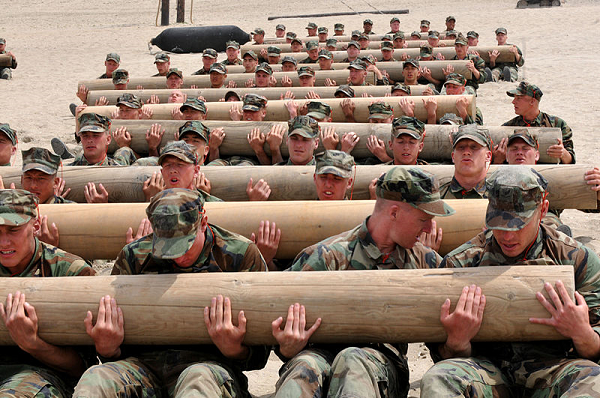
The Marine Corps is widely regarded as having the most physically and mentally demanding basic training. In addition to passing the ASVAB, meeting the height and weight standards, Initial Strength Test (IST), and age limit, their 13-week Recruit Training (at Parris Island or San Diego) emphasizes discipline, rifle marksmanship, close-order drill, and turning every Marine into a basic rifleman first.
The culminating event, nicknamed The Crucible, is a notorious 54-hour field exercise with minimal sleep and food that all Marines must go through in order to graduate from boot camp.
Marines are also subject to regular physical readiness tests like the PFT, swim test qualification, and Combat Fitness Test (CFT).
Many veterans say the constant pressure and high standards make it feel like the toughest overall experience, especially for those who thrive on tradition and esprit de corps.
Tough jobs within the Marines
If you can make it through Marine boot camp, you might find the challenge is not over. There are some tough Marine MOS training to consider, as well, and we cover a couple.
USMC Combat Engineer (MOS 1371)
Combat Engineers specialize in explosives, recovery, and building and demolishing structures.
Often, Combat engineers are on the front lines with those in the infantry.
Furthermore, Combat engineers go to all the advanced training and take what they learn to the battlefield.
USMC Scout / Sniper (MOS 0317)
Scout Snipers are another Marine MOS with excellent training in shooting.
To become a sniper, you must be a part of the infantry and hope you have an opportunity for a screening where the Marines weed out potential snipers to find the best.
Then, you might go to sniper school, where the passing rate is rather low.
#2. United States Army

While the US Army has relatively low ASVAB test requirements, a relatively high age limit, and relatively easy overall entry requirements, every Soldier has to go through basic training at one of their 4 locations.
And it’s no walk in the park, either.
Army Basic Combat Training lasts 10 weeks and focuses heavily on combat skills, rifle qualification, and team-based field exercises like The Forge. It is physically demanding with long marches, obstacle courses, and rigorous PT. The Army has a broad range of jobs, with some extremely challenging (infantry, special forces pipelines) and others more technical.
Many soldiers report that while basic training is tough, the real difficulty often comes later in advanced individual training (AIT) or during deployments.
Tough jobs in the Army
Many who join the military have aspirations of going into special forces. However, the training before even making it to the official special forces training is, by design, going to weed out everyone but the best.
However, that does not mean those who do not make it are weak. The failure rate means the training is that hard.
Army Diver (MOS 12D)
Army Divers are another field with demanding training.
A Diver can conduct reconnaissance underwater as well as demolition and construction.
You learn about special warfare, explosives, hyperbaric, and a whole lot more.
After boot camp, there are 29 weeks of advanced training.
Plus, the ASVAB score for this field must be, at a minimum, 98 for General Maintenance and 107 for General Technical, and 106 for Skilled Technical.
#3. United States Navy

Navy boot camp at Great Lakes, Illinois, runs about 8–10 weeks and includes significant water confidence training, shipboard damage control, rifle and pistol qualification, and firefighting scenarios.
The famous “Battle Stations” event is a grueling 12-hour overnight simulation. Navy training tends to balance physical demands with technical classroom work.
For those heading to certain ratings or special programs, the pipeline becomes far more difficult after boot camp (especially if you’re an old guy like me). That’s also assuming you meet the ASVAB test score standards to even qualify for the job you want.
Your best bet is to thoroughly prepare for Navy boot camp before you go, and it will make your like a lot easier.
Tough jobs in the Navy
Just like the other branches of the military, the Navy has its own set of challenging jobs (called “Ratings” or “Rates”). They include:
Nuclear Field
One of the more challenging jobs to get in the Navy is in the Nuclear Field. This field of work includes several specifications, and both officers and enlisted members make up this field.
As an enlisted seaman, you might be an electronics technician, an electrician’s mate, or a machinist’s mate.
To get into this field, you must score well on the science, electronics, and math sections of the ASVAB test.
Once through boot camp, the first round of advanced training, called “Nuke School.”
Then, depending on which area of Nuke you are in, you have more schools between three to six months in length.
Also, the second school is not the end of it because you still have a six-month training program where students learn, hands-on, how to operate a nuclear propulsion plant.
Navy SEAL
Another tough Navy job is Special Warfare.
The community of seamen making up Special Warfare is close to 8,000 strong.
However, the Special Warfare Operators, or SEALs, make up a smaller percentage of the community (about 2,400 on active duty).
Just getting to the training (BUD/S) in Special Warfare is tough. However, making it through SEAL training is something else entirely.
Related Article – Navy SEAL Weapons & Gear
#4. United States Air Force & Space Force
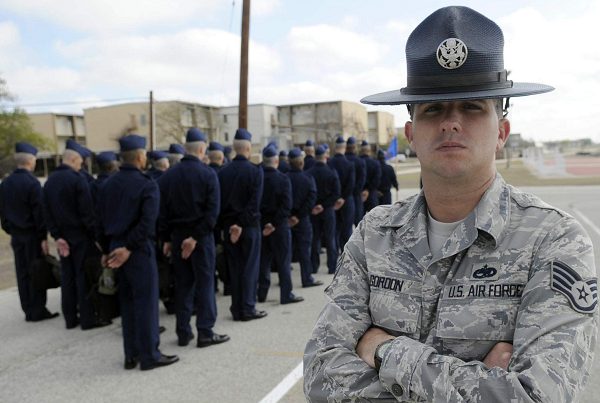
Air Force Basic Military Training (BMT) is the shortest at roughly 7.5 weeks. It emphasizes discipline, Air Force history, combat skills, and teamwork with less sleep deprivation than other branches. Many describe it as more structured and less “in your face” than Marine or Army training.
Space Force follows the same program. While physically demanding, it is often viewed as the least physically grueling of the branches, though certain combat career fields (Pararescue, Combat Control) have extremely tough follow-on pipelines.
It also has the highest required ASVAB scores of any branch of the military, and some of the hardest follow on training after basic training as well.
Tough jobs in the Air Force
The Air Force has several job opportunities, and some jobs are rather intense.
Cyberspace Defense Operations (1B4X1)
For instance, a career in Cyberspace Defense Operations means you handle cyberspace capabilities for the Air Force.
Your skills include defending against cyber-attacks and handling command and control of cyberspace forces and operations.
Those in this field tend to have a lot of STEM experience, and some have some college coursework in technology.
Technical training is five months to become an apprentice. The field itself has ongoing and continuous training throughout your career.
SERE Specialist (1T0X1)
Another tough career option in the Air Force is the Survival, Evasion, Resistance, and Escape (SERE) Specialist.
A SERE Specialist’s goal is to train others to survive in all situations.
In this field, you are an expert in hostile territory and have the know-how to complete a mission when things do not go as planned.
However, there is a minimum score of 55 in the General Knowledge section of the ASVAB.
Plus, there is a stamina and physical abilities test before you are up for consideration for this field. If you make it, you have a SERE Specialist training orientation course.
Afterward, you have a nearly six-month apprentice course in Washington, where you will become an expert in your AFSC.
#5. United States Coast Guard

Coast Guard basic training at Cape May, New Jersey, lasts about 8 weeks and includes a mandatory swim test plus intense water survival and rescue training. Because the Coast Guard is smaller, it can be more selective, often rejecting applicants who are too old to join or have poor ASVAB scores.
Some veterans argue it combines elements of Navy and Marine training with a strong emphasis on real-world search-and-rescue scenarios in harsh conditions.
Tough jobs in the Coast Guard
While there are several tough jobs in the Coast Guard, a couple stands out.
Aviation Survival Technician (aka Rescue Swimmer)
Rescue Swimmers, or Aviation Survival Technicians, have a physically demanding job.
Therefore, they must remain in top physical shape, and they have monthly tests to prove they are able.
The monthly test includes the usual push-up and sit-ups. However, rescue swimmers must demonstrate they can do a 500-yard swim within 12 minutes, an underwater swim for 25 yards, and a 200-yard swim while towing a buddy.
The Rescue Swimmer training includes a four-month course even to get ready for the Rescue Swim course. If you can make it through the initial course, you continue with your training.
Related Article – Coast Guard Special Forces
Which Branch Is Actually the Hardest?
Most sources and veteran consensus still rank the Marine Corps as having the toughest basic training due to its length, emphasis on discipline, and the “every Marine a rifleman” philosophy.
However, “hardest” changes once you leave boot camp. Navy SEAL, Army Ranger, or Air Force Pararescue pipelines have far higher attrition rates than any basic training. For day-to-day life, some Army and Marine infantry units experience more frequent deployments and physical wear than many Air Force or Navy support roles.
The best answer is this: The hardest branch is the one that challenges you the most, including physically, mentally, or in terms of the lifestyle you want.
Real Experiences from Service Members
Veterans often say:
- “Marine boot camp broke me down completely, but I came out with unbreakable discipline.”
- “Army basic was physically brutal with all the ruck marches, but my AIT for a technical job was surprisingly chill.”
- “Air Force BMT felt more like intense summer camp compared to what my Marine buddies described.”
Final Thoughts & Advice
There is no universal “hardest” branch, only the one that best matches your goals, personality, and tolerance for specific types of stress.
If you want maximum physical and mental challenge with strong tradition, the Marines often top the list. If you prefer technical skills with shorter initial training, the Air Force or Navy may suit you better. The Army offers the widest variety of roles and locations.
Talk to recruiters from multiple branches, speak with veterans, and be honest about what kind of challenge you’re seeking. Every branch has proud, tough warriors, the real question is which one you’ll be proud to serve in.
Have you gone through basic training in any branch? Share your honest experience in the comments below to help others deciding which path to take.
Last updated: April 2026. Information based on official branch training guidelines and veteran accounts. Training programs can evolve slightly over time.
References:

I am an old disabled Marine Corps veteran ! I was a 0331 machine gunner and loved it ! I went through boot camp at Paris Island and did my infantry training school at Camp Pendleton and then went on to sea school ! I decided to go back out into the fleet Marine Corps instead of guard duty on a ship ! I love the corps and I would do it all over again in a heart beat ! It was the hardest thing I have ever done, but it made me the man and husband and father and grandfather that I am and installed pride, honor , duty and perseverance in me that I could not have gotten anywhere else ! Being a Marine makes you know that you are the Red, White and Blue, America’s Son and I am glad I claimed the title with all of my brother and sister Marines !
I think one thing about Marine Corps boot camp Paris Island is that missed is the psychological part. They on your ass every minute and if you show any signs of metal problems they will find it and usher you out.